


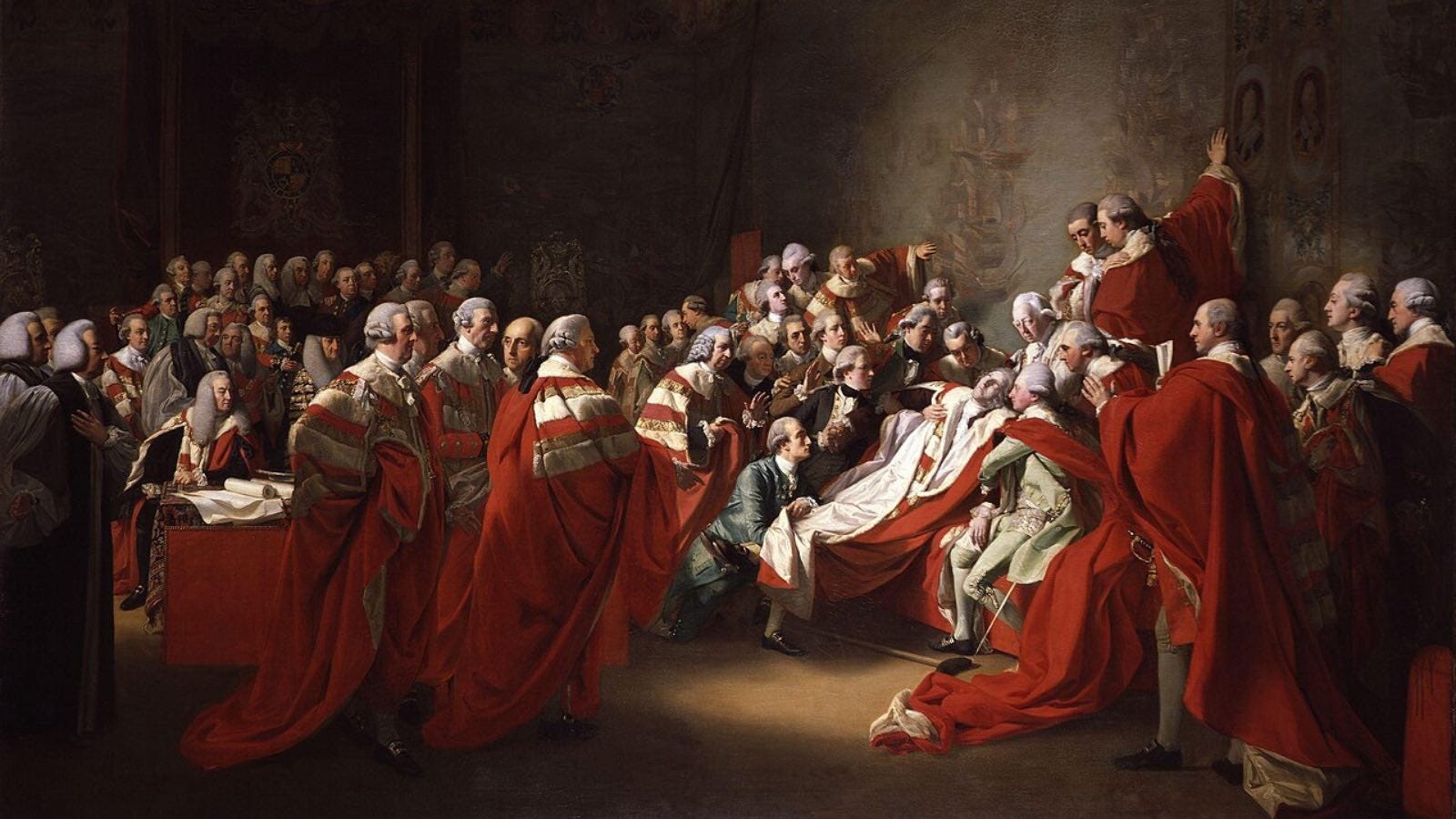

15th June 1215
5th July 1770
11th May 1778
(read time: 11 mins.)
William Pitt the Elder called Magna Carta “the Bible of the English constitution.” By 1606, when the first English settlers crossed the Atlantic, Magna Carta had been part of English law for nearly four centuries. When the detested Stamp Act’s repeal came before the House in early 1766, Pitt declared Americans as “the sons, not the bastards, of England.“ Those who had resisted the Stamp Act, he added, were “defenders of the cause of liberty.”
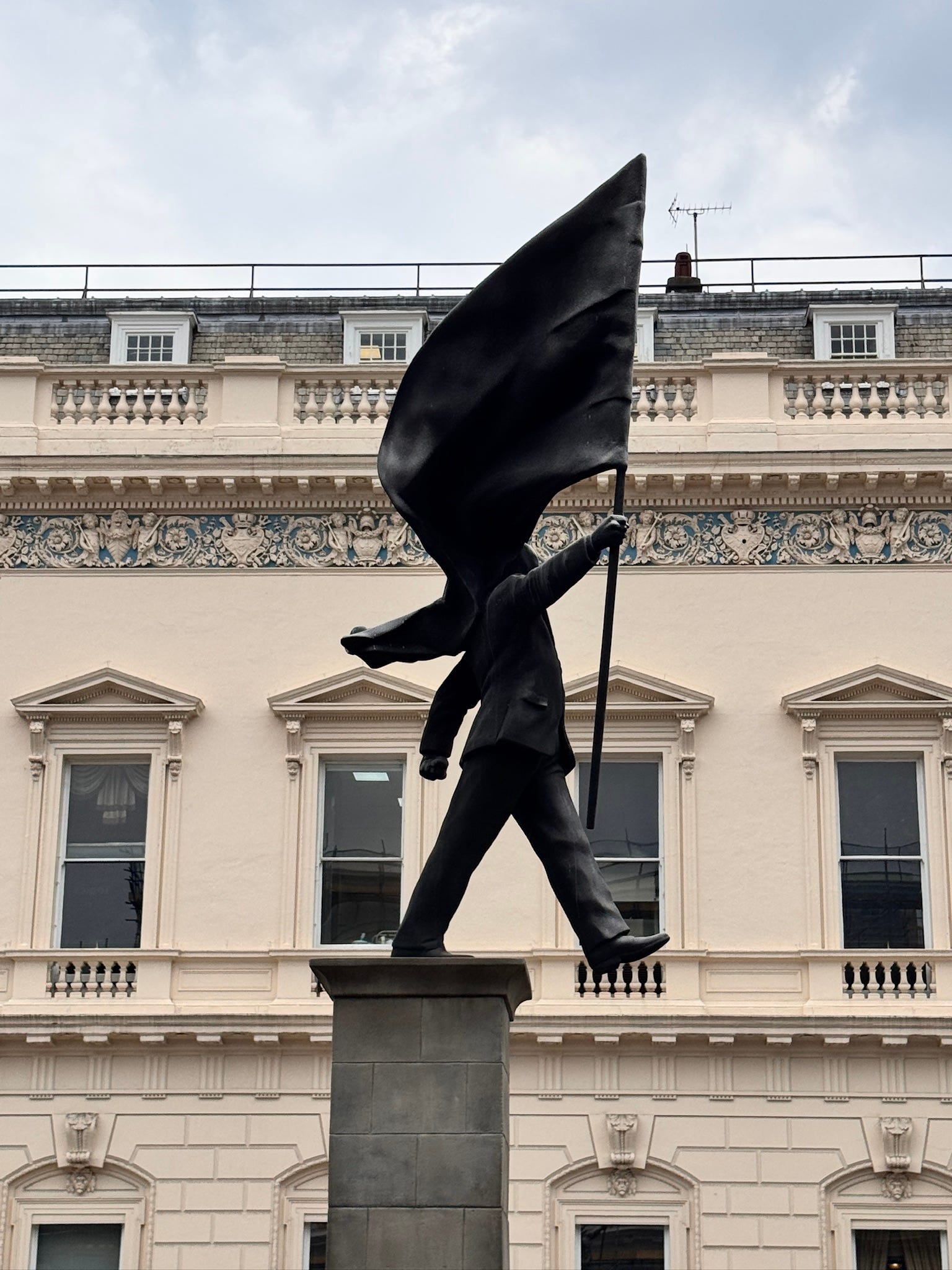
A couple of weeks ago while in London, I took a small detour to look at a new Banksy that was causing quite a stir just up the road from the National Gallery. I’m not easily impressed. This one was impressive.
In case you’ve never heard of Banksy, he is an anonymous street artist who has spent the last few decades leaving stencilled images on walls around the world without asking anyone’s permission and, as a result, has become one of the most extraordinarily successful artists on the planet.
The work I was standing in front of was a little different. It was a statue. A man in a suit, face wrapped in a flag so he can’t see where he’s going, is walking straight off his plinth into the void. It’s packed with symbolism, but the truly mind-bending point isn’t the meaning—it’s the existence. The piece is about twenty feet tall, must weigh close to a tonne and looks as though it has been standing there as long as Florence Nightingale and Edward VII, who have been sharing the same patch of Waterloo Place for over a century.
Nobody saw it go up. Nobody knows how. It simply appeared one morning, fully formed, entirely unbothered. Awesome.
The rumour on the street is that Banksy originates from Bristol, which brings me, in a fairly straight line, to a very famous statue in that city.
In June 2020, a crowd of protesters in Bristol looped a rope around the neck of a bronze statue of Edward Colston, the 17th-century merchant whose considerable fortune was bound up with the slave trade. The figure was then hauled from its plinth and pitched into Bristol’s Floating Harbour just yards away. The whole sequence was over in minutes. The argument it triggered wasn’t.
It was the moment a debate that had been simmering for years finally boiled over. Colston had been standing there since 1895, celebrated as a great civic benefactor while his sideline in the transatlantic slave trade was airbrushed from the record.
Once Colston hit the water, the floodgates opened. In London, the statue of Scottish slave trader Robert Milligan was quietly removed from outside the Museum of London Docklands. In Oxford, campaigners fixed their sights on Cecil Rhodes, gazing serenely down from Oriel College, while in Westminster, Winston Churchill’s statue in Parliament Square was boarded up overnight... just in case.
The question being asked was simple: whose version of history are we actually commemorating—and do we still agree with it?
In the months that followed, that question was asked across Britain and around the world, as monuments on every continent came under renewed scrutiny.
Which makes it all the more remarkable that a certain statue in Charleston, South Carolina, is still standing.
America’s first public monument...
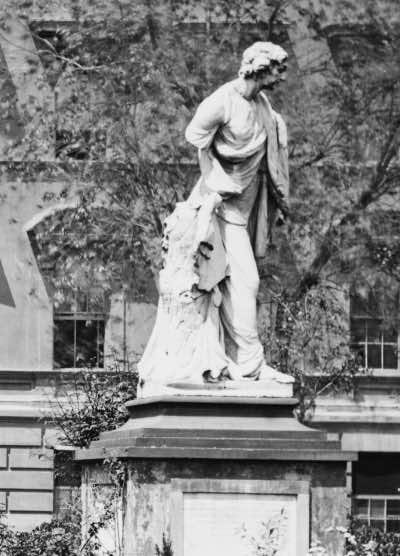
...stands inside the Charleston County Courthouse on Broad Street. It turns out that the 10-foot-high marble figure—17 feet including the plinth—has had rather a difficult two and a half centuries.
It was first unveiled on 5 July 1770 at the crossroads of Broad and Meeting Streets, commissioned by the South Carolina Commons House of Assembly. The English sculptor, Joseph Wilton, depicted the subject in classical Roman style: wrapped in a toga, one arm raised towards the heavens in defence of American liberties and the other cradling a scroll—the Magna Carta. Dignified. Permanent. Immortal.
Well, actually, not so immortal...
In the spring of 1780, the Revolutionary War was blazing through the South, and General Sir Henry Clinton arrived outside Charleston with fourteen thousand soldiers and ninety ships. He wasn’t there to negotiate. For six weeks, his guns methodically tightened around the city until the American garrison—hungry, isolated, and running out of options—surrendered. It was the greatest British victory of the entire war, and the worst American defeat.
Amid the cannon fire, the burning buildings and the chaos, a British round shot found its way to the intersection of Meeting and Broad Streets and neatly removed the statue’s upraised right arm. The British had managed to mutilate a monument to an English statesman who had spent much of his career arguing in Parliament against fighting this very war. We can only assume the gunner was not a student of irony.
Since then, the statue has been shuffled from site to site but now appears, for the moment at least, to have come to rest at the County Courthouse.
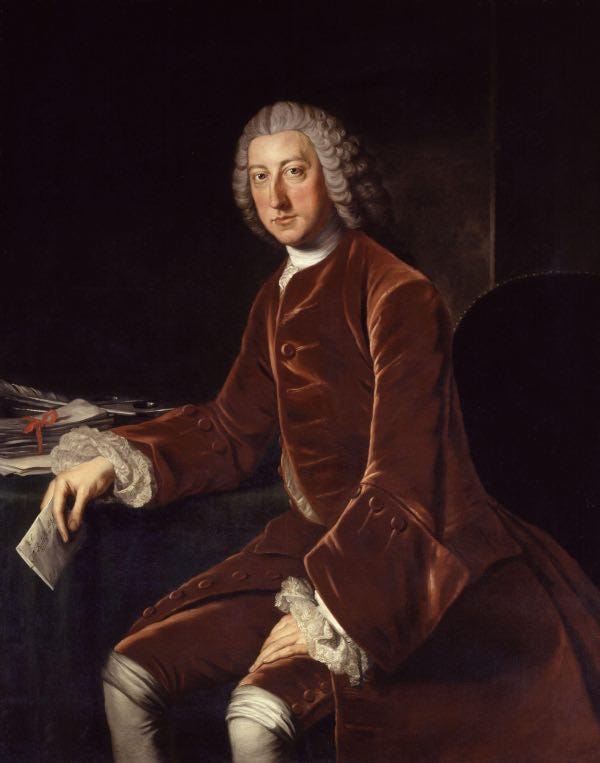
...William Pitt the Elder, first Earl of Chatham
‘The Great Commoner‘ was born in Westminster in 1708, grandson of Thomas “Diamond” Pitt, a former East India Company governor at Fort St George in Madras. His grandfather had returned from India with a fortune and one of the great Golconda stones, later cut and sold to the French regent, Philippe II. In other words, the Pitts had money, connections and, for good measure, a hereditary gift for gout. William inherited all three.
Out of Curiosity
Philippe II, duc d’Orléans, bought the Golconda stone from Pitt in 1717 for the staggering sum of £135,000—somewhere in the region of £30 million in today’s money.
The newly-titled Regent Diamond enjoyed a glittering career of its own; Set into the coronation crown of Louis XV, pinned to Marie Antoinette’s black velvet hat, stolen during the Revolution along with the rest of the French Crown Jewels, then recovered and mounted by Napoleon as the centrepiece of his sword.
Today, it rests sedately as a standalone diamond in the Louvre, Paris.
Pitt first rose to speak in the House of Commons in April 1736, already marked by the gout that would dog him for life. In later years he sometimes arrived at Westminster swathed in bandages, propped up on crutches with one foot encased in a bucket-sized gout-boot.
If the House was tempted to titter, it didn’t last long. Politician and writer Horace Walpole, recalling one speech in 1755, told a friend there was...
“more humour, wit, vivacity, finer language, more boldness, in short more astonishing perfections in it than he could imagine.”
As war minister and Secretary of State, Pitt steered the country to its defining victories in the Seven Years’ War (1756–1763), turning Britain into a formidable imperial power. British regulars and colonial troops drove the French from key posts across North America, including Fort Duquesne at the forks of the Ohio, which was rebuilt and renamed Fort Pitt in his honour.
While the honour itself was never in question, the spelling has proved more challenging over the years. General Forbes, writing home after the victory, called the place Pittsbourgh, which subsequently morphed to Pittsburgh, then Pittsburg, then back to Pittsburgh, where it remains today.
Prime minister from 1766 to 1768, Pitt had already earned the nickname the ‘Great Commoner‘ by spending most of his career in the House of Commons and refusing every peerage that would have carried him into the Lords. In an age when high office was a licence to help yourself, he made a point of declining the backhanders that came with the job. In Georgian politics, this was considered faintly eccentric.
Which, given what was coming, would prove to be rather important.
Magna Carta
Magna Carta was born in 1215 out of a simple arrangement that had gone badly wrong. King John taxed his barons heavily, dispensed justice arbitrarily and squandered men and money on losing wars in France.
The barons had reached their limit.
When John refused to change course, the barons seized control of London and marched him to Runnymede, a water-meadow by the Thames, where they presented him with a list of demands so comprehensive that his clerks needed an entire charter to write them all down. They called it Magna Carta. John sealed it on 15 June 1215—he had little choice—establishing a principle that, up to that point, had been unthinkable: even a king was subject to the law.
John, naturally, had other ideas. He promptly had the Magna Carta annulled by Pope Innocent III and plunged back into civil war with his barons.
When John died in 1216, his nine‑year‑old son Henry III needed those same barons back on side. His councillors reissued a Magna Carta Lite, going a little gently on the taxation clause. Not bad statecraft for a nine-year-old, even if he did have a little help.
Successive kings continued to reissue Magna Carta, pruning the taxation clauses each time since monarchs found them a little inconvenient.
Edward I was forced to climb down in 1297 when he tried to levy additional taxes for wars against Scotland, Flanders and France without consent.
Charles I ran into fiercer resistance in the 1620s and 1630s, attempting to raise taxes for wars against Spain and France without consulting Parliament. It ended in civil war and cost him his head.
And yet Magna Carta survived all of it—the annulments, the pruning, the convenient reissues—and transformed from a failed peace deal into something far more powerful: a foundational statement of the rule of law and the liberties of English subjects.
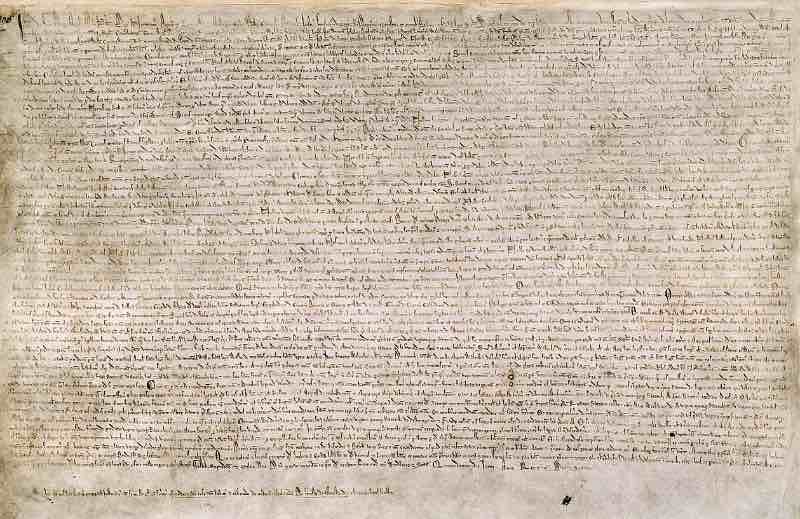
Magna Carta and America
By 1606, when the first English settlers crossed the Atlantic, Magna Carta had been part of English law for nearly four centuries. Long enough for a baronial grievance to become a birthright.
No person could be imprisoned without lawful cause—the seed of habeas corpus. No one punished without the judgment of their peers—the ancestor of the jury. Property could not be seized on a royal whim. Even the king was subject to the law, not floating cheerfully above it.
And tucked away in the small print was the clause that would one day prove explosive: that the king had no right to levy new taxes without the consent of those who paid them—the medieval ancestor of “no taxation without representation.”
When King James I issued the First Charter of Virginia in 1606, he guaranteed the settlers and their descendants all the liberties and rights of anyone born in England. The men who boarded those ships didn’t think of themselves as pioneers of a new legal order. They were Englishmen abroad, and they packed their rights accordingly.
Charters followed in other states, each guaranteeing the same English rights to due process, jury trial and consent to taxation ultimately rooted in Magna Carta.
When the Founding Fathers sat down to write the Constitution and subsequently the Bill of Rights, they were drawing on rights that English law had been developing since 1215.
They hadn’t invented a new idea. They had simply decided that, this time, nobody was going to take it away from them.
America and William Pitt the Elder
In March 1765, Parliament passed the Stamp Act—the first direct internal tax ever imposed on the colonies. Until now, taxes had fallen on imports and exports. This was different. Now taxes fell on everyday items: the documents they signed, the newspapers they read, even the playing cards they shuffled.
Pitt once called Magna Carta “the Bible of the English constitution.” He meant it. When Parliament began treating the American colonists as a convenient revenue stream rather than as British subjects with British rights, he took it personally.
The Act’s repeal came before the House in early 1766. Pitt was bedridden with gout as he told a friend:
“If I can crawl or be carried, I will deliver my mind and heart upon the state of America.”
Once in the chamber, he turned on his own brother-in-law George Grenville—the Act’s architect—and declared Americans as “the sons, not the bastards, of England.“ Those who had resisted the Stamp Act, he added, were “defenders of the cause of liberty.”
The Stamp Act was dead. Pitt’s speech had done much of the heavy lifting.
