



14 October 1910
14 October 1890
(read time: 3 mins.)
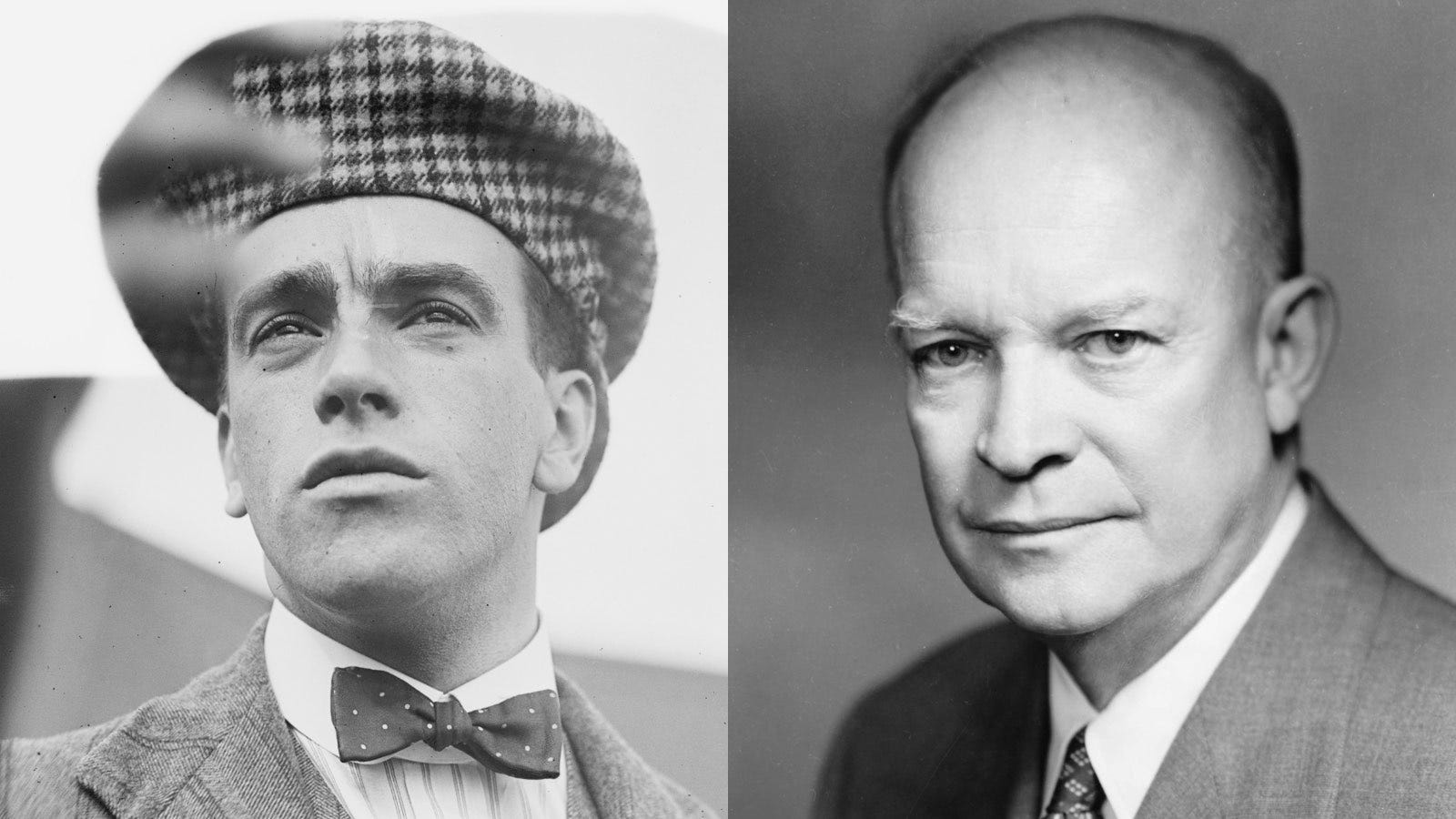
On 14 October 1910, Claude Grahame-White’s Farman III biplane glided down to a perfect landing in the middle of West Executive Avenue, a small roadway between the White House and today’s Eisenhower Executive Office Building. Through a strange historical coincidence, Claude Grahame-White’s landing coincided with Dwight Eisenhower’s 20th birthday.
Claude Grahame-White…
… was born in my county, Hampshire, England in 1879. From an early age, Claude had a fascination with machines and speed.
He had made his fortune from a motor car business by his early twenties. This was impressive since the first commercial vehicle, the Karl Benz Motorwagen, had only rolled off the production line when he was about six years old.
Claude turned his attention to flying. He bought his own Bleriot monoplane and competed in aviation competitions across Europe and America. He earned a reputation as one of the most daring pilots of the era.
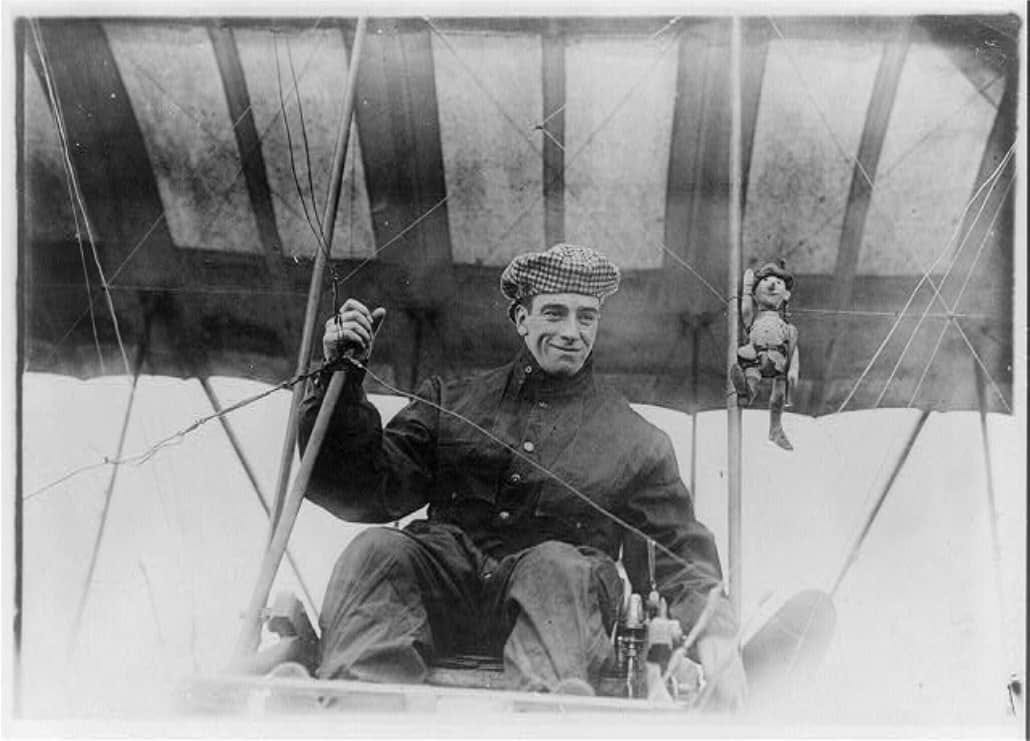
In 1910, flying was still very much a novelty. So, one autumn morning, when Grahame-White was in Washington D.C. with time on his hands and an aeroplane at his disposal, he decided to cause a stir. He contacted General Robert S. Oliver at the US War Department to inform him of his plan.
Word spread rapidly.
By the time Claude had started his aerial display over the heart of Washington D.C., a sizeable crowd had gathered. After 15 minutes, his daring acrobatics would give way to a more remarkable and audacious feat.
Grahame-White circled the Washington Monument at an altitude of approximately 500 feet, then cut his engine.
On 14 October 1910, Claude’s Farman III biplane glided down to a perfect landing in the middle of West Executive Avenue, a small roadway between the White House and today’s Eisenhower Executive Office Building.
Protocols were a little more relaxed in the early 20th century. Rather than face arrest for a breach of White House security, Grahame-White was celebrated by newspapers and applauded by military officers who had been watching.
After a spot of lunch at the Metropolitan Club, Claude departed as elegantly as he had arrived.
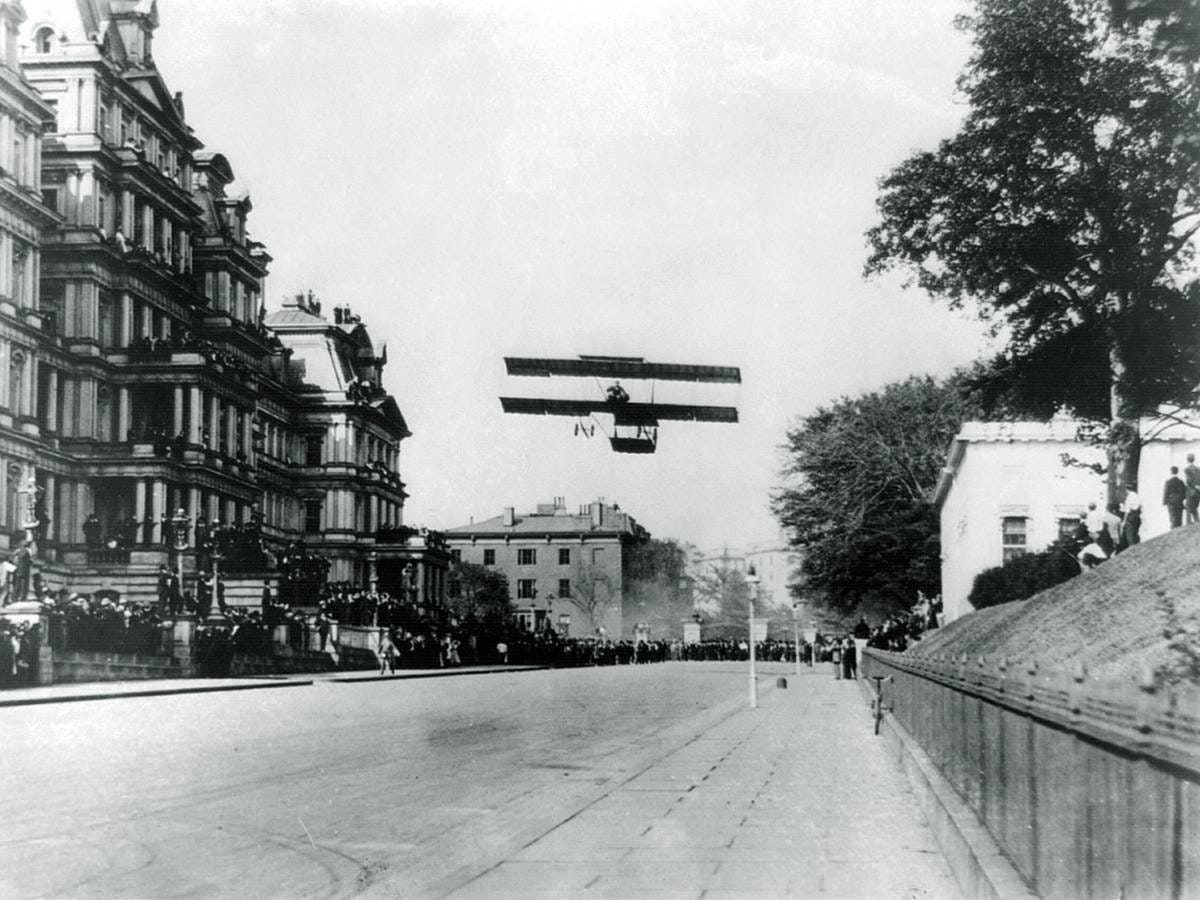
Through a strange historical coincidence, Claude Grahame-White’s landing alongside the future Eisenhower Executive Office Building coincided with…
…Dwight Eisenhower’s 20th birthday.
Eisenhower was born on 14 October 1890, in Denison, Texas. Of course, there was no connection between the two events at the time—Eisenhower was still unknown and a year away from joining the military.
His pacifist mother was devastated when he was accepted into West Point Military Academy in 1911.
Thirty-three years later, Eisenhower was appointed Supreme Commander of Allied Forces in Europe. He would orchestrate D-Day on 6 June 1944, the largest amphibious invasion in history. Eleven months later, the Nazis capitulated and the war in Europe was over.
Eisenhower’s popularity propelled him into the White House, where he served as the 34th President of the United States from 1953 to 1961.
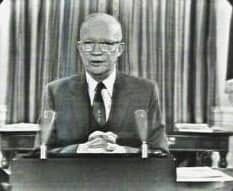
In his 1961 farewell address, Eisenhower recognised America’s pre-eminence as the world’s most powerful nation, but highlighted that America would be judged on ‘how we use our power in the interests of world peace and human betterment’.
Despite Eisenhower’s military career, his mother’s fundamental opposition to warfare had always remained in his thoughts. Perhaps her influence played a part in that final farewell address when he noted…
We should take nothing for granted. Only an alert and knowledgeable citizenry can compel the proper meshing of the huge industrial and military machinery of defence with our peaceful methods and goals so that security and liberty may prosper together.

Thank you for joining me.
Steve
CHIEF STORY HUNTER & WRITER
ATTRIBUTIONS
Claude Grahame-White: Courtesy of Library of Congress, no known restrictions on publication.
Claude Grahame-White, White House: Courtesy of Wikipedia.
Dwight Eisenhower: See page for author, Public domain, via Wikimedia Commons.
Cover image: Claude Grahame-White; Bain News Service, publisher, Public domain, via Wikimedia Commons. Dwight Eisenhower: Fabian Bachrach, Public domain, via Wikimedia Commons.


_LCCN2014685332_(cropped).jpg)
