


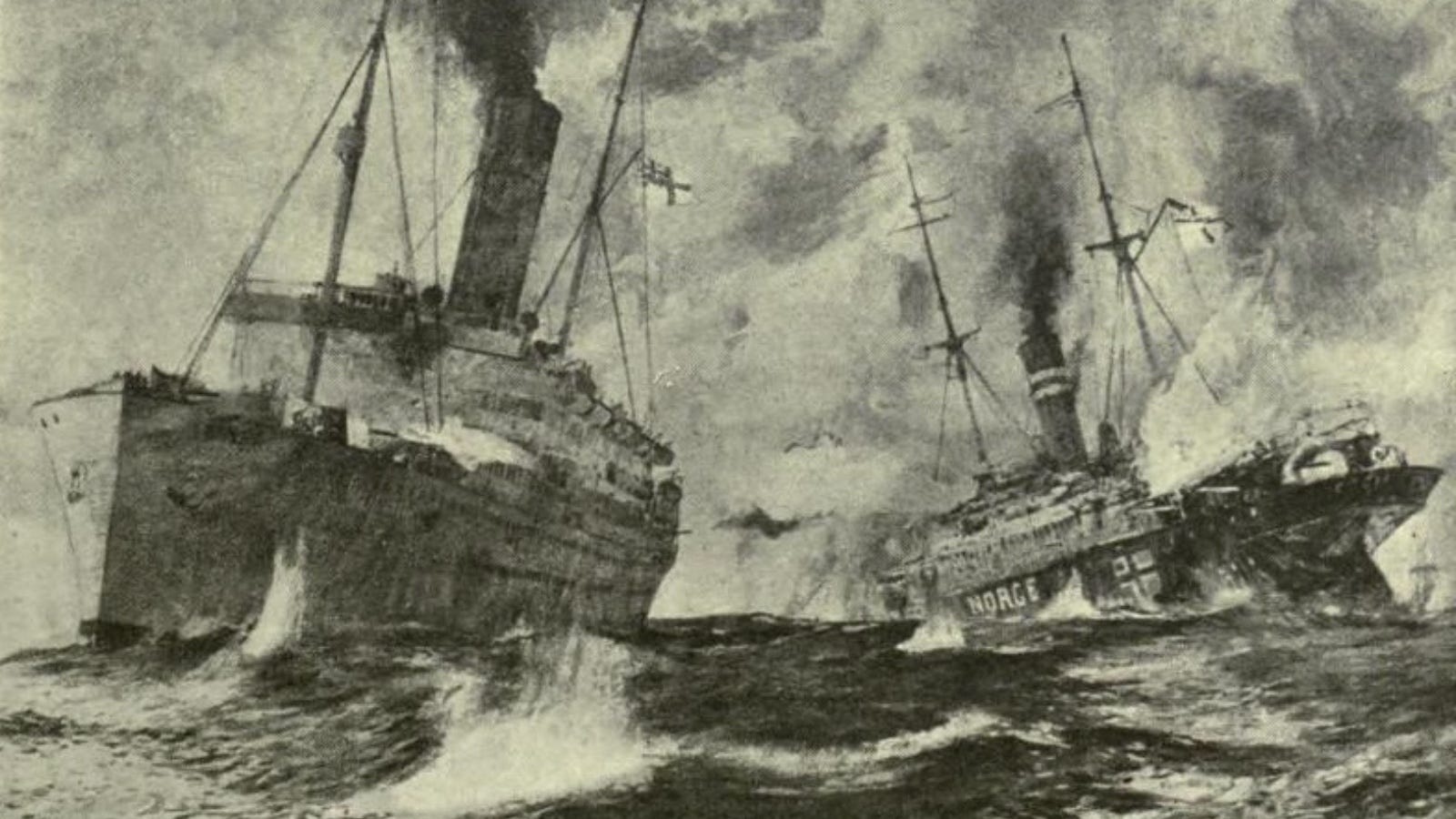

11th February 1937
(read time: 9 mins.)
To clear up the maths, Arthur Priest had survived two crippling collisions and four sinkings in his short nine-year career at sea. In that time, he had been torpedoed, mined, shelled, rammed… and iced. Cats have nine lives, Priest had already used up six.
There is a particular kind of bad luck that attaches itself to certain people and simply refuses to let go.
I have previously written about Roy Sullivan, a Shenandoah National Park ranger in Virginia, who somehow survived being struck by lightning seven times.
I’ve also shared the story of Tsutomu Yamaguchi, a marine engineer, who survived the atomic bombing of Hiroshima, caught the train home to Nagasaki, and survived an atomic bomb there too.
More recently, Melanie Martinez of Braithwaite, Louisiana, lost her house to Hurricane Betsy in 1965. Then to Hurricane Juan in 1985. Then to Hurricane Georges in 1998 and to Hurricane Katrina in 2005. In 2012, a reality television crew arrived and spent $20,000 renovating her home. Eight days after they left, Hurricane Isaac flattened it.
Arthur John Priest
For Arthur John Priest from Southampton, England, luck was less a bolt from the blue than a slow, persistent tide—a relentless companion.
Whether it was good or bad rather depends on your point of view and, one suspects, on whether you were the one being fished out of the North Sea at the time.
Priest was born in August 1887, the ninth of twelve children in a working-class family headed by his father Harry, a labourer.
Southampton in the late Victorian era was a city defined by the sea. The docks were the city. They were the jobs, the identity, the backbone of the local economy.
If you were a young working-class man in Southampton at the turn of the twentieth century, the sea would eventually claim you one way or another.
For Arthur Priest, that meant going to sea as a stoker on passenger liners.
A word on the…
…British Class System
I mentioned above that Arthur Priest was working class. Most people who didn’t grow up in the British class system tend to view it with bewilderment.
The idea of class is a throwback to a duke from northern France, William the Bastard, who invaded England in 1066.
The English drew the line at having to say ‘Bastard’ out loud in perpetuity so, over time, the Duke of Normandy’s title became William the Conqueror.
William granted swathes of the country to his rapacious Norman barons, creating a two-tier society before the dust had even settled.
The French became the haves and the English... the have-nots.
The Normans owned and consumed the animals, so our words for meat are French: boeuf, porc, mouton, veau (veal). The Saxon peasants herded and slaughtered them, so our words for living animals are English: cow, pig, sheep, calf.
The third tier—the middle classes—swelled during the Industrial Revolution, when manufacturers, bankers, lawyers, doctors and accountants found themselves with lots of money but no titles.
And that’s pretty much how it is today. At the ‘top’ sit the upper classes; the aristocracy, the landed gentry and other people whose families were once important for reasons no-one can remember.
At the other end of the scale, the working classes do all the hard work while the middle classes sit uncomfortably between the two.
But it’s not all about money. To talk about how much you earn or have stashed away is taboo. A person can be a millionaire and still be working class, while another could be completely broke and indisputably upper class.
Your class is determined by your accent, education, how you hold a fork and whether you call the evening meal dinner, tea or supper.
The upper classes use napkins, the middle classes use serviettes while the working classes don’t bother with either.
The middle classes worry about class incessantly. The upper classes don’t think about being upper class because… they just are, while the working class think the whole fuss is completely ridiculous.
In short, the upper classes have the titles, the working classes have the numbers and the middle classes have the anxiety.
That’s it.
The Black Gangs
Nineteenth century engine-room crews of the great steam liners were called the black gangs—men who spent their working lives in the bowels of a ship, stripped to the waist in ferocious heat, shovelling coal into furnaces around the clock.
On the big ocean liners, 29 boilers cried out for 600 tons of coal every single day.
The work was brutal, the noise deafening. The air was constantly filled with the smell of coal dust, engine oil and sweat. It was thankless work: not glamorous, not celebrated, not even particularly well paid, but essential.
Without the black gangs, the great liners wouldn’t move.
In terms of safety, the stokers were in the worst place imaginable; in the depths of the ship far below the waterline, connected to the upper decks by a maze of gangways, corridors and companionways. In other words—a very long way from a lifeboat.
This was Arthur Priest’s world.
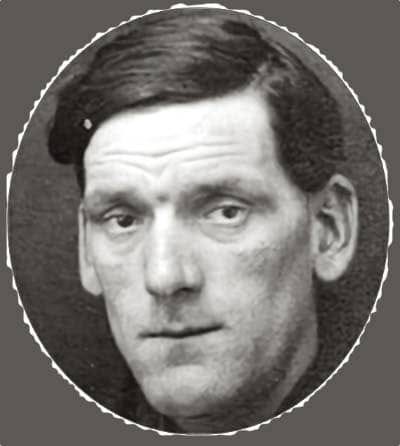
HMS Alcantara
Priest had been at sea for six years when the First World War broke out in 1914.
The Royal Navy needed ships. Specifically, it needed vessels to sweep 200,000 square miles of the North Sea to strangle Germany’s access to Atlantic trade routes.
This meant commandeering passenger liners, stripping out the chandeliers, bolting on some guns and sending them back to sea as Armed Merchant Cruisers—keeping many of the crews who had signed up to serve canapés, not their country.
HMS Alcantara, a handsome Royal Mail liner, had only been in service for a few months when the Admiralty came calling.
Arthur Priest was on board as a coal stoker.
By 1916, the British naval blockade had tightened its grip on Germany’s jugular. Much of its merchant shipping was bottled up in port and civilians were feeling the squeeze of real shortages.
Desperate situations need desperate measures. The Germans needed ‘raiders’ to get in amongst the British shipping in the open Atlantic and create havoc.
One such raider was SMS Greif. A former German-Australian cargo steamer, she sailed under the name Rena, flying Norwegian colours and displaying Norwegian markings on her hull.
To all intents and purposes, she was a harmless Scandinavian cargo ship going about her business. She was not.
Hidden behind false walls and removable panels, the Greif carried one 105mm gun, four 150mm guns and two torpedo tubes. The idea was simple: let any British inspection party get close enough and then let ‘em have it.
On 29 February 1916, HMS Alcantara was patrolling northeast of the Shetland Islands when her lookouts spotted smoke on the horizon.
Captain Thomas Wardle manoeuvred to investigate. At 5,000 yards, he ordered the vessel to stop for inspection. The Rena obligingly did so.
Alcantara closed to 2,000 yards. Then, at nine forty in the morning, Greif made her move.
The Norwegian ensign came down. The steering house at her stern vanished in favour of the 105mm gun. Along both sides of the steamer, hidden gun ports fell open.
Greif opened fire. The first shell struck the Alcantara’s bridge, taking out her steering gear and all lines of communication.
Down in the engine room, Arthur Priest felt the impact of those first shells before he heard anything. Then the alarm, the rush of orders, the flooding.
The visceral urge to get out of the stokehold must have been overwhelming.
For about fifteen minutes, the two ships hammered each other at close range—sometimes as little as 750 yards, which in naval terms is practically a bar fight.
The German ship had got her torpedoes away and one hit Alcantara amidships on the port side. The engine room began flooding. She slowed to three knots and began listing heavily to port.
At 11:02 in the morning, HMS Alcantara rolled over and sank, taking 68 crew with her.
The destroyer HMS Munster arrived as the Alcantara went down, pulling survivors from the water. Priest had successfully negotiated those gangways and corridors, managing to escape with nothing more than a few shrapnel wounds.
This was no victory for the Greif—she too was finished. Riddled with shells and ablaze, she succumbed to the weight of fire from arriving British warships.
By the end of the day, both ships were gone.
The Britannic
Nine months later, November 1916, Priest was back at work. This time in the boiler room of HMHS Britannic—the infamous Titanic’s younger sister ship and currently one of the largest hospital ships in the fleet. The war was still raging.
HMHS Britannic was on her way to the Mediterranean to collect casualties. On the 21st, near the Greek island of Kea, Britannic struck a mine.
Once again, Priest fought his way up from the lower decks. He reached a lifeboat—just as it was dragged into the still-turning propellers. He jumped. The water closed over him.
The blades spun him like a rag doll and moments later he resurfaced into a tangle of wreckage and bodies. A drowning man grabbed at him. He shook him off.
HMHS Britannic sank in under an hour. Thirty people died. Priest survived.
In Oscar Wilde’s The Importance of Being Earnest, when confronted with Jack Worthing’s orphaned childhood, Lady Bracknell sniffs…
To lose one parent, Mr. Worthing, may be regarded as a misfortune;
to lose both looks like carelessness.
You wonder what Lady Bracknell would have made of Arthur Priest. His crew mates christened him The Unsinkable Stoker. Others called him Jonah. Some refused to sail with him altogether.
The Donegal
Four months later, April 1917, Priest was serving as a fireman aboard the hospital ship SS Donegal, crossing the English Channel, when she was torpedoed by a German U-boat and sunk.
This time, Priest didn’t escape entirely unscathed. However, despite being pulled under by the suction, he came up under wreckage in the water, suffering a serious head injury.
At this point, you can see that Arthur John Priest was developing a rather complicated relationship with the sea. Saner men would have moved to the Midlands and found a desk job.
If you were in Priest’s stoker boots, would these three sinkings have caused you to reconsider your career choice?
Before you answer, I should come clean—there’s more.
RMS Asturias and RMS Olympic
In fact, Priest’s first brush with disaster came before the war even started. In 1908, his first ship, RMS Asturias, managed to collide with another vessel on her maiden voyage. Nobody died and the ship limped home. As a career opener, it wasn’t particularly encouraging.
Three years later, in September 1911, Priest was serving aboard the RMS Olympic—the other sibling of the RMS Titanic.
