



7th, 10th, 12th, 13th, 14th June 1381
15th June 1381
(read time: 12 mins.)
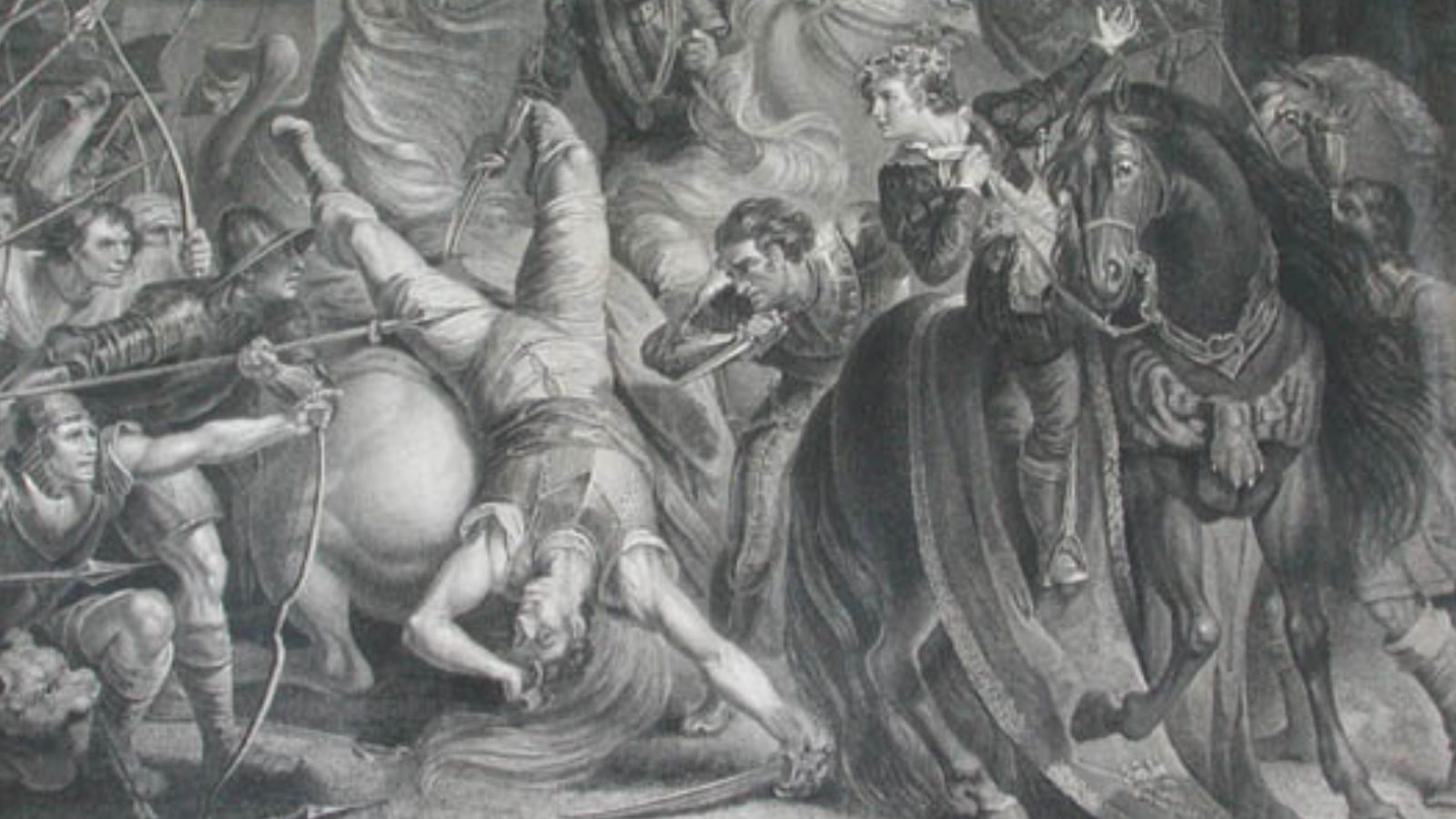
King Richard II rode out to Smithfield. Wat Tyler’s men were waiting, armed and ready to fight. Tyler rode out from their lines to speak with the king—a tiler from Kent, face to face with the King of England. Then, in the heat of the June afternoon, Tyler called for a flagon of water, rinsed his mouth, and spat it out in full view of the royal party. In one minute, everything changed.
If you walked into Smithfield in the City of London in the small hours of the morning, you’d find the great Victorian iron-and-glass halls of the old meat market, traders hard at work while dazed club-goers spill out of nearby Fabric nightclub, uncertain for a moment what century they’re in.
A few steps away stands St Bartholomew’s Hospital—Barts—the oldest hospital in London still on its original site, patching people up since 1123.
On one of the blocked window bays of the hospital’s north wall, a memorial marks where the Scottish hero William Wallace was hanged, drawn and quartered in 1305, alongside remembrances of the Protestant martyrs burned here under Queen Mary between 1555 and 1558.
A third plaque, on another blocked window bay, recalls an event from 15 June 1381.
That day, a man rode into Smithfield at the head of a rebel army and tilted the course of English history. The fact that he was dead before the day was out is beside the point.
His name was Wat Tyler.
The English feudal system...
...was crystallised by William the Conqueror after 1066, from roots back in Anglo-Saxon England. William imposed a new order on old inequalities. The principle was simple: with the exception of Church lands, England belonged to him.
How’s that for simple?
He then distributed land rights downward in exchange for loyalty and military service. Barons and bishops received large estates which they carved up among lesser lords and knights on similar terms. At the bottom of the pile, the peasants—serfs or villeins—worked the land in exchange for the right to live on it... and little else.
It was a medieval pyramid scheme, with William firmly at the top. The Domesday Book of 1086 was his great audit of the whole arrangement—a meticulous survey of who held what, what it was worth, and what they owed for it. Nobody appealed the findings.
Out of curiosity
Villein is the root of our word villain—which tells you everything you need to know about how the propertied classes viewed the rural poor.
By 1348, the feudal system was looking frayed. Knights were more often paying cash than riding to war. Towns were filling up with merchants and craftsmen who didn’t fit into the old pyramid. Some serfs had negotiated their way out of serfdom. The Church held vast estates and answered to Rome rather than Westminster.
Then the plague arrived. With little warning, the old rules stopped working.
The Black Death...
The Black Death arrived in England in 1348, probably through the port of Melcombe Regis, Weymouth on the Dorset coast. Victims developed hideously swollen, darkened lymph nodes, sweated and shivered, sometimes coughed blood—and were often dead within days.
Whole villages vanished, harvests rotted in the fields and the Church lost priests faster than it could ordain replacements.
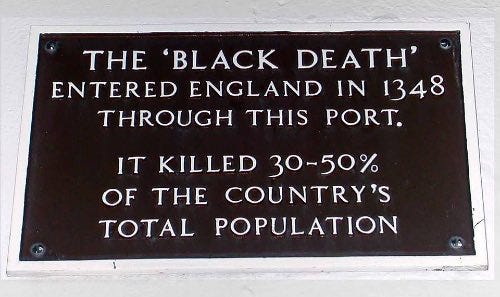
In total, the plague killed between a third and a half of the population within two years. Imagine if every other person you have ever seen or met was now dead. It was a staggering number.
Huge swathes of the workforce had simply disappeared. Those who remained found themselves strangely indispensable.
Lords watched on as labourers slipped away to neighbouring estates offering better terms. For the first time in living memory, peasants had leverage. The brutal arithmetic of supply and demand had done what centuries of feudal habit could not—made the common man’s labour unmistakably valuable.
Change didn’t happen overnight. Instead, over the next thirty-five years, a string of decisions and disasters conspired to make an already unhappy situation considerably worse.
Parliament passed the Statute of Labourers in 1351, fixing wages at pre-plague rates and trying to prevent peasants from seeking better-paid work elsewhere. Resentment simmered just beneath the surface.
The Black Death kept coming back with fresh waves in 1361–62, 1369 and 1374–5, each one killing more labour and tilting economics even further in the peasants’ favour.
The Hundred Years’ War ground on. The celebrated victories at Crécy and Poitiers were fading into memory while new campaigns bled the treasury dry. It was not going well.
And then came the final straw.
Parliament imposed a third poll tax in 1381, following previous levies in 1377 and 1379—but this time charging three groats per head on everyone over fifteen.
Out of curiosity
A poll tax was a flat-rate tax levied on every individual—’poll‘ meaning head, from the old word for skull (it survives in ‘tadpole‘, literally ‘toad-head‘). Unlike taxes on land or income, it charged everyone the same nominal sum regardless of wealth.
It was a grotesquely regressive tax—hitting the poor proportionally far harder than the rich.
Three groats—twelve pence, several days’ wages.
It was an outrage.
By the spring of 1381, the tax collectors were running into more than grumbles. Instead of harvesting revenue, they were sowing the seeds of revolution.
In Essex, towards the end of May, a crowd of men from nearby villages drove a royal tax commissioner clean out of Brentwood. Within days, the unrest had spread and both Essex and Kent were in open revolt.
At this point, our central character took to the stage.
Wat Tyler
Almost nothing is known of Wat Tyler’s early life. He was probably born in the early 1340s, around the time of the first Black Death. He may have been a roof tiler—hence the name. He was from Kent. Or possibly Essex.
That’s about it. As it turns out, Wat Tyler’s moment in the light of history would last just nine days.
But what a nine days they were.
7 June 1381: The Kentish rebels
Tyler was chosen as the captain of the Kentish rebels soon after they had stormed Rochester Castle. Why him? Well, I could tell you that he was a natural leader—commanding, decisive, with the kind of authority that could turn a crowd into an army. I could suggest that he had some military experience and the confidence of a man who had nothing much to lose. But I’d be guessing.
10 June 1381: The March on Canterbury
The Kentish men marched on Canterbury, arriving in force to a surprisingly sympathetic welcome. They threw open the jails, burned bundles of legal and tax records, drove out Archbishop Simon Sudbury’s officials and declared him deposed.
Sudbury himself—also Lord Chancellor and closely associated with the hated poll tax—had the good sense to have fled to the relative safety of the Tower of London.
12 June 1381: The March on London
The two rebel factions now marched on London. The Essex men came in from the north and east, camping on the fields at Mile End. The Kentish rebels approached from the south, gathering at Blackheath—the open heath above the Thames, just south of Greenwich.
On the same day Tyler was chosen as captain, a wandering radical priest, John Ball, was freed from Maidstone prison. He would become one of the revolt’s most incendiary voices.
That evening, Ball preached to an assembled crowd of armed men. His sermon turned on a single rhetorical question:
“When Adam delved and Eve span, who was then the gentleman?”
If Adam dug the earth and Eve spun the wool—just two people doing what was needed to survive—where, Ball was asking, was the need for noblemen?
The gathered crowd liked what they heard. The loose swirl of grievances that had brought them to Blackheath was hardening into something that genuinely threatened the Crown.
By the way, if you ever get a little confused over the finer points of the British class system, check out my thirty-second guide here.
Out of curiosity
If you’re wondering how thousands of peasants could form such an effective force, the reality is a little different from the folklore.
The backbone was indeed agricultural labourers and the rural poor, but the so-called Peasants’ Revolt also drew in skilled tradesmen, parish clerks, minor officials, and former soldiers—men of some local standing.
They marched under captains and arrived in London with clear political demands. They knew exactly where the power was held on manorial rolls, tax registers and legal records. They also knew what to do with them.
13 June 1381: The Kentish men march on the Savoy Palace
The following day, Tyler led his men to London Bridge. The defences were up—the city authorities had given the matter some thought. Not enough, as it turned out.
Sympathetic Londoners opened the gates uncontested and thousands of Kentish rebels poured into the city. The French had been trying to take London for fifty years. They should have just knocked.
Once inside, the Kentish men drove west, opened the Fleet Prison, then headed for the lawyers’ district at the Temple, feeding piles of legal records to the flames when they arrived.
From Temple, they turned along the Strand towards the biggest prize of all: the Savoy Palace—the magnificent London residence of John of Gaunt, the king’s uncle and, in many eyes, the most powerful man in England.
The palace was looted and set ablaze. England held its breath.
Out of Curiosity
In 1881, on the old site of John of Gaunt’s Savoy Palace, the Savoy Theatre became the first public building in the world to be lit entirely by electric light.
Next door, the Savoy Hotel followed in 1889 as Britain’s first fully electric-lit luxury hotel.
14 June 1381: Richard II meets the Essex men.
Richard II was fourteen years old.
He was not yet the calculating, tyrannical figure history would later sketch. He was a teenager with a crown, hemmed into the Tower of London with what remained of his court, surrounded by thousands of furious subjects. His principal commanders were scattered across the country, while his powerful uncle, John of Gaunt, was out of reach in Scotland.
Right now, Richard was on his own.
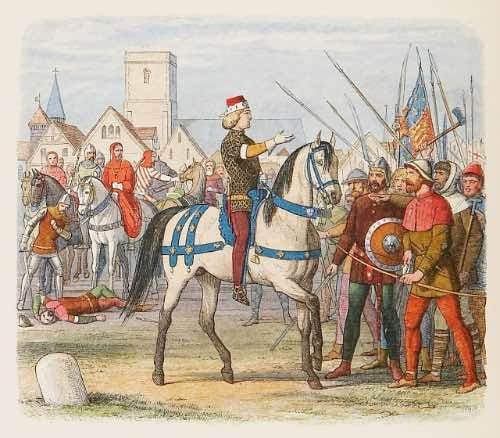
He rode out to Mile End to meet the Essex rebels. He agreed in principle to almost everything they asked—an end to serfdom, fixed money rents in place of labour services, and a pardon for all who had risen up. It was an astonishing capitulation.
Many of the rebels were willing to take yes for an answer. They received their sealed charters from the teenage king and began drifting back towards their villages.
Meanwhile...
Once the king was at Mile End, a force led by the formidable woman Johanna Ferrour—the same Ferrour linked to the burning of the Savoy Palace the day before—pushed into the Tower of London.
The gates were opened from within and the rebels more or less walked in. The garrison, without their king and unsure which way the wind was blowing, offered little resistance.
Inside, the rebels hunted down royal officers and foreigners—lawyers, ministers and even Flemish traders unlucky enough to be within reach.
Two of the most hated men in England—Simon Sudbury, Archbishop of Canterbury and Lord Chancellor, and Sir Robert Hales, the king’s treasurer, both blamed for the poll tax—were dragged out and beheaded unceremoniously on Tower Hill. Their heads were displayed on London Bridge.
Sudbury’s mummified skull, axe marks and all, still rests in St Gregory’s Church in his home town of Sudbury, Suffolk.
15 June 1381: Tyler’s fateful audience with the king
Richard had faced down the Essex rebels at Mile End, but he still had the Kentish army to deal with.
He rode out to Smithfield. Wat Tyler’s men were waiting, armed and ready to fight. Tyler rode out from their lines to speak with the king—a tiler from Kent, face to face with the King of England.
In one minute everything changed.
