



8th April 1856
(read time: 9 mins.)
At a sitting on 8 April 1856, just days after the peace was signed, Camillo forced the ‘Italian question’ onto the agenda of the assembled great powers. Napoleon III had taken note. Secondary sources quote him as privately asking Cavour, “Que puis-je faire pour l’Italie?” What can I do for Italy? Five years later, Victor Emmanuel II was proclaimed the first king of a unified Italy.
The Crimean War—1853–1856. You probably know the story. Well, more likely the British version.
Six hundred horsemen. One valley flanked by Russian artillery on three sides. One baffling order. And presiding over it all, a cast of characters so magnificently, catastrophically unsuited to the task of high command that the charge of the Light Brigade was doomed before the first trumpet sounded.
“Forward, the Light Brigade!”
Was there a man dismayed?
Not though the soldier knew
Someone had blundered.
Theirs not to make reply,
Theirs not to reason why,
Theirs but to do and die.
Into the valley of Death
Rode the six hundred.
ALFRED, LORD TENNYSON.
The Charge of the Light Brigade, 1854.
The British Army 1853–56
This was the era when much of the British Army ran on a beautifully simple principle: if you were born into the right family, the right rank would follow. In most infantry and cavalry regiments, commissions were bought, not earned—meaning the people most likely to get other people killed were the least likely to know how to avoid it.

Take Lord Raglan… the British commander-in-chief in Crimea hadn’t commanded troops in the field since the Battle of Waterloo, 39 years earlier. He also had a somewhat disconcerting habit of referring to the French as ‘the enemy’… the French, that is, who were fighting alongside the British against the Russians.
Then there was the Earl of Cardigan, who commanded the Light Brigade… a man described by one of his own officers as having “as much brains as my boot”.
And let’s not forget the Earl of Lucan, Cardigan’s brother-in-law and the man who relayed the fateful order—whom the rank and file had cheerfully nicknamed ‘the cautious ass’.
All of which is to say: The British blundered their way through the Crimean War with a kind of extravagant, aristocratic confidence that was breathtaking to behold.
But here is the thing about the Crimean War: It wasn’t just a British story. The French and the Ottomans were there too. And towards the end of the war, another party appeared—the Kingdom of Sardinia, also referred to as Piedmont-Sardinia.
Which raised an obvious question. What was a relatively small kingdom tucked into the north of the Italian peninsula doing rubbing shoulders with the great powers in a war being fought on the far side of Europe?
As it happens, the Piedmontese had their own reasons for showing up, and it had nothing whatsoever to do with Crimea.
Remember Garibaldi’s Italy?
A couple of weeks ago, I wrote about Giuseppe Garibaldi and the unification of Italy—how his red-shirts landed in Sicily in 1860 and worked their way up the peninsula, how a nation seemed to be born from the sheer force of one man’s military audacity, and how Victor Emmanuel II the King of Piedmont-Sardinia, was proclaimed the first King of Italy in 1861.
What I didn’t mention was where the story actually began. Not on a Sicilian beach. Not with a red shirt or a drawn sword.
It began in a conference room in Paris six years earlier in 1856, with the signing of the Treaty of Paris that ended the Crimean War—and with a small northern kingdom that had earned itself a place among the great powers.
It turns out that there was more than one way to earn a seat at the peace table when it was all over.
You didn’t have to blunder your way there. You could just be smarter than everyone else.
I’m jumping ahead; back to the Crimean War…
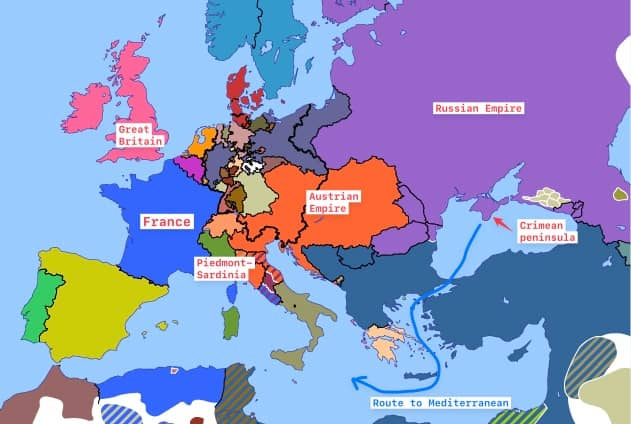
The seeds of the Crimean War were sown in 1853, when a squabble broke out between the Ottoman Empire and Russia over who had the right to protect the Christian holy sites in Jerusalem. At least, that was the spark for a deeper issue... Russia’s drive for secure access from the Black Sea to the Mediterranean.
At the time, the Ottoman Empire controlled the Bosphorus and the Dardanelles, the two narrow straits forming the only sea-route between the Black Sea and the Mediterranean.
Russia’s great northern ports on the Baltic and in the Arctic iced up in winter, leaving much of its fleet effectively powerless for months at a time.
Access from the Russian naval base at Sevastopol on the Crimean peninsula through those straits to the Mediterranean was therefore existential for Russian sea power.
Out of Curiosity
As the saying goes, “History doesn’t repeat itself—but it sure rhymes”.
When Russia annexed Crimea in 2014, the anxiety driving it would have been instantly familiar to anyone who had followed the events of 1853.
Sevastopol was still there. The Black Sea Fleet was still there. Russia’s most important warm-water route to the wider world was still there. A century and a half had passed. The ambition hadn’t moved an inch.
Russia used the Jerusalem quarrel as cover to start pushing into Ottoman territory. The French and British, with no desire to see Russia parading their ships through the Mediterranean, decided enough was enough.
The two Empires joined the Crimean War on 28 March 1854.
The war itself was, for the most part, a siege. Allied forces landed on the peninsula in September 1854 and spent the next eleven months trying to batter their way into Sevastopol.
It was grinding, miserable work in the trenches and batteries around the city—punctuated by a handful of set-piece battles at Alma, Balaclava and Inkerman.
The war’s most effective killer turned out to have nothing to do with the Russians. Cholera, dysentery and typhus tore through the Allied camps with a thoroughness that the enemy never quite matched. More men died of disease than in action.
Rewinding back to 1810…
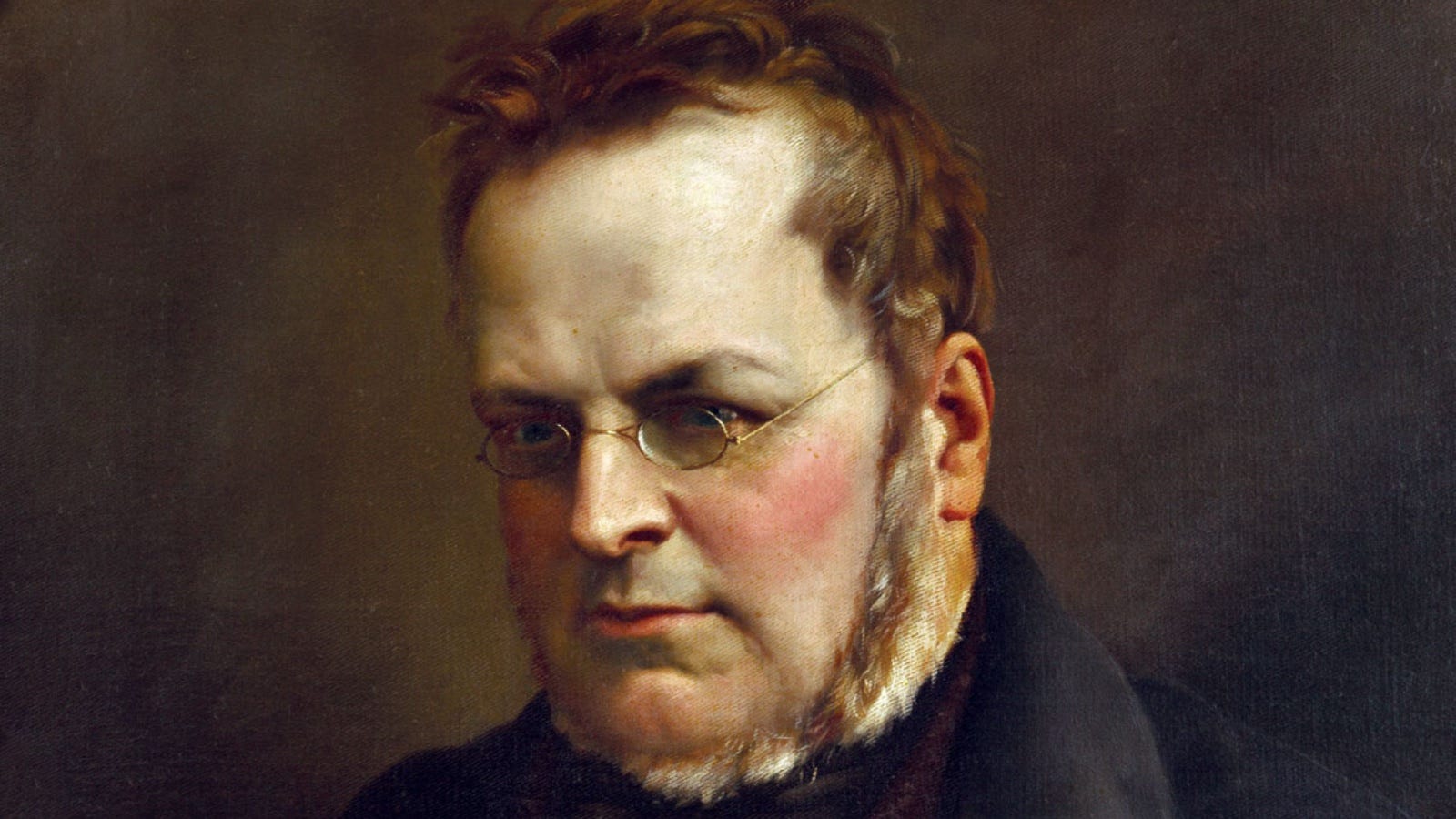
Camillo Paolo Filippo Giulio Benso, Count of Cavour, was born in Turin on 10 August 1810. He was the second son of an ancient Piedmontese noble family—which, in the arithmetic of nineteenth-century aristocracy, meant he would inherit neither the estate nor any particular expectations.
As such, second sons were directed towards the church or the army and left to get on with it.
Camillo chose the army, and was duly dispatched to the Royal Military Academy in Turin. He proved a capable soldier, but a man of his restless intelligence was never going to thrive on drill and obedience.
Five years after graduating, he walked away from the uniform, one suspects before the uniform had the chance to walk away from him.
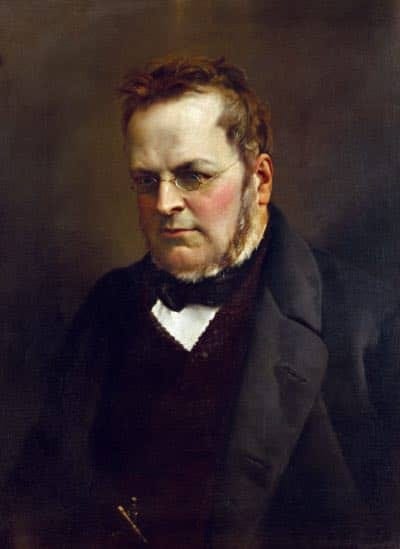
Cavour was short, stocky, round-faced and sported thick spectacles. By the time he reach forty, his reddish hair was thinning and his scanty beard had almost given up.
Camillo had rather more the air of a man who might audit your accounts than redraw the map of a continent. He was also a heavy gambler and womaniser of considerable dedication.
Spoiler alert… the Count of Cavour never married.
However, what he may have lacked in appearance and personal restraint, Camillo more than made up for with intelligence. And patience. And a strategic clarity of vision that would have made Lord Raglan weep with envy.
The dream of Italy
As Cavour was growing up, a unified Italian nation was the dream of revolutionaries and poets, not ministers and kings. Austria, which controlled the rich northern provinces of Lombardy and Venetia, had every interest in keeping it that way.
Cavour understood early that this would not change through revolution alone. Austria was too strong. Piedmont-Sardinia was too small. He needed to secure the military backing of a major European power.
And the only major European power likely to be sympathetic was France—specifically, its new emperor, Napoleon III.
After a stint managing his family’s estates, Cavour entered politics, founded an influential newspaper called Il Risorgimento—The Resurgence—and rose with remarkable speed to become Prime Minister of Piedmont-Sardinia in 1852.
From his desk in Turin, Camillo watched the Eastern crisis slide into the Crimean War with the focused attention of a chess player studying the board. And he began, quietly, to plan his move.
The gamble
By 1855, Britain and France were urging Piedmont-Sardinia to join the war against Russia. They needed troops. Although Cavour was privately reluctant, his eye was on the endgame.
When the guns fell silent, there would be a peace congress. And at that peace congress, the great powers would sit around a table and decide what Europe would look like going forward.
Cavour needed to be at that table.
So, in January 1855, he committed 18,000 Piedmontese troops to the Crimea. They fought with genuine distinction and suffered around 2,000 casualties. The bill was steep. But Cavour was not paying for military glory.
He was buying a chair.
Belt and braces
To reinforce his military gamble, the Count of Cavour conjured up a supplementary strategy.
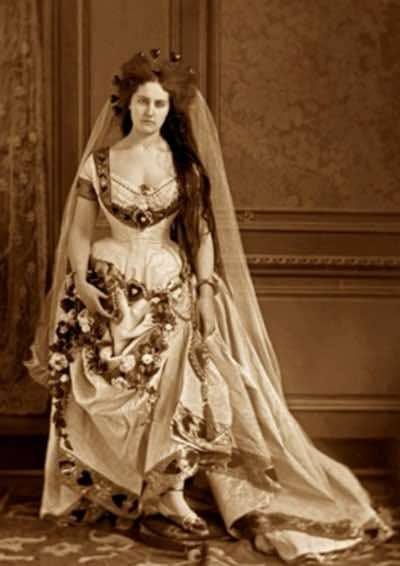
He had a cousin, Virginia Oldoini, Countess of Castiglione. The Countess was considered by some to be the most beautiful woman in Europe, a distinction that proved to be her greatest asset and most persistent problem.
She was eighteen, unhappily married, and possessing a restless intelligence that the men around her were far too distracted to notice.
Cavour noticed.
In December 1855, as the Congress of Paris was being prepared, he arranged for the Countess to travel to Paris, instructing her to “succeed by whatever means you wish—but succeed” in securing Napoleon III’s sympathy for Italian unification.
At one of her first appearances at the Tuileries Palace, she made a carefully timed—and fashionably late—entrance. The dancing stopped. The orchestra stopped. Napoleon III stopped.
The affair began shortly after, as did conversation of a unified Italy.
Whether it was the 18,000 troops, the Countess, or a combination of both, Piedmont-Sardinia secured its seat at the Congress of Paris.
The Congress of Paris
Sevastopol finally fell in September 1855, after the French stormed a key defensive position the Russians had held for nearly a year. With their great fortress gone and Black Sea Fleet scuttled, Russia had little left to fight with.
The Crimean War ended, as wars do, with a treaty—the Treaty of Paris. The Congress opened at the Quai d’Orsay on 25 February 1856. Around the table sat representatives of France, Britain, Russia, Austria, Prussia and the Ottoman Empire.
And, of course, Piedmont-Sardinia.
Cavour arrived in Paris and for five weeks threw himself into the proceedings with characteristic energy. He watched, he waited and worked every room that he entered.
The official business of the Congress was settled relatively quickly. By the time the Treaty of Paris was signed, 30 March 1856, Russia had been deprived of its Black Sea war fleet. The sea was declared neutral, closed to all warships and naval arsenals, while the Danube was opened to international commerce.
In addition, the Ottoman Empire was admitted to the Concert of Europe, its independence and territorial integrity guaranteed.
Russia was humiliated, but not destroyed. The European balance of power had been restored… for the moment.
Cavour’s move
One of the signatories had a rather different balance in mind. Cavour had played a hand so quiet and so patient that many of the men around the table only realised how much he had gained when the cards were already on the cloth.
At a sitting on 8 April 1856, just days after the peace was signed, Camillo forced the ‘Italian question’ onto the agenda of the assembled great powers. Austria was not pleased. But Britain and France, leaning back in their chairs and with little love for Rome and Naples, raised no serious objection.
Although Cavour left Paris without a written guarantee, Napoleon III had taken note. Secondary sources quote him as privately asking Cavour, “Que puis-je faire pour l’Italie?” What can I do for Italy?
For Cavour, that was enough. Five years later, Victor Emmanuel II was proclaimed the first king of a unified Italy.
