



4th February 1746
(read time: 9 mins.)
Andrzej Tadeusz Bonawentura Kościuszko was born on 4 February 1746, in what was then the Polish-Lithuanian Commonwealth, now modern-day Belarus. But what turned a minor nobleman from a Polish-Lithuanian backwater into someone remembered across three continents, from West Point to the Snowy Mountains?
A couple of years ago I chatted with Rebecca Bratspies for the Batting the Breeze podcast. Rebecca is a New York environmental and human rights lawyer who’d just written a wonderful book, ‘Naming Gotham—The Villains, Rogues and Heroes Behind New York’s Place Names’.*
Rebecca shared stories of well-known characters who have been commemorated through the bridges, tunnels, parkways, boulevards and parks of New York.
Our conversation centred on Jackie Robinson, who became the first Black Major League Baseball player in modern US history when he joined the Brooklyn Dodgers in 1947. The Kosciuszko Bridge was mentioned briefly, but we moved on.
Not long after, I was talking to my Australian cousin in Melbourne. He went to great lengths to convince me that there is fantastic skiing in the Kościuszko National Park, situated in the Snowy Mountains in the southeast corner of New South Wales.
I think a hardened skier more familiar with the steeps of Jackson Hole, the bowls of Whistler or the black runs at Val d’Isère, Zermatt or Alpe d’Huez might baulk at the word ‘fantastic’, but the point was made.
Inevitably, instead of the widely accepted ‘kosh-TCHYUUSH-koh‘ pronunciation, cousin Bren settled on ‘kozzy-osco‘—more reminiscent of a discount supermarket than a Polish national hero.
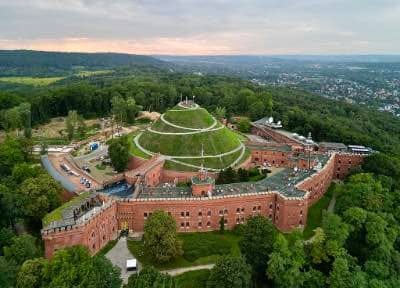
And then recently, a Polish friend mentioned the Kościuszko Mound in Kraków, Poland, a memorial to a Polish-Lithuanian military leader built between 1820 and 1823.
Three mentions turns out to be the magic number where my indifference transforms into investigative compulsion, a sort of historical tipping point where I stop grazing and start digging.
I had to find out who this chap was that people loved and remembered from the East Coast of the United States, across Europe and down to the southeast corner of Australia.
(*See Rebecca’s episode Beyond the Baseball Color Line.)
Andrzej Tadeusz Bonawentura Kościuszko
...was born 4 February 1746, in what was then the Polish-Lithuanian Commonwealth, now modern-day Belarus. He was born out of minor nobility, comfortable enough to open the doors to education, but not wealthy enough to count as true aristocracy.
And, naturally, when you hear about someone like that, the first question isn’t so much what they did, but why? What lit the fuse? What turned a minor nobleman from a Polish-Lithuanian backwater into someone worth remembering on at least three continents?
Stage 1—belief
It turns out that Tadeusz’s eureka moment struck when he was packed off to the Catholic Piarist college in Lubieszów, where he became fascinated by the ancient Greeks and Romans.
In particular, he was obsessed by the story of Timoleon, a Greek statesman who freed the Corinthians and Sicilians from Carthaginian tyranny.
Tadeusz was nine years old.
In later years, when he was asked why Timoleon held such a strong hold on him, he said because... ‘he overthrew tyrants, set up republics and never demanded any power for himself’ .
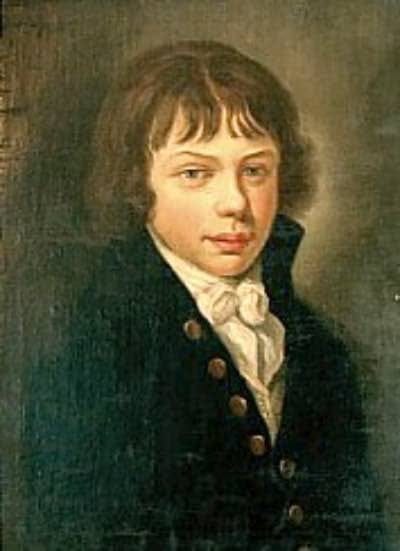
That, at least, was the trigger. At the age of nineteen, just after Warsaw’s Corps of Cadets opened its doors, Kościuszko enrolled at the king’s military academy.
He impressed his teachers so much that, with backing from powerful royal patrons—the Czartoryski family—and a royal scholarship, he was packed off to Paris to continue his studies.
This was the European Age of Enlightenment with Paris at its pulsating centre. Here, Tadeusz immersed himself in the language of natural rights and popular sovereignty—the intoxicating world of Rousseau, Voltaire and John Locke, where freedom and dignity were universal birthrights, not aristocratic favours.
These ideas shaped everything that followed—they became the blueprint for his entire life.
While Tadeusz dutifully attended his art classes, he was also hiring private tutors and studying military engineering—specifically fortifications and military architecture, subjects not generally known for their sparkling dinner party potential.
Stage 2—circumstances
Back in Poland in 1774, Kościuszko made the mistake of falling for the wrong woman—Ludwika Sosnowska. Her father, the formidable General Joseph Sosnowski, took one look at the penniless military engineer and was spectacularly unimpressed.
When the young lovers attempted to elope, the enraged general gave chase. Tadeusz barely escaped with his dignity intact, fleeing back to France before the general could express his disapproval in more permanent terms.
As it turned out, By 1776, the French were glued to reports from America’s East Coast, where the colonials were picking a fight with the world’s most powerful empire.
For France’s intellectuals and chattering classes, it was irresistible—a real-life experiment in liberty… and a chance to watch Britain take a beating.
Louis XVI was cautious about backing a rebellion against the British. The optics were tricky—encouraging revolution might set a precedent he might live to regret. (Spoiler alert: it did.)
But Kościuszko wasn’t for waiting. He didn’t need the comfort blanket of official approval. He’d seen people fighting for liberty and concluded, with admirable simplicity, that he should probably help.
By the time Tadeusz had arrived in Philadelphia, the Thirteen American colonies, acting through the Second Continental Congress, had declared independence from Great Britain.
Stage 3—Carpe Diem
Carpe diem, quam minimum credula postero.
Pluck the day, trusting as little as possible in the next one.
HORACE: Odes (Book 1, poem 11) 23 BCE.
When Tadeusz arrived in 1776, he made a beeline for the ‘most famous American in the world’—Benjamin Franklin.
He walked into Franklin’s lodgings unannounced—no letter of introduction, no appointment, barely any English. Through some improvised French, Franklin gathered enough to recognise that this Polish engineer with the unpronounceable name might actually be useful to the revolution.
Armed with a recommendation from Benjamin Franklin, Kościuszko was then welcomed into the Continental Congress as an engineer with the rank of colonel. At that point, the revolutionaries were suffering a chronic shortage of trained engineers. Someone with an education in European military architecture was gold dust.
Stage 4—Execute at West Point
Within a year, Kościuszko’s early fortifications had caught the attention of George Washington, who wrote…
I would take the liberty to mention, that the Engineer in the Northern Army (Cosieski, I think his name is) is a Gentleman of science and merit.
Well, ‘Cosieski’ was close enough I guess.
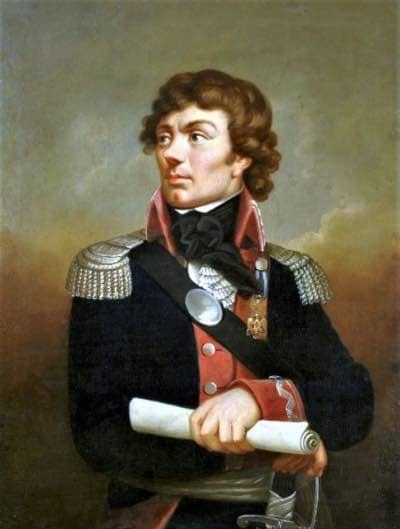
In March 1778, Washington awarded Kościuszko his most important assignment to date:
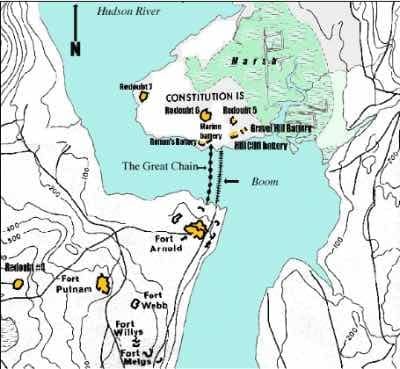
Fortify West Point on the Hudson River.
The mighty Hudson River stretches from New York City on the East coast all the way back through New York State to just 80 miles short of the Canadian border at Lake Henderson in the Adirondack Mountains.
With primitive roads, the Hudson was a liquid highway. Control the Hudson and you controlled the movement of troops, artillery and supplies.
From a British perspective, the Hudson River separated New England—the spark of the revolution north of the river—from the middle and southern colonies. The South provided food, raw materials and manpower.
Control the river, split the colonies in half and the rebellion would collapse.
From the American perspective, West Point represented the strategic pinch point of the river, an S-bend with prominent high ground all around—a natural fortress the Americans had so far failed to hold.
If Kościuszko could fortify the site properly, British ships would have to crawl upriver under a hail of cannonfire.
Instead of trying to build one mega-fort to defend the river, Kosciuszko built 30 individual forts and redoubts at different heights, overlapping each other. Any British attack by ship or land would face a gauntlet of cannon fire from multiple angles. It was almost impossible to breach.
Kościuszko’s solution was the first decentralised defensive fortification system in Western military history.
Kościuszko also supervised installation of the Great Chain—65 tons of iron stretched across 600 yards of river from West Point to Constitution Island, a physical barrier to block British ships from sailing further upstream.
In the end, the resourceful Pole’s fortifications worked perfectly—which is to say, West Point never fired a shot. The British took one look and stayed away.
Out of Curiosity
The Revolutionary‑War fortress at West Point became the site of the United States Military Academy in 1802. The US Army has occupied the site ever since.
A monument was completed in 1913 to the honour of the ’patron saint of West Point’.
Stage 5—Rinse & Repeat
Kościuszko returned to Poland in 1784 to find his country being methodically erased. The First Partition of 1772 had allowed Russia, Prussia and Austria to carve off pieces of the Polish-Lithuanian Commonwealth.
A second, more savage partition followed in 1792. Poland was being erased from existence. Kościuszko stepped forward.
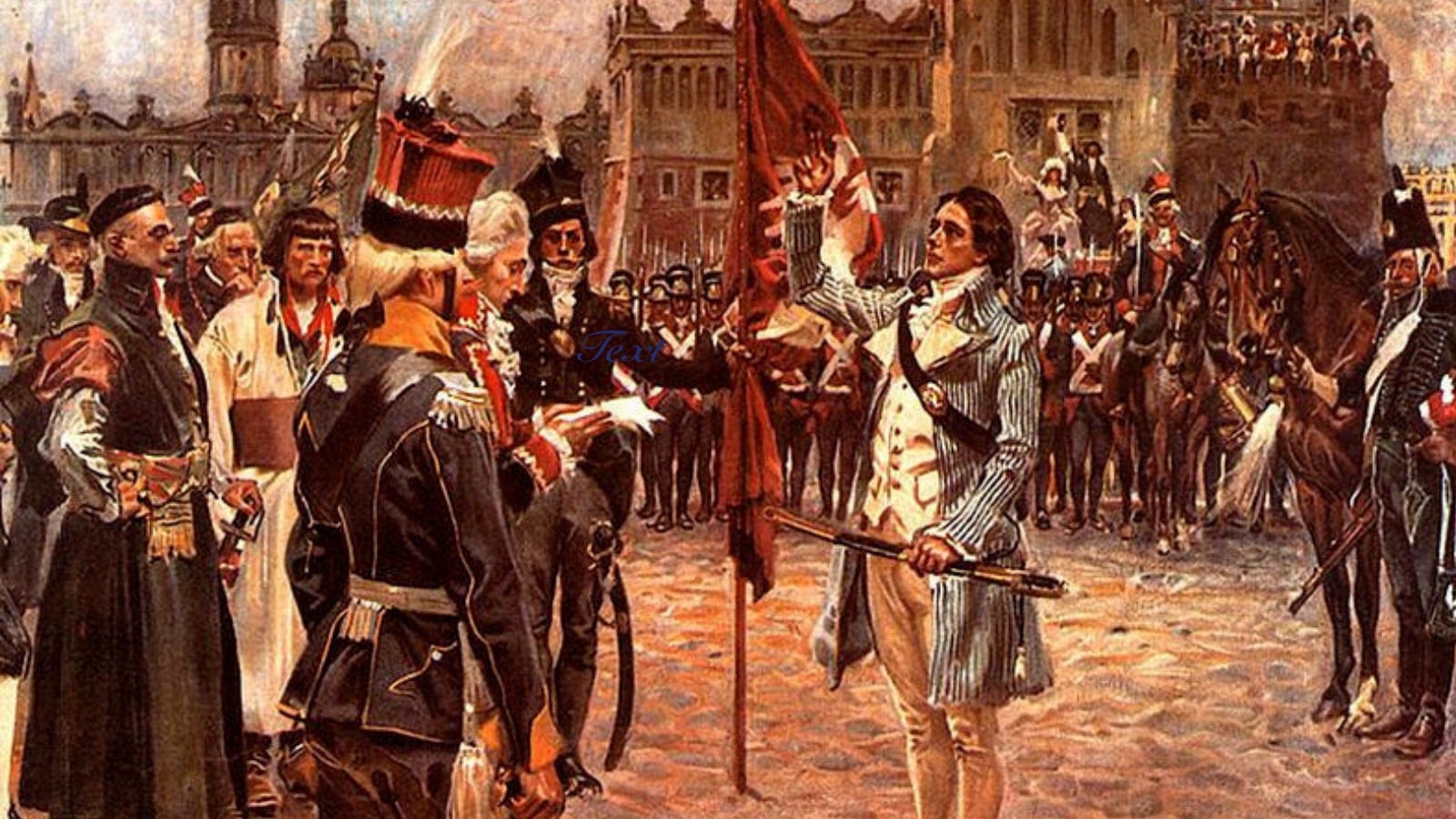
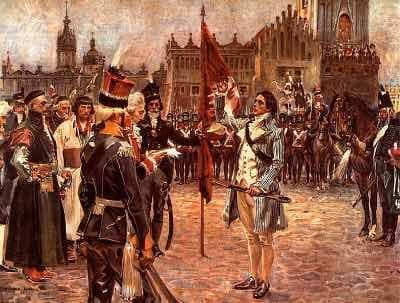
On 24 March 1794, he stood in Kraków’s main square before an enormous crowd and took the oath as commander-in-chief of all Polish forces.
The Kościuszko Uprising had begun.
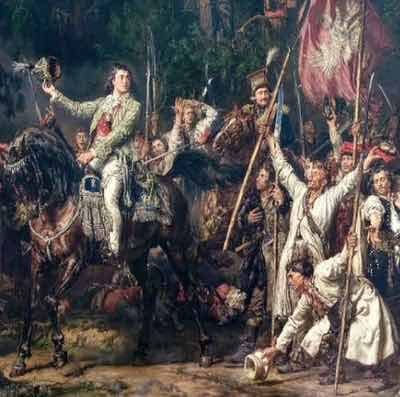
Kościuszko had the rare ability to unite peasants, soldiers and nobility in common cause. At the Battle of Racławice in April 1794, 2,000 scythe-wielding peasants fought alongside 4,000 regular troops and defeated the Russian army.
In their honour, Kościuszko addressed his army wearing a ‘sukmana’—traditional Polish peasant clothing.
That image—a Paris-educated engineer in peasant clothing—became the defining symbol of the uprising. Kościuszko wasn’t just honouring the farm workers; he was demolishing centuries of social hierarchy with a single costume change.
Inevitably, the uprising eventually collapsed. The Poles simply ran out of ammunition. Kościuszko, wounded and captured, was imprisoned in St. Petersburg while Warsaw fell. Russia, Prussia and Austria carved up what remained—Poland vanished from the map for 123 years.
Pardoned by Tsar Paul I, Kościuszko spent time in America before settling in Europe. When Napoleon offered him command of Polish forces in 1799, Tadeusz declined. He was done fighting.
Following complications from a fall from his horse, Tadeusz Kościuszko died in Solothurn, Switzerland, in October 1817. He was 71 years old.
Out of Curiosity
While in America, Tadeusz Kościuszko befriended Thomas Jefferson who said of him that he was ‘as pure a son of liberty as I have ever known, and of that liberty which is to go to all, and not to the few or the rich alone.’
In 1798, while sailing back to America, Kościuszko wrote a will leaving his entire American estate to Thomas Jefferson.
The instructions were explicit: use the money to buy enslaved people their freedom—from Jefferson’s own property or elsewhere—then educate them and prepare them for independent lives as citizens.
