



30 December 1865
(read time: 7 mins.)
Rudyard Kipling’s writing reveals a contradiction that ran through him like lettering through a stick of Blackpool rock. Kipling was an imperialist to his core. He believed Western empires had a duty to bring order to the world. So how come “You’re a better man than I am, Gunga Din”?
If you were to imagine the life of one of literature’s most celebrated poets, you might picture an introverted soul penning verses in a cramped Parisian apartment, nursing a glass of absinthe in some dimly lit café or hunched over a notebook in an opium-hazed London tavern.
You might not picture a man who was born in Bombay, spent his formative years being systematically abused by foster parents, befriended kings and presidents, and lived with a deep-rooted contradiction that would define everything he wrote.
But that was Rudyard Kipling.
Joseph Rudyard Kipling
…was born on 30 December 1865, in Bombay—now Mumbai—during the early decades of the British Raj. This was the period between 1858 and 1947 when the British imposed colonial rule over India, though British interference under the guise of the East India Company stretched back to 1600.
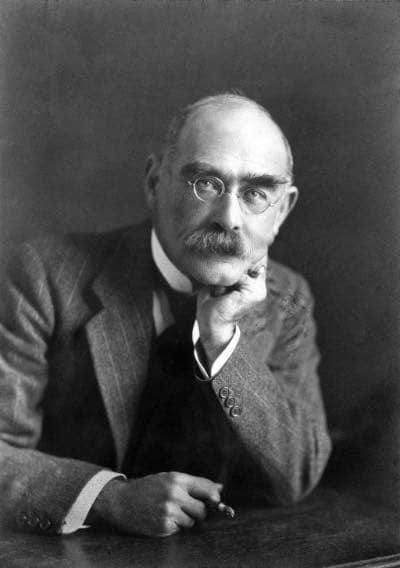
Kipling was born into a life of privilege. His father was a professor of architectural sculpture at the Bombay School of Art. He was cared for by Indian servants who indulged his every whim.
In the 1860s, the British Empire was still building a head of steam. Apart from direct rule in India, it held other colonies across the globe, laying the groundwork for later expansion into Africa, Southeast Asia and the Pacific.
In 1871, at five years of age, Kipling’s idyllic existence received a jolt.
Rudyard’s parents shipped him and his younger sister back to England. Standard practice—India’s climate and diseases weren’t kind to British children. What happened next, however, was anything but standard.
Rudyard and his sister were placed in a foster home in Southsea. For the next six years, Rudyard was physically and psychologically abused. He would be beaten and spend regular periods in dark, solitary confinement.
By the time his horrified mother returned to England in 1877, the damage was already done. The scars of sustained cruelty would haunt him for the rest of his life.
Rudyard Kipling the storyteller
At United Services College in Devon, a military preparatory school, Rudyard proved hopeless at soldiering but brilliant at storytelling. He discovered a talent for writing stories that readers couldn’t put down. The boy who couldn’t shoot had found his weapon of choice.
Out of Curiosity
Rudyard Kipling was a first cousin to future British Prime Minister Stanley Baldwin. He was also a good friend of US President Theodore Roosevelt.
Rudyard returned to India to work as a journalist before turning seventeen. Over the next seven years, he wrote at a furious pace—short stories, newspaper columns, anything with a deadline. He captured the landscape, the people, the beauty and the brutality of imperial India.
When Kipling returned to London in 1889, he became a literary sensation almost overnight. Works like ‘The Ballad of East and West‘ and ‘Gunga Din‘ captured the British imagination. Critics were comparing him to Lord Byron and Alfred, Lord Tennyson—heady company for a man barely into his twenties.
Kipling moved effortlessly between soldier ballads and Indian tales, between verse and prose. The British public devoured it all. They were hungry for stories from the far-flung empire and Kipling—with his intimate knowledge of India—was perfectly placed to feed them.
1890 was Rudyard Kipling’s year.
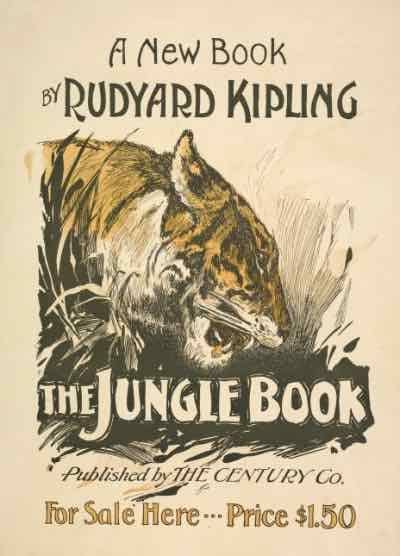
A couple of years later, after marrying American Caroline Starr Balestier in London, Kipling moved to her family’s corner of Vermont. There he wrote The Jungle Book (1894)—instant literary immortality.
But immortality wasn’t enough for Rudyard. He kept writing, kept pushing. His fame extended across Europe, Russia and North America through the 1890s.
In 1907, Kipling won the Nobel Prize for Literature at just 41 years old.
The white man’s burden and Gunga Din
If you first encountered Kipling’s works and read just two of his greatest hits—The Jungle Book and the barrack‑room ballad ‘Gunga Din‘—you would wonder how the same imagination could inhabit worlds so far apart.
You would also discover a contradiction that ran through Kipling like lettering through a stick of Blackpool rock.
Kipling was an imperialist to his core. He believed Western empires had a duty to bring order to the world. The British Empire wasn’t just defensible—it was morally necessary.
In ‘The White Man’s Burden‘, he urged the United States to take up colonial rule in the Philippines as a moral duty toward their ‘new-caught, sullen peoples, half-devil and half-child’.
Yet he could write with profound respect for individuals from those same ‘sullen peoples’—praising their courage, dignity and resilience in ways that seemed to contradict his own imperial beliefs.
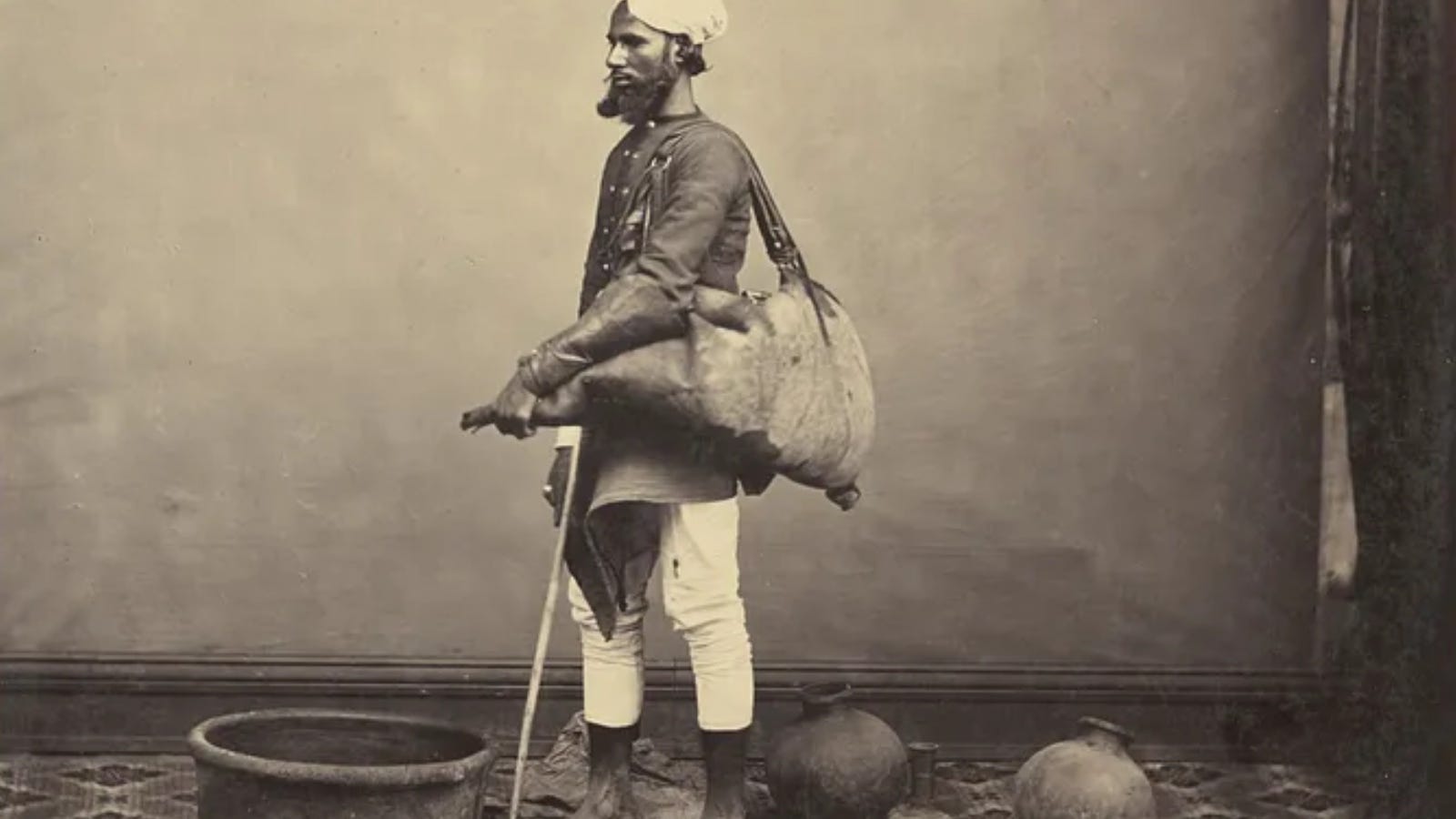
In ‘Gunga Din’, a British soldier recalls how his Hindu bhishti—a low-status water carrier—is routinely beaten, mocked and insulted as he drags the soldier’s goatskin bag through brutal heat and battle.
Despite this, when he is shot and left ‘mad with thirst‘, Gunga Din selflessly rushes through enemy fire to bring him water, bandage his wounds and carry him to safety.
In the act of rescue, the humble bhishti takes a bullet. As he lies dying, the soldier finally grasps what should have been obvious all along:
Though I’ve belted you and flayed you,
By the livin’ Gawd that made you,
You’re a better man than I am, Gunga Din!"
Doublethink
In George Orwell’s ‘1984‘—a thinly veiled critique of totalitarianism set in the fictitious Oceania—he introduces the concept of ‘Doublethink‘:
…to hold simultaneously two opinions which cancelled out,
knowing them to be contradictory and believing in both of them.
Was Kipling guilty of Doublethink?
Perhaps. But in his imperial worldview, there was no contradiction: a low‑caste Indian water carrier could be the better man, yet still belong to a people who must be ruled.
By 1910, Kipling remained widely admired across the English-speaking world. But British imperialism had overextended itself and was creaking under pressure from colonial resistance. His imperial beliefs were now marking him as a divisive figure—the ‘poetic voice of a racist empire‘.
Which makes it all the more extraordinary that Rudyard’s most famous work, published that same year, would transcend this growing antipathy to become one of the most enduring poems in English literature.
If—
On 29 December 1895, Dr Leander Starr Jameson, a close ally of Cecil Rhodes, led the ill‑fated Jameson Raid from Bechuanaland (Botswana) into the Transvaal—a botched incursion that inflamed tensions and helped set the stage for the Second Boer War.
The unauthorised raid staggered on for just five days when Jameson surrendered and was shipped back to Britain to face trial and a brief spell in prison.
Keep calm and carry on.
Kipling was fascinated by Jameson’s resilience in the face of total humiliation—his self-control, his refusal to complain, his tenacity in dusting himself off and starting again. (Jameson went on to become Prime Minister of the Cape Colony in 1904.)
It was this resilience that inspired Rudyard to write his most iconic work, ‘If—‘.
The poem is a guide to being a decent human being in an indecent word, to staying upright when the world is tilting sideways. Some of those lines have become among the most quoted in the English language:
If you can meet with Triumph and Disaster
And treat those two impostors just the same;
If you can fill the unforgiving minute
With sixty seconds’ worth of distance run,
Yours is the Earth and everything that’s in it,
And—which is more—you’ll be a Man, my son!
‘If—‘ was later published in 1910 in Kipling’s collection, ‘Rewards and Fairies‘.
The poem was an immediate hit; reprinted in newspapers, quoted in speeches and taught in schools. British officers memorised it as a personal code of conduct. When World War I broke out four years later, ‘If—‘ became the definitive morale-boosting text.
