


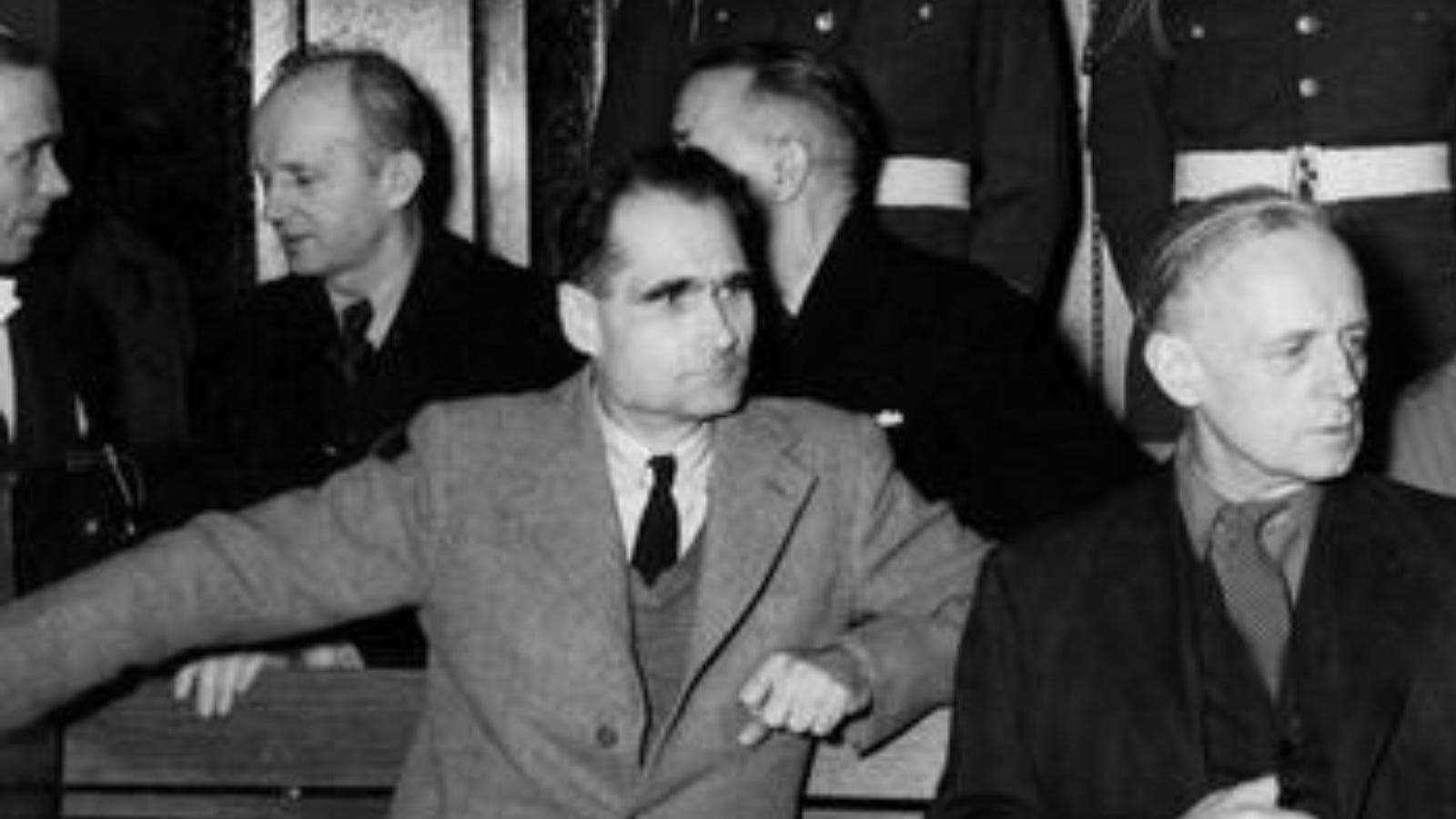

10th May 1941
(read time: 11 mins.)
Rudolf Hess had Hitler’s ear, his loyalty and his protection. But Hess was out of his depth. The Deputy Führer was—in practice—a loyal puppy in a room full of hungry wolves. To resurrect himself, Hess hatched a one-man plan. With the support of his anonymous astrologer, he would fly to Scotland, arrange an audience with King George VI and broker a peace settlement between two countries currently bombing each other flat. What could possibly go wrong?
Last Friday, we celebrated the 100th birthday of Sir David Attenborough—broadcaster, naturalist and all-round good egg—which fell, rather beautifully, on the same day as the anniversary of VE Day, marking the end of the Second World War in Europe.
Last year marked the 80th anniversary of Victory in Europe Day, and with so few veterans still with us, we were flooded with stories from the war even more so than normal—the strategic successes and the catastrophic blunders, the fine margins that separated defeat from victory, the individual acts of heroism that still take the breath away.
And then there were the other stories.
Alongside the courage and the sacrifice, the Second World War produced a remarkable collection of tales no novelist would have dared submit to a publisher.
I have written recently about Karl Adolf Schlitt, the German U-boat commander whose submarine was sunk by a toilet malfunction, and about William of Orange—the carrier pigeon, not the former King of England—whose flights from the front lines saved thousands of lives.
There are plenty more where they came from. What about the British ‘corpse spy’ Glyndwr Michael, whose floating body hoodwinked the Germans in Operation Mincemeat, or ‘Mad Jack’ Churchill, the British commando officer who charged into battle armed with a Scottish broadsword and bagpipes—presumably on the basis that if the sword didn’t finish them off, the bagpipes probably would.
Then there were the Monuments Men—a ragtag collection of museum directors, artists and curators who raced across Europe rescuing millions of stolen artworks from Nazi hideouts, armed with little more than maps and trucks.
And what about the secret American unit of artists, engineers and radio operators who conjured entire phantom armies from inflatable tanks, forged radio traffic and theatrical sound effects, leaving the Germans chasing shadows across the French countryside.
Remarkable, every one of them.
But there is one story I have always found quite extraordinary, which I don’t think has ever received quite the attention it deserves. It involves a senior Nazi official, a Messerschmitt, a field in rural Scotland and one very surprised Duke.
Rudolf Walter Richard Hess…
…was born on 26 April 1894 in Alexandria, Egypt—a rather unlikely birthplace for one of the most senior figures in the Third Reich. His father, Fritz, ran a prosperous export business there, and Rudolf grew up in a comfortable villa on the Mediterranean coast, cocooned in the orderly, self-contained world of the German merchant class abroad.
It was a pleasant enough childhood which took a turn in 1908 when, at the age of 14, Rudolf was packed off to a boarding school in Bad Godesberg, a borough of the city of Bonn, back in the motherland. It was there that he absorbed the culture, the language and—rather less helpfully, as it turned out—the politics that would come to define him.
The question of Hess’s intelligence has never been entirely settled. He attended university, wrote coherently throughout his life and was held in genuine esteem by his intellectual mentor, Karl Haushofer. So far, so promising.
On the other hand, he has been described as credulous, impressionable and prone to ‘magical thinking‘—a man who put his faith in astrology, alternative medicine and conspiracy theories. He used divining rods to check for underground water before sleeping, hung magnets above his bed and was a devoted enthusiast of telepathy and mesmerism, the rather whacky 1770s treatment for mental illness practised by Franz Anton Mesmer, which I wrote about last week.
Rudolf also demonstrated a spectacular talent for misjudging both people and situations. For the record, the man whose trust he craved above all others was a certain Adolf Hitler. And then there was the issue of Scotland… but we’ll come to that.
First World War
When the First World War broke out in 1914, Hess enlisted in the 7th Bavarian Field Artillery Regiment before transferring to infantry service. He was wounded twice—once by shrapnel at Verdun in 1916 and again by a bullet through the chest in 1917.
At this point, he was transferred to the German Flying Corps as a pilot trainee in October 1918, though the war ended before he could distinguish himself in the air.
It was a solid if unspectacular war record—a detail Hess would spend the next two decades trying to reshape.
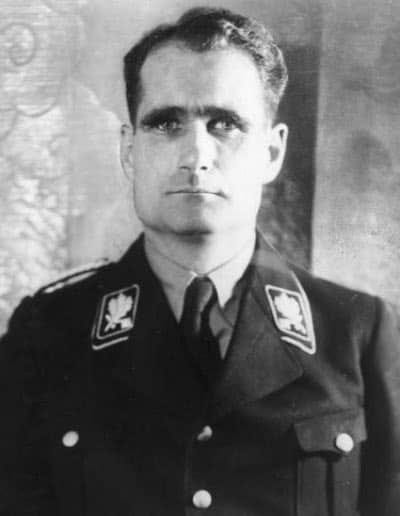
Munich 1920—a city simmering
After the war, Hess drifted into the ferment of post-war Munich—a “bubbling cauldron of resentment, nationalism and dangerous ideas“.
He enrolled at Munich University in 1919, where he fell under the spell of Karl Haushofer, a geographer and political theorist whose teachings on Lebensraum—the idea that a nation required living space to survive and grow—would become one of the intellectual cornerstones of Nazi ideology.
But it was another Munich figure who would define the rest of Hess’s life.
In early 1920, Adolf Hitler was making a name for himself delivering speeches for the German Workers’ Party at small gatherings in Munich beer halls. He spoke passionately about the humiliation of Versailles, the betrayal by Jews and Marxists and the need for national renewal.
Rudolf Hess attended one of these early speeches and was, by all accounts, transfixed. He joined the newly-formed National Socialist German Workers’ Party (the Nazi Party) that same year, becoming member ‘number 16’. He was among the inner circle at the failed Beer Hall Putsch of November 1923—the shambolic attempt to seize power in Munich that ended with gunfire in the streets, Hitler’s arrest and Hess fleeing to Austria.
Out of Curiosity
Lebensraum—literally ‘living space‘—was a concept developed by the German geographer Friedrich Ratzel in the 1890s.
Ratzel’s original idea was ecological rather than political. He observed that all living organisms—plants, animals, people—naturally expand to fill the space available to them, and contract when that space is reduced.
He applied this logic to nations, arguing that a healthy, vibrant state would inevitably need to expand to support its growing population. It was an argument about resources—farmland, food production and access to raw materials—not about conquest or racial superiority. Ratzel was, in his own mind at least, simply doing geography.
Karl Haushofer refined and personalised the idea, identifying the fertile plains of Eastern Europe and western Russia as the logical direction for German expansion. Hess, his most devoted student, was captivated.
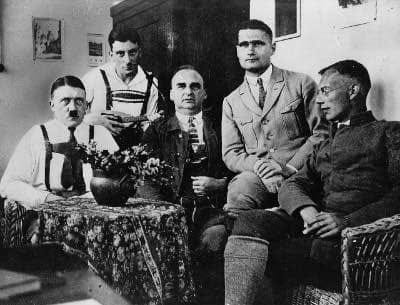
It was Hess who carried the idea into Landsberg Prison in 1924, where he and Hitler were serving time together. Hitler wove the concept into Mein Kampf—his two-volume political manifesto-cum-extended rant. What had begun as a geographer’s quiet hypothesis had been repackaged as racial destiny and imperial imperative.
Haushofer lived to see what his ideas had helped to unleash. His son Albrecht was arrested for his part in a plot to assassinate Hitler and shot dead in the street by the SS in the final days of the war. Haushofer himself spent a short period imprisoned at Dachau concentration camp. Unable to bear Albrecht’s death, he and his half-Jewish wife Martha took their own lives together at their Bavarian estate soon after the war.
Hess, Hitler and Landsberg Prison
Hitler had been arrested two days after the Putsch collapsed.
Rudolf slipped out of Munich in the immediate chaos, took brief refuge with the Haushofer family and fled across the border into Austria. Haushofer convinced him that staying in exile would look cowardly and that Hitler needed his loyal lieutenant beside him in the dock.
Hess returned, was arrested, tried and sentenced to Festungshaft—fortress confinement—at Landsberg Prison.
Rudolf found himself in confinement with Hitler. Up to this point, his relationship with Hitler could be described as intensely admiring and subordinate. By the time he had left Landsberg Prison having acted as private secretary and transcriber for Hitler’s Mein Kampf, he was less a political colleague of the future Führer and more a devoted disciple—a lapdog who had found his owner and would follow him anywhere.
Hess’s slide
Through the 1930s, Hess had been a climber. By 1933 he was Deputy Führer, and in 1935 a signatory to the Nuremberg Race Laws—the legal backbone of Nazi racial policy.
He had Hitler’s ear, his loyalty and his protection.
But Hitler had reached a verdict on Rudolf. Surrounded by the cold ambition of Hermann Göring, the bureaucratic menace of Heinrich Himmler and the ruthless political instincts of the rising Martin Bormann, Hess looked like a man out of his depth. He was still Deputy Führer in name, but in practice was a loyal puppy in a room full of hungry wolves.
Rudolf was being sidelined. The man who had transcribed Hitler’s manifesto was no longer being invited to the meetings where history was being decided.
The idea
The Deputy Führer had long harboured a belief—shared, to a degree, by Hitler himself in the early stages of the war—that Britain and Germany need not be enemies. The real enemy, in this worldview, was Soviet Russia. A negotiated peace with Britain would free Germany to turn east without the ruinous burden of fighting on two fronts.
Simple enough in theory.
There was, however, a small chink in this idea. Nobody in the British government had asked for his opinion—a detail about which a lesser man might have taken the hint.
Instead, Rudolf Hess would take to the skies.
He hatched a one-man plan. He would fly to Scotland—alone, uninvited, unannounced and, as it turned out, unwanted—land on the estate of the Duke of Hamilton, convince him to arrange an audience with King George VI and broker a peace settlement between two countries that were, at that precise moment, engaged in bombing each other flat.
What could possibly go wrong?
