


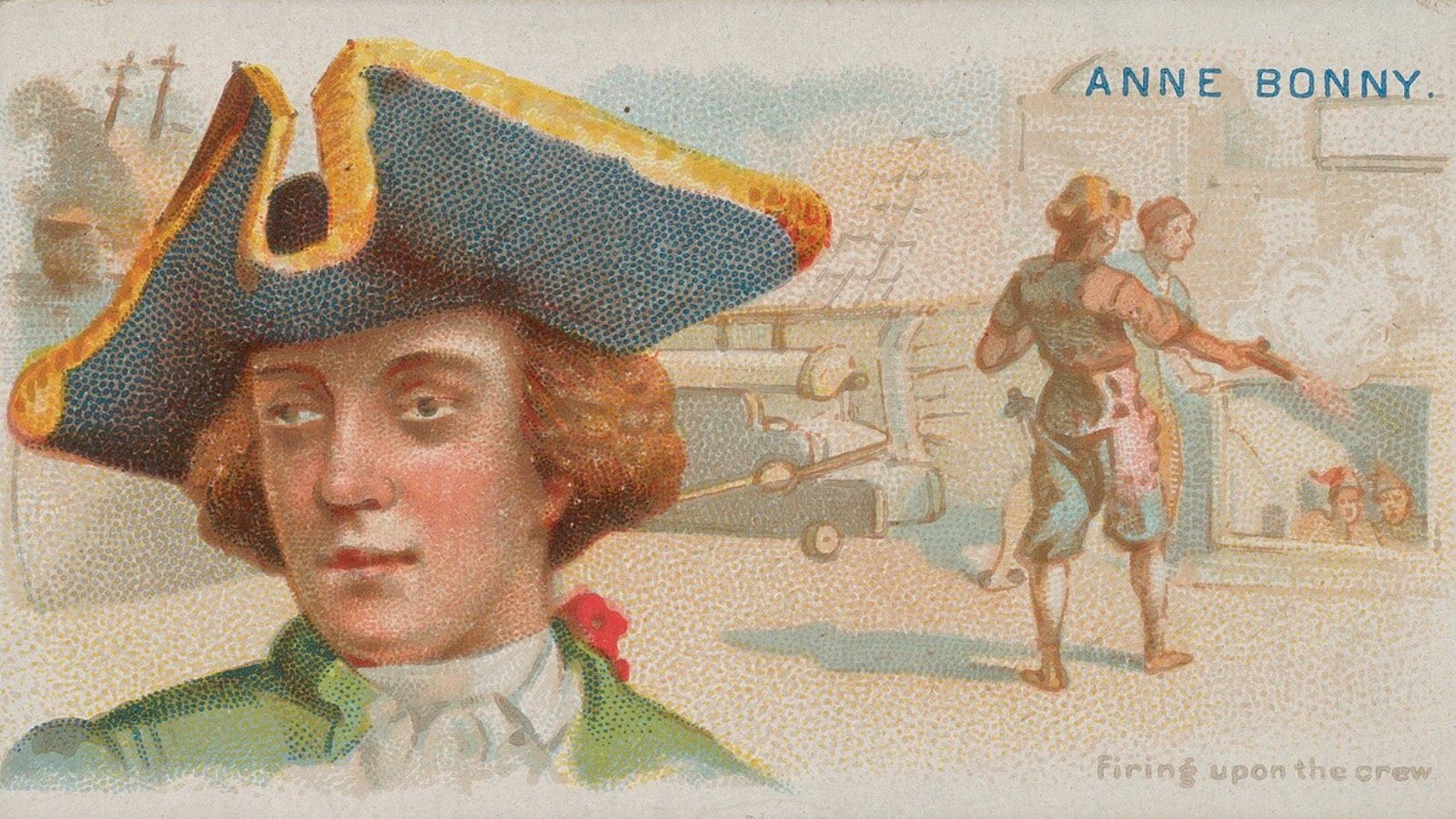

28th November 1720
(read time: 2 mins.)
On 28 November 1720, pirate Anne Bonny stood trial in Spanish Town, Jamaica, charged with piracy on the high seas. She was ‘pleading the belly’—seeking immunity on the grounds of being pregnant. Not surprisingly, the less-than-scientific testing received the derision it probably deserved.
The year 1720 was a bad year for the pirates of the Caribbean. The Royal Navy had finally yielded to pressure from London’s merchants whose export profits were dwindling. They called in the pirate hunters.
High on the wanted list was an unlikely culprit…
Anne Bonny
Anne was born around 1697 in County Cork, Ireland, the illegitimate daughter of a wealthy lawyer and the housemaid. She grew up in relative comfort until scandal struck—she had married a small-time privateer, James Bonny.
The marriage lasted just long enough for Anne to be disinherited by her father. In 1719, she abandoned her good-for-nothing husband for ’Calico Jack’ Rackham.
Rackham was a budding pirate who earned his colourful nickname from his fondness for calico cotton clothing, rather than any daring deeds on the high seas.
Together they pilfered the sloop ‘William’, assembled a ragtag crew and set sail from Nassau Harbour on a brief but notorious spree—raiding fishing craft and coastal traders from the Bahamas to Jamaica.
Anne had befriended another woman from the crew, Mary Read, who had been disguising herself as a man. They became fierce friends and even fiercer pirates.
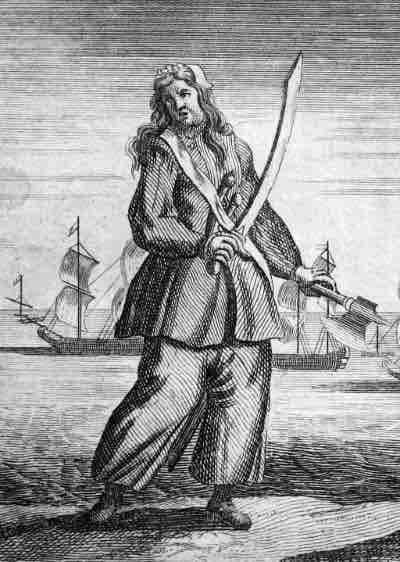
When they raided other boats, the woman wielded their cutlasses and pistols while Calico Jack and many of the male crew were pickling in rum below deck.
One night in October 1720, the party ended. Pirate hunter Captain Jonathan Barnet cornered Calico Jack’s sloop off the coast of Jamaica. With only Anne, Mary and a few conscientious men to put up any meaningful resistance, the sloop was soon overwhelmed.
Pleading the belly
On 28 November 1720, Anne Bonny and Mary Read stood trial in Spanish Town, Jamaica, charged with piracy on the high seas. The evidence was damming. The verdict was swift. Guilty.
Then came the twist.
Anne and Mary were ‘pleading the belly’. By declaring themselves pregnant, the women would be reprieved from the gallows if an inspection by a ‘jury of matrons’ agreed that they were, indeed, pregnant.
In this pre-pregnancy test era, this inspection involved nothing more than prodding and poking the abdomen to detect foetal movement. Not surprisingly, the less-than-scientific testing received the derision it probably deserved.
One physician, who had presumably had his nose put out of joint, bemoaned that women weren’t very effective at detecting their own pregnancies, let alone anyone else’s. In Daniel Defoe’s Moll Flanders published just two years later, the eponymous heroine admits she’s “no more with child than the judge that tried me”.
The only recorded evidence for both ladies being ‘quick with child’ was the cutting-edge observation that their breasts seemed rather large. Which raises the obvious question: compared to what, exactly?
Fortunately for Anne and Mary, that line of enquiry seems to have been overlooked and they were reprieved from the gallows, temporarily at least.
We will never know if either woman would have received the ultimate penalty. Mary died from fever in prison a year later, while Anne Bonny simply disappeared from the records.
Bonny’s farewell to her lover, Calico Jack, the night before his execution, did warrant recording for posterity; On her final visit to the beleaguered sot, Bonny scowled….
If you had fought like a man, you need not have hanged like a dog.
Who ever said romance is dead.

Thank you for joining me.
Steve
HOST & CHIEF STORY HUNTER
ATTRIBUTIONS
Anne Bonny: Engraved by Benjamin Cole[2] (1695–1766), Public domain, via Wikimedia Commons.
Anne Bonny, Firing Upon the Crew, from the Pirates of the Spanish Main series (N19) for Allen & Ginter Cigarettes. Geo. S. Harris and Sons, CC0, via Wikimedia Commons.
![Benjamin Cole[2]](https://commons.wikimedia.org/wiki/File:Ann_Bonny,_Cole_1724.jpg)
_for_Allen_%26_Ginter_Cigarettes_MET_DP835030.jpg)
CC0: https://creativecommons.org/public-domain/cc0/