



28th January 1871
(read time: 8 mins.)
Otto von Bismarck didn’t attempt to storm the city—he settled in for a siege, cutting off all supply routes. The Siege of Paris. Nothing came in. Nothing went out. By late January, the situation had become unbearable. Bread rations were reduced to a bare minimum. Fuel was so scarce that Parisians were chopping down trees in the parks and burning their furniture. On 28 January 1871, an armistice was signed. The 132-day siege was over.
I turn on the news with trepidation these days. There will be talk of shifting power balances, the rise of new empires and the demise of others. I will hear about spheres of influence and redrawn borders. Alliances are made and unmade. World leaders reach for war-war before jaw-jaw.
It all feels rather modern and urgent.
But 155 years ago, Europe was playing the same game—just with different flags and rather more elegant moustaches.
The nation-state itself—that apparent timeless building block of international relations—is also a modern construction. For most of human history, people have identified with their city, religion or ruler, not with some abstract concept of national identity.
In 19th-century Europe, a cluster of forces had come together to change all that.
Centuries of printing had spread and standardised languages. Now, railways, steamships and telegraph lines weaved distant regions together, while the Industrial Revolution demanded much larger, integrated markets, protected by armies to match.
The idea that Italians should unite under one flag rather than remaining Venetians, Florentines or Neapolitans was bold—and to many, absurd. That Germans should prioritise being German over being Bavarian or Prussian was equally radical.
Someone had to be among the first architects of this new European order.
One of those architects turned out to be a Prussian aristocrat, Otto von Bismarck. He would seek to unite Germany through a masterclass in manufactured conflict.
Bismarck understood—as do many authoritarian leaders today—that to unite a nation, you needed to offer up a common enemy.
Otto Eduard Leopold von Bismarck…
…was born on 1 April 1815 in Schönhausen, Prussia. He came into this world less than three months before Napoleon Bonaparte’s final defeat at Waterloo.
The timing was poetic. Napoleon had spent nearly 20 years carving out a French‑dominated empire, marching across Europe in an attempt to bind reluctant peoples under French rule. He failed spectacularly.
Otto would use similar tools—war, diplomacy and pressure—to stitch together a patchwork of kingdoms, duchies and principalities into something that had never existed before: a unified Germany.
The map of Europe was about to be redrawn, and the baby born on April Fool’s Day would have the last laugh.
The Bismarck family were Prussian landed nobility (‘Junkers’), squires of the Schönhausen estate and part of the rural aristocracy that supplied so many officers and officials to the Prussian state.
Otto’s childhood was divided between his father’s country estate and his mother’s more polished, bureaucratic world in Berlin.
The young Bismarck was more suited to the former. At the universities of Göttingen and Berlin he studied law. He was marked as a capable student but also as a rebel. While studying, he drank, gambled and fought numerous duels.
Whatever his obvious gifts, Bismarck proved a mediocre lawyer and a less-than-exemplary estate manager. His heart was just not in it.
But then he pivoted into politics: a staunch conservative who defended the monarchy and aristocratic privileges against liberal reformers.
Bismarck’s strength… a sharp tongue and a brutal, mocking wit that reduced opponents to silence, akin to the cut-and-thrust of a Disraeli or Palmerston.
Postings to Frankfurt and then St Petersburg around 1860 transformed the brawling Junker into a European statesman. He understood how Europe’s great powers manoeuvred, negotiated and, when necessary, went to war.
Bismarck learned how to read the room. And that room was an entire continent.
Bismarck delivers “iron and blood”
In 1861, Wilhelm I became King of Prussia. He immediately faced a constitutional tangle over proposed military reforms. His plans were being blocked by the liberals.
Wilhelm needed a political plumber to unblock the deadlock. He needed Bismarck.
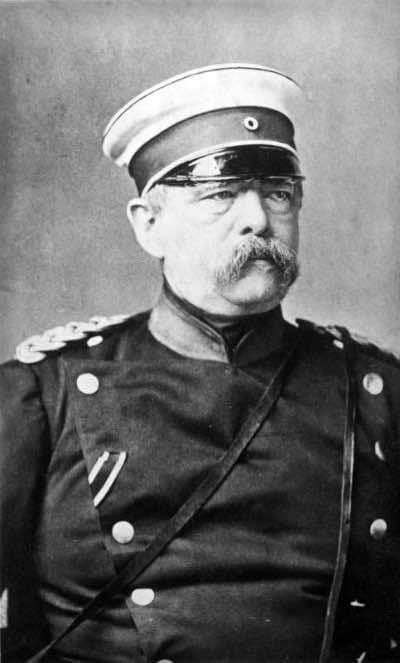
Within days of being appointed Minister President in 1862, Bismarck wasted no time in declaring that the great questions of the day would not be settled by speeches and majority votes, but by “iron and blood.”
Iron and blood it was. First came the Danish-Prussian War (1864). Then, the seven-week Austro-Prussian War (1866) when the Austrians were ejected from German politics entirely.
Which left France.
Bismarck would wait patiently for an opportunity to present itself. Like a crocodile at a waterhole, he lay in wait for the French to lean in for a drink, his eyes just above the waterline, ready to strike.
Four years had passed when a Prussian prince was offered the Spanish throne in 1870—Napoleon III’s nightmare scenario: France surrounded by German influence.
The Ems Despatch
On 13 July 1870, the French ambassador to Germany approached King Wilhelm while walking in the spa town of Ems to discuss the matter. The ambassador demanded that the Spanish offer should not be accepted. Wilhelm politely declined. The meeting was cordial and a telegram describing this civil exchange was sent to Bismarck.
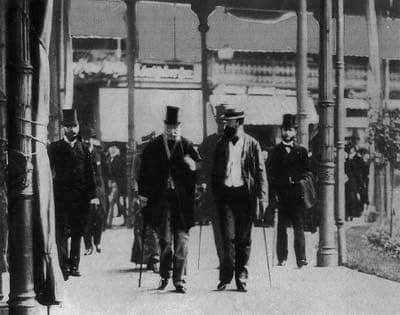
The crocodile struck. Bismarck revised the telegram. He stripped out the courteous language, reducing the meeting to a stream of mutual abuse—the King dismissing the French ambassador with contempt, the ambassador storming off in outrage and so on.
Bismarck released the revised version to the press.
He had invented the rage-bait tweet, 150 years before ‘X-formerly known as Twitter’ existed. He understood what modern social media executives know instinctively: nothing spreads faster than manufactured outrage.
The doctored ‘Ems Dispatch’ went viral—via telegraph rather than retweet. Both sides’ honour was on the line. Within days, the French and Prussian public were baying for war.
France declared war on 19 July 1870.
The French expected a quick victory, but the Prussian military machine crushed their forces in a series of devastating battles. The Prussian army arrived at the gates of Paris on 19 September 1870 and encircled the city.
What followed was one of the most extraordinary sieges in modern history.
The Siege of Paris 1870-71
Paris in 1870 was Europe’s most glamorous city, home to two million people. The city prided itself on its cuisine, its culture, its sophistication. None of which prepared Parisians for what was coming.
The Prussians didn’t attempt to storm the city—they settled in for a siege, cutting off all supply routes. Nothing came in. Nothing went out.
Well, almost nothing.
The ingenious Parisians improvised a postal service using hot-air balloons. Two and a half million letters and—gloriously—one Interior Minister, Léon Gambetta, successfully drifted over the Prussian lines.
Some of the balloons landed in Belgium, one in Norway and two disappeared over the sea, though not Léon Gambetta, who landed safely near Tours in the Loire Valley, 150 miles southwest of Paris.
For the return post, the French used carrier pigeons. Tiny photographic reductions of messages—microfilm, essentially—were attached to the birds’ legs.
It was brilliantly innovative, but utterly useless for feeding two million people.
Parisians starve
By October, the food situation was becoming serious. By November, it was desperate. By December…
The butchers ran out of beef, then mutton, then pork. The price of horse meat skyrocketed. When they ran out of horses, Parisians ate donkeys. Then mules.
Then dogs and cats. Over time, rats became a delicacy. Restaurants served rat pie and pâtés de rat.
Even two elephants from a local zoo—Castor and Pollux—were slaughtered and sold to butchers. Apparently, trunk is a little tough and, at forty francs a pound, rather disappointing.
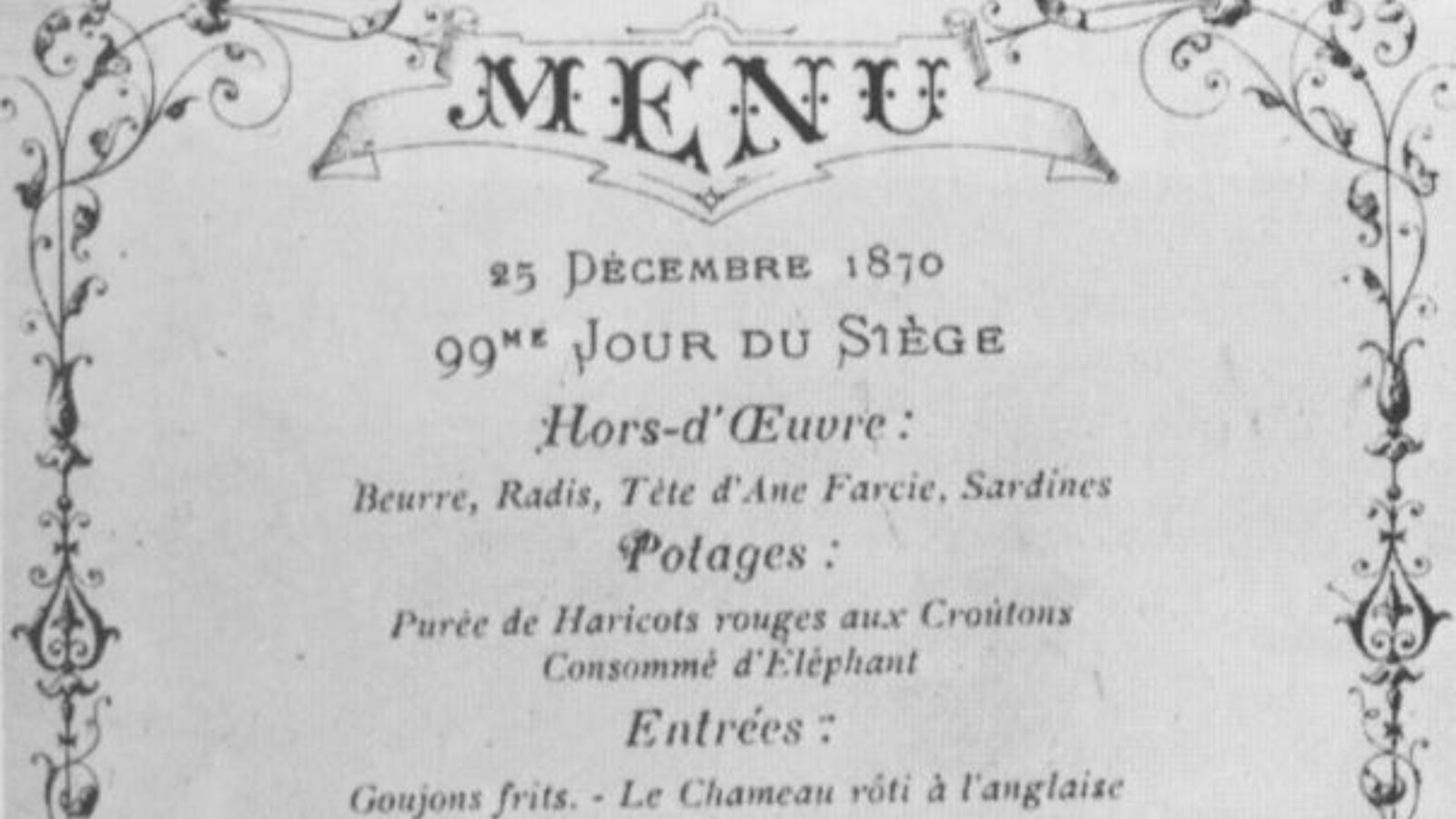
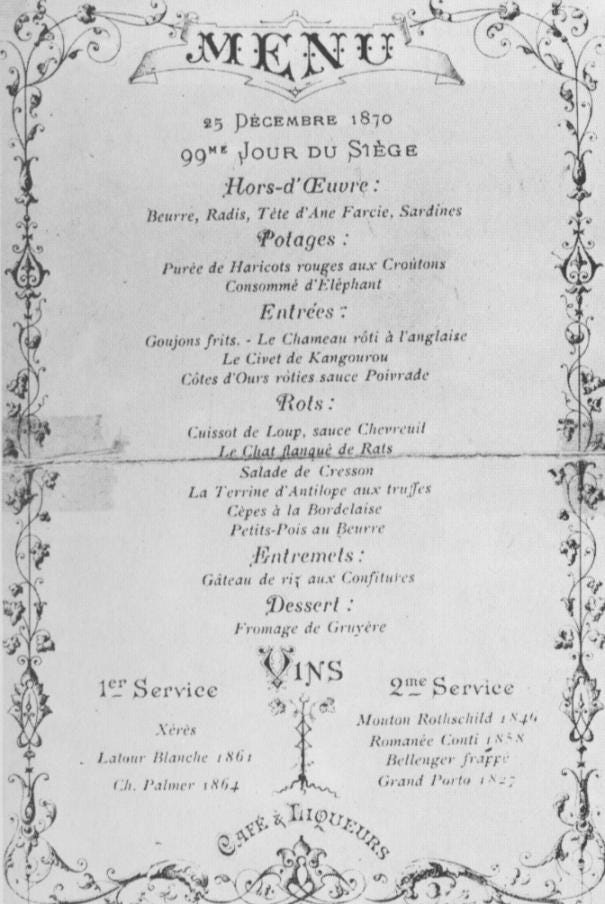
The absurdity reached its peak on Christmas Day 1870, when Voisin’s, one of Paris’s finest restaurants, served ‘stuffed donkey’s head, elephant consommé, roast camel, antelope terrine and bear chops in pepper sauce’.
Kangaroo stew was also on the menu, though it is not clear whether the marsupial came from the Jardin d’Acclimatation (i.e. the zoo) like the others, or whether it had inadvertently hopped over the siege wall in a moment of exceptionally poor navigation.
Prussian artillery bombarded the city. Civilians died and the psychological impact took its toll. Morale slumped. Deaths from malnutrition and disease climbed week by week.
The armistice that ended the Siege of Paris
By late January, the situation had become unbearable. Bread rations were reduced to a bare minimum. Fuel was so scarce that Parisians were chopping down trees in the parks and burning their furniture.
On 28 January 1871, an armistice was signed. The 132-day siege was over.
Many thousands of Parisians had died from disease, starvation and the odd shell burst.
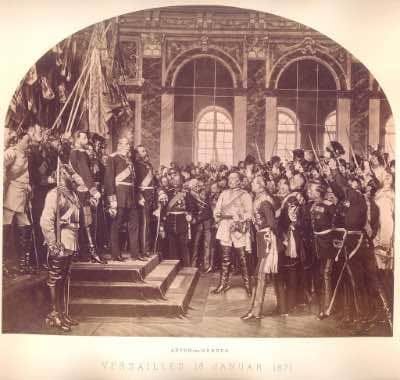
Those who survived soon learned of Bismarck’s act of total humiliation ten days earlier. While they were eating rats and cutting down trees in the parks for firewood, he had staged the proclamation of Wilhelm I as Emperor of a new, unified German Empire.
But the performance wasn’t enacted in Berlin. Bismarck chose the ultimate symbol of French power and glory: the Palace of Versailles.
The Hall of Mirrors is a breathtaking space within the palace. Three hundred and seventeen chandeliers, 357 mirrors and ceiling paintings celebrating numerous military victories. It is a 73-metre corridor to French greatness.
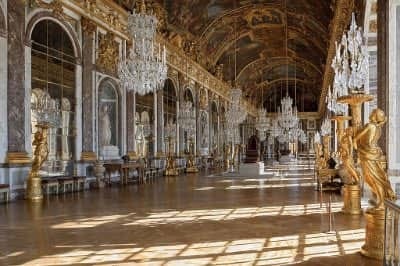
And there, in the Hall of Mirrors, Wilhelm I was proclaimed German Emperor. Louis XIV’s monument to French prowess had hosted a German triumph while Paris was disintegrating.
The formal peace treaty, the Treaty of Frankfurt, was signed on 10 May 1871. France was broken.
Bismarck’s achievement was extraordinary. Through three short, carefully managed wars, he had united Germany, neutralised Austria and humiliated France. A collection of squabbling German states had become Europe’s newest great power.
But France never forgot. Never forgave.
Out of Curiosity
When Germany was defeated in World War I, French Prime Minister Georges Clemenceau insisted on one detail above all: where the peace would be signed.
The Treaty of Versailles was signed in the same Hall of Mirrors where Germany had proclaimed itself a nation.
Revenge from a festering 48 years of humiliation was served.

Thank you for joining me.
Steve
CHIEF STORY HUNTER & WRITER
ATTRIBUTIONS
Hall of Mirrors: Photo: Myrabella / Wikimedia Commons.
Voisin menu: Alexandre Étienne Choron, Public domain, via Wikimedia Commons.
Proclamation of the German Empire: Anton von Werner, Public domain, via Wikimedia Commons.
Otto von Bismarck: Bundesarchiv, Bild 183-R29818 / CC-BY-SA 3.0, CC BY-SA 3.0 DE, via Wikimedia Commons.
Wilhelm I: AnonymousUnknown author, Public domain, via Wikimedia Commons.


CC BY-SA 3.0: https://creativecommons.org/licenses/by-sa/3.0
CC BY-SA 3.0 DE: https://creativecommons.org/licenses/by-sa/3.0/de/deed.en