


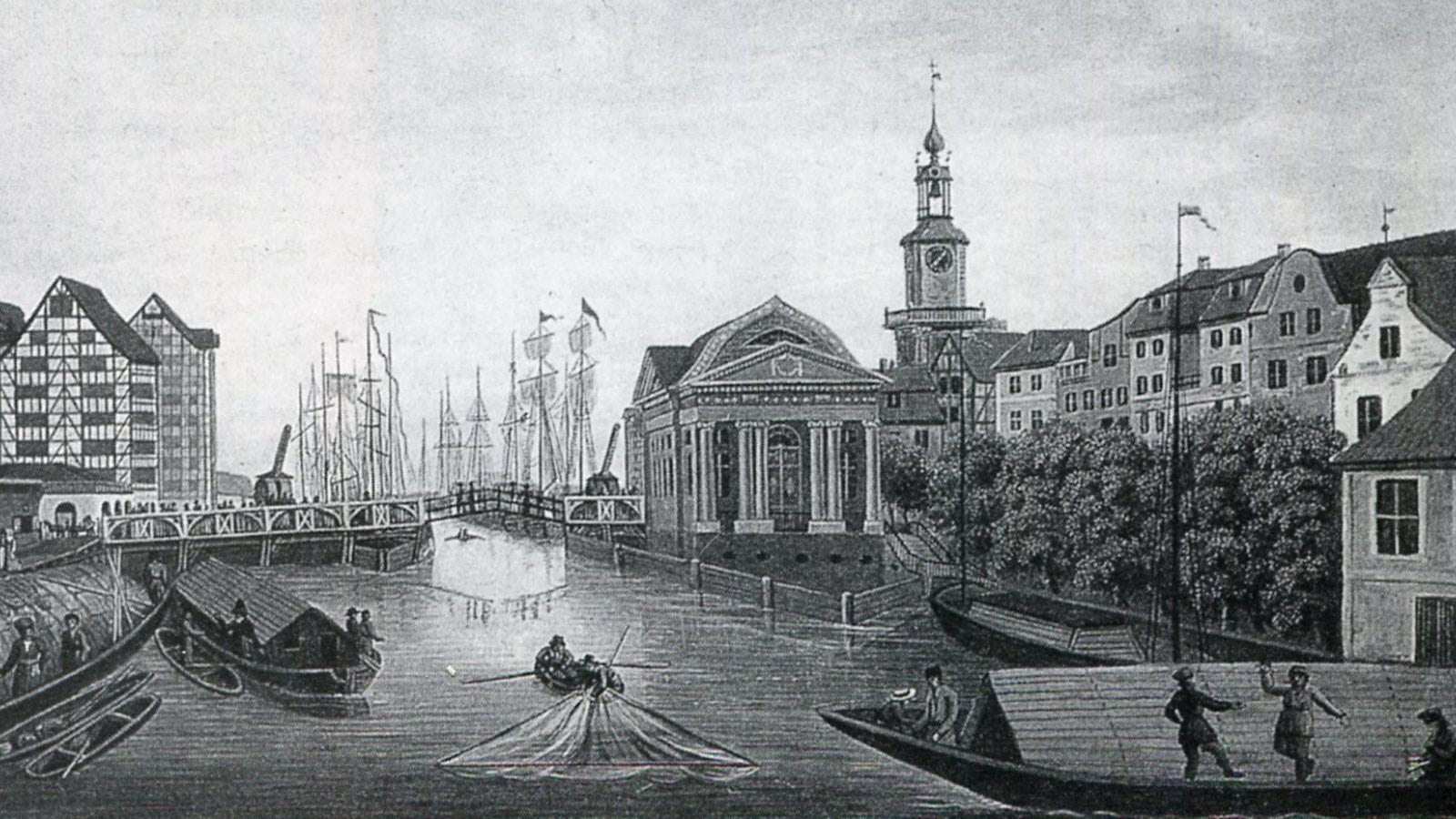

4th July 1946
(read time: 7 mins.)
On 4 July 1946, the Soviets renamed Königsberg as Kaliningrad—after Mikhail Kalinin, the Chairman of the Praesidium of the Supreme Soviet. The logic wasn’t entirely clear. Kalinin—humble, quietly decent and completely spineless—was hardly a figure whose credentials demanded a city.
Doom scrolling has developed a well-earned reputation. This is the practice of picking up your phone for thirty seconds and resurfacing three hours later, slightly hollowed out and with absolutely nothing to show for it.
There is, however, a far more rewarding version of the same condition, and it involves a map. Same bottomless rabbit hole, but none of the self-loathing afterwards.
Get lost in any such map and you can fritter away an entire afternoon, curious about everything and bored by nothing. Stumble from one obscure corner of the world to the next with each discovery pulling you further in. Joy.
For instance, have you ever looked closely at a map of Europe’s Baltic coastline? Squeezed between Poland and Lithuania, you’ll find an odd patch of territory that, at first sight, looks like an orphan who’s been separated from its motherland.
That orphan goes by the name of Kaliningrad Oblast—a Russian exclave perched on the Baltic coast some 240 miles from the nearest point of mainland Russia.
Its capital is the city of Kaliningrad, which today serves as home to the Russian Baltic Fleet and Russia’s primary foothold on the Baltic Sea.
As it turns out, the orphan is remarkably well-armed. Kaliningrad is one of the most heavily militarised corners of Europe. It bristles with air-defence batteries, combat aircraft, missile systems and, quite possibly, nuclear warheads all looking west.
There is a delicious irony buried in all this—Kaliningrad wasn’t always Russian, and this westward-pointing fortress was developed by people who were far more interested in looking east.
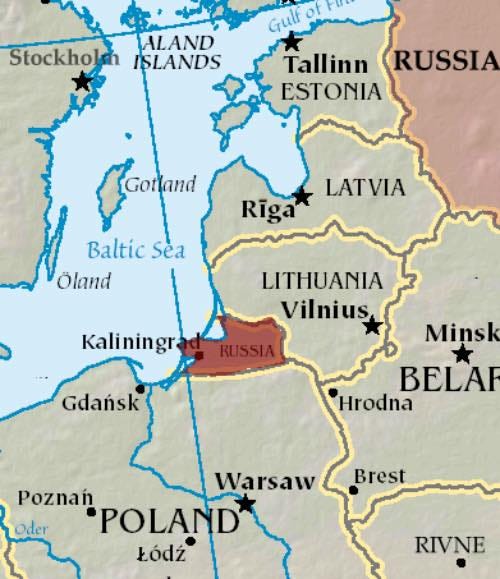
Out of Curiosity
An enclave is a territory completely surrounded by another country. Vatican City and San Marino are both swallowed whole by Italy, while Lesotho has the distinction of being the only entire nation encircled by a single other country—in its case South Africa.
Büsingen am Hochrhein is a small German town entirely surrounded by Switzerland. I imagine its inhabitants spend a lot of time explaining themselves at borders... and dinner parties.
An exclave, by contrast, is a territory belonging to one country but physically detached from it—Alaska cut off from the United States by Canada, or Spain’s north African outposts of Ceuta and Melilla. And then there is Kaliningrad, Russia’s Baltic fragment, perhaps the most dramatic example of the lot.
Enclaves and exclaves aren’t really opposites. All enclaves are exclaves, but not all exclaves are enclaves. Kaliningrad, with its Baltic coastline, is an exclave but not an enclave—it isn’t entirely surrounded by foreign territory.
Where it all started…
For centuries, the Prussian stronghold of Twangste occupied the banks of the lower Pregel. Then, in 1255, the Teutonic Knights—a German crusading order that had grown out of the Third Crusade—pushed into Prussian territory and built a fortress on the site. The Knights named it Königsberg, or ‘the king’s mountain’, after Ottokar II of Bohemia, a sponsor of the Teutonic expedition.
The name is a little bizarre, as the city and the surrounding region had no mountains to boast of.
By the same logic, the Netherlands might be renamed ‘the Rockies‘ or the Norfolk Broads rebranded as ‘Everest Base Camp‘. Why not christen a goldfish as ‘Great White‘ or declare a wet Tuesday in Slough as the ‘Golden Age‘? That’s enough now.
Logic was never the point. History has always awarded the naming rights to whoever wins.
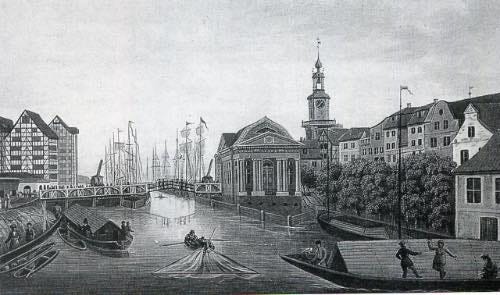
The thriving city of Königsberg
Name aside, over the next seven centuries, Königsberg grew into a major Baltic trading port, the capital of East Prussia and a key city of the Prussian kingdom. By the time Prussia stood at the heart of a unified Germany, the old fortress had sprouted merchant houses, guildhalls and university cloisters, and was widely counted among Central Europe’s great centres of culture and learning.
The philosopher Immanuel Kant was born in Königsberg in 1724 and died there in 1804. It’s rumoured that he had never travelled more than ten miles from the city.
By 1939, Königsberg was a sizeable metropolis of roughly 370,000 people, brimming with merchants, soldiers and scholars. The streets were lined with 19th-century apartment blocks, guildhalls and department stores while the trams rattled by. It was a confident, bourgeois capital of bustling cafés and crowded lecture halls.
Then, on 1 September 1939, Hitler invaded Poland. Over the next six years, Königsberg would be bombed, besieged and erased from the map.
The Second World War comes to Königsberg
The old Prussian port became a military hub and staging ground for Wehrmacht units along the Baltic front. The city watched as troop trains headed east and the wounded headed back. By 1944, the tide had turned. Now the guns were pointing back at Königsberg.
The city was heavily damaged by two Royal Air Force raids between 26 and 30 August 1944, which laid waste to much of Königsberg’s historic heart and left tens of thousands homeless. By January 1945, with Germany’s defeat all but certain, Soviet and Western Allied armies were racing across Nazi-occupied Europe, seizing as much territory as they could before the Reich finally collapsed.
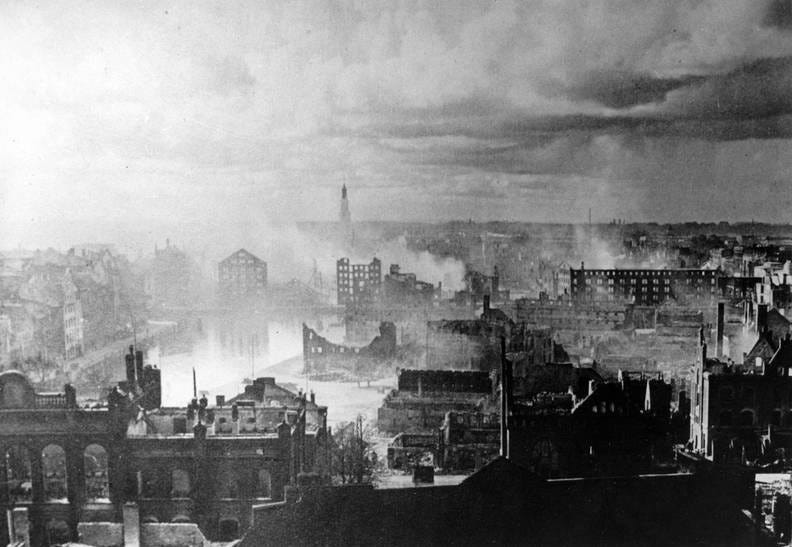
In April 1945, troops of the 3rd Belorussian Front took Königsberg by storm. Lithuania, Latvia and Estonia had already been absorbed into the Soviet Union in 1940, so the ruined East Prussian capital slotted neatly into the USSR’s expanding jigsaw.
Hitler had earmarked Königsberg as the gleaming eastern face of his Thousand-Year Reich. The Red Army had different plans. The Germans were driven out, Soviet settlers were shipped in from across the union—arriving to rubble, shortages and a city they had never asked for.
The would-be beacon of German civilisation had become something rather different: a Soviet watchtower looming over the West.
Mikhail Kalinin...
...was born into a peasant family, and had risen through the revolutionary ranks to become Stalin’s nominal head of state—a position of considerable ceremonial grandeur and virtually no power whatsoever.
The Soviet propaganda machine cast him as the ‘All-Union Elder‘—modest, unassuming, happiest in simple clothes, eating with train crews and porters rather than troubling any gilded dining rooms.
In other words he was seen as a reassuring figurehead that ordinary citizens might write to with their problems. Nikita Khrushchev later confessed he could never quite establish what practical work Kalinin had actually carried out. Neither, it seems, could anyone else.
There was a darker side to this. From the gulags, thousands of prisoners and their families wrote to him—’Grandpa Kalinin‘—begging the All-Union Elder to intervene on their behalf. He never did.
