



31 October 1517
(read time: 5 mins.)
On 31 October 1517, Martin Luther published the Ninety-five Theses, challenging the Catholic Church’s practice of selling ‘indulgences’; that is, receiving cash in return for the forgiveness of sins. But what was the chain of events that led from this, leaving one nation with two languages?
You’ll have to excuse me, I have taken an impromptu trip to Belgium and Germany, hence the normal Sunday missive has taken a back seat this week.
In fact, when you read this shortened piece, I will probably be in Dortmund, ready to watch the mighty German Bundesliga team Borussia Dortmund playing football.
Why have I bothered to travel so far for a footie match? I’ll save that for another day... and no, I am not worried about my house being burgled by publicising that I am not there; my middle son is in charge while I am away, so I know the house will already be crawling with unauthorised aliens of every description.
The point is this: I was going to bypass an episode altogether, because I don’t like sharing something that’s rushed or falls short of the normal rigour of a weekly newsletter.
However…
There is an anniversary this week that—bearing in mind where I am at the point of writing—I had to share with you. And here’s the reason why;
Last night, my youngest son and I arrived in Brussels, capital of Belgium. Although we arrived late, we did manage to pop out for a couple of glasses of the finest Belgian ale… La Chouffe, to be precise.
While we were sitting in the bar chatting, I couldn’t help but eavesdrop on the table next to us. Two locals were having an animated conversation entirely in French. Fifteen minutes in, they seamlessly switched to Dutch and continued—without missing a beat. Same people, same chat, just a different operating system.
In Belgium, both languages are spoken, French and Dutch. They weave together so beautifully, you can’t help but notice.
But how on earth did this situation arise?
A small warning; you need to concentrate just a little more than for your usual Sunday morning read; partly because the story has its complications and partly because I am on my third glass of Kwak, the most delightful—but 8.4% a.b.v—Belgian ale. Well, here goes…
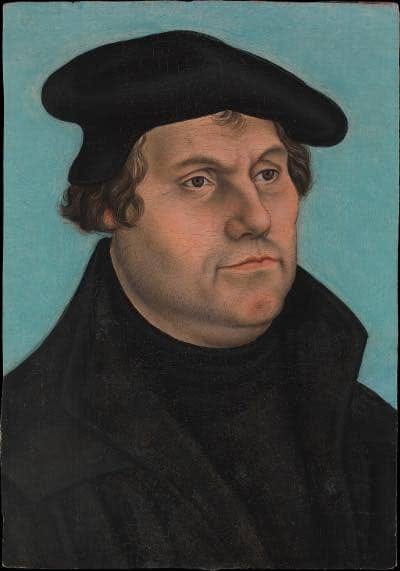
Martin Luther
…was born in 1483 in the small Saxon town of Eisleben, Germany, destined for a conventional life. He’d trained as a lawyer, following his father’s ambitions.
Then a violent thunderstorm changed everything.
Lightning struck near enough to convince the lawyer that God had plans for him—plans that didn’t involve courtrooms. Convinced he’d been spared by divine intervention, Luther abandoned law and entered an Augustinian monastery in 1505.
By 1512, he was a theology professor at the University of Wittenberg, wrestling with questions of sin, salvation and whether good works or faith alone could save a soul.
It was this internal spiritual struggle that would set Luther on a collision course with the most powerful institution in Europe.
Ninety-five Theses
On 31 October 1517, Martin Luther published the Ninety-five Theses, challenging the Catholic Church’s practice of selling ‘indulgences’; that is, receiving cash in return for the forgiveness of sins.
The system was breathtakingly audacious. The Catholic Church had convinced believers they could buy their way out of purgatory, not just for themselves but for deceased relatives already suffering there.
Professional pardoners toured Europe like travelling salesmen, hawking forgiveness with the enthusiasm of market traders. One particularly successful pitch promised that…
…as soon as the coin in the coffer rings, the soul from purgatory springs.
It was a lucrative business. The money flowed to Rome, funding everything from lavish papal lifestyles to the construction of St Peter’s Basilica. For Luther, a German monk troubled by his own conscience, the whole enterprise was an obscene corruption of Christian faith.
Burning of the Papal Edict
Pope Leo X explicitly demanded that Luther recant his writings in the papal bull Exsurge Domine, in June 1520.
On 10 December 1520, Luther publicly—and dramatically—burned the papal edict demanding his recantation.
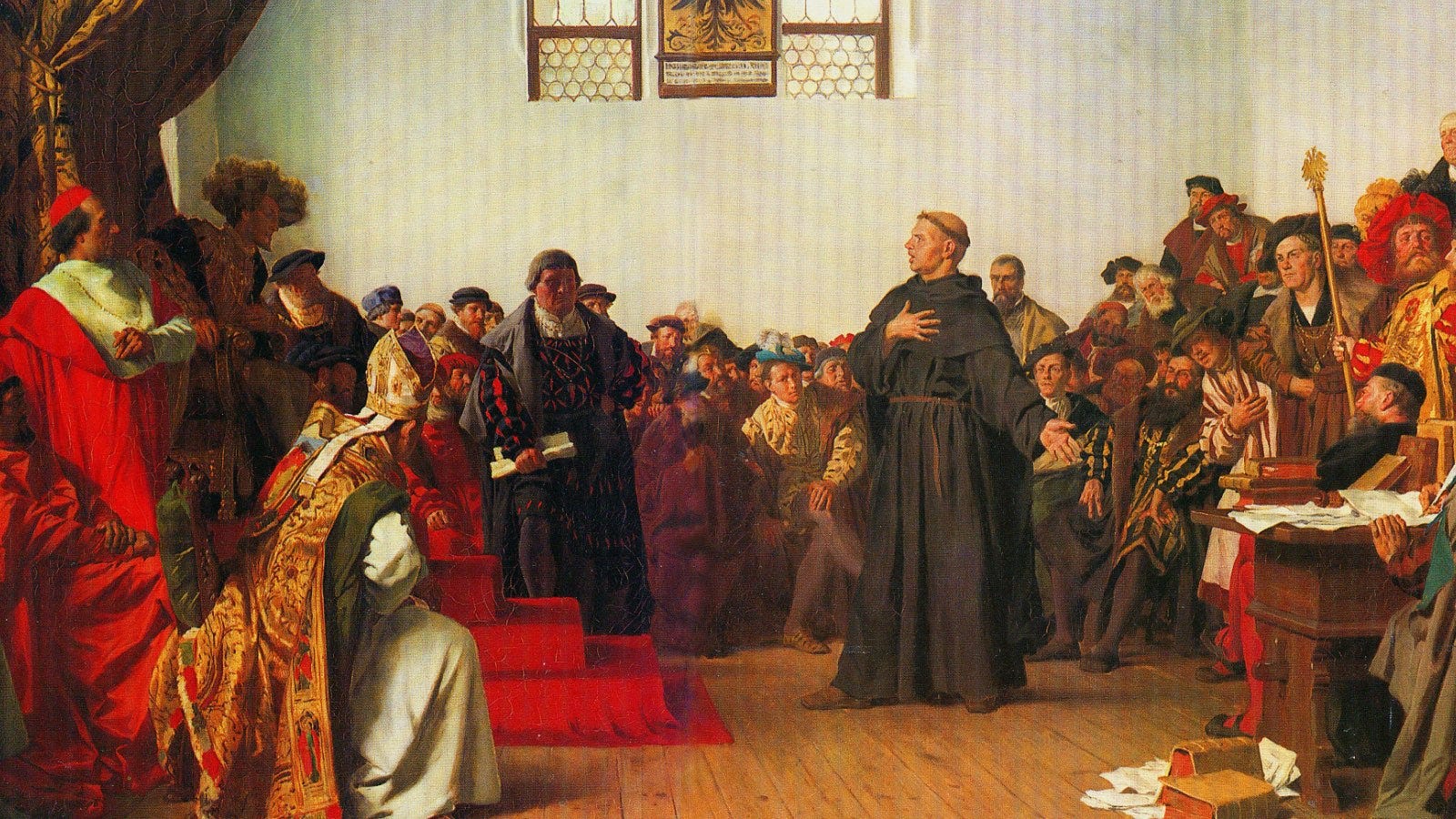
Luther was summoned to the Diet of Worms and given a final opportunity by Pope Leo to recant his work. Luther refused, declaring the immortal line…
I cannot and I will not retract anything, since it is neither safe nor right to go against conscience. Here I stand. I cannot do otherwise. God help me. Amen.

Out of Curiosity
A ‘Diet’ was the name for an assembly in the period of the Holy Roman Empire. Worms is one of Germany’s oldest cities, lying on the west bank of the river Rhine, 40 miles south of Frankfurt.
Martin Luther was excommunicated from the Roman Catholic Church the following year, 1521, and the seeds of Protestantism were sewn.
The flames spread fast.
Luther’s preachings reached the Low Countries; a collection of 17 provinces (the ‘Habsburg Netherlands’) under Habsburg rule that today includes Belgium, the Netherlands and Luxembourg.
Frankish, Picard, Walloon and Champenois
The Low Countries had been linguistically split for over a thousand years. When the Germanic Franks invaded in the 5th century—ironically from Germany, not France, despite the name—they pushed south from the northeast.
The Franks settled across the northern territories, bringing their Germanic language, which evolved into Dutch.
However, over the same period, the southern areas evolved from a variety of Romance languages—Picard, Walloon and Champenois—eventually weaving into today’s French.
The result, emerging over several centuries, was a clear linguistic border running roughly east-west: The Flemish Dutch speakers to the north, the French-speaking Walloons to the south.
Reformation ideas spread in the Low Countries soon after Luther, but they faced harsh repression and remained clandestine at first.
By the mid‑sixteenth century, Protestantism—especially Calvinism—flourished in major southern cities such as Antwerp and in several French‑speaking Walloon towns.
As a result, the ruling Catholic Habsburgs responded with fierce persecution. Fifty years later, this persecution—together with grievances relating to politics and taxation—erupted into 80 years of brutal religious war—the Dutch Revolt of 1568.
One nation, two languages
Here’s where geography played its hand differently. When the dust settled in 1648 with the Peace of Westphalia, the northern provinces had won independence as the Protestant Dutch Republic—and these provinces were almost entirely Dutch-speaking.
But the southern provinces that remained under Catholic Spanish control straddled the old linguistic border; they included both Dutch speakers in Flanders and French speakers in Wallonia.
The religious divide would prove more powerful than the linguistic one. When Belgium finally gained independence in 1830, it emerged as a Catholic nation divided by two languages, shaped by a fire Martin Luther had lit over 300 years earlier.
