


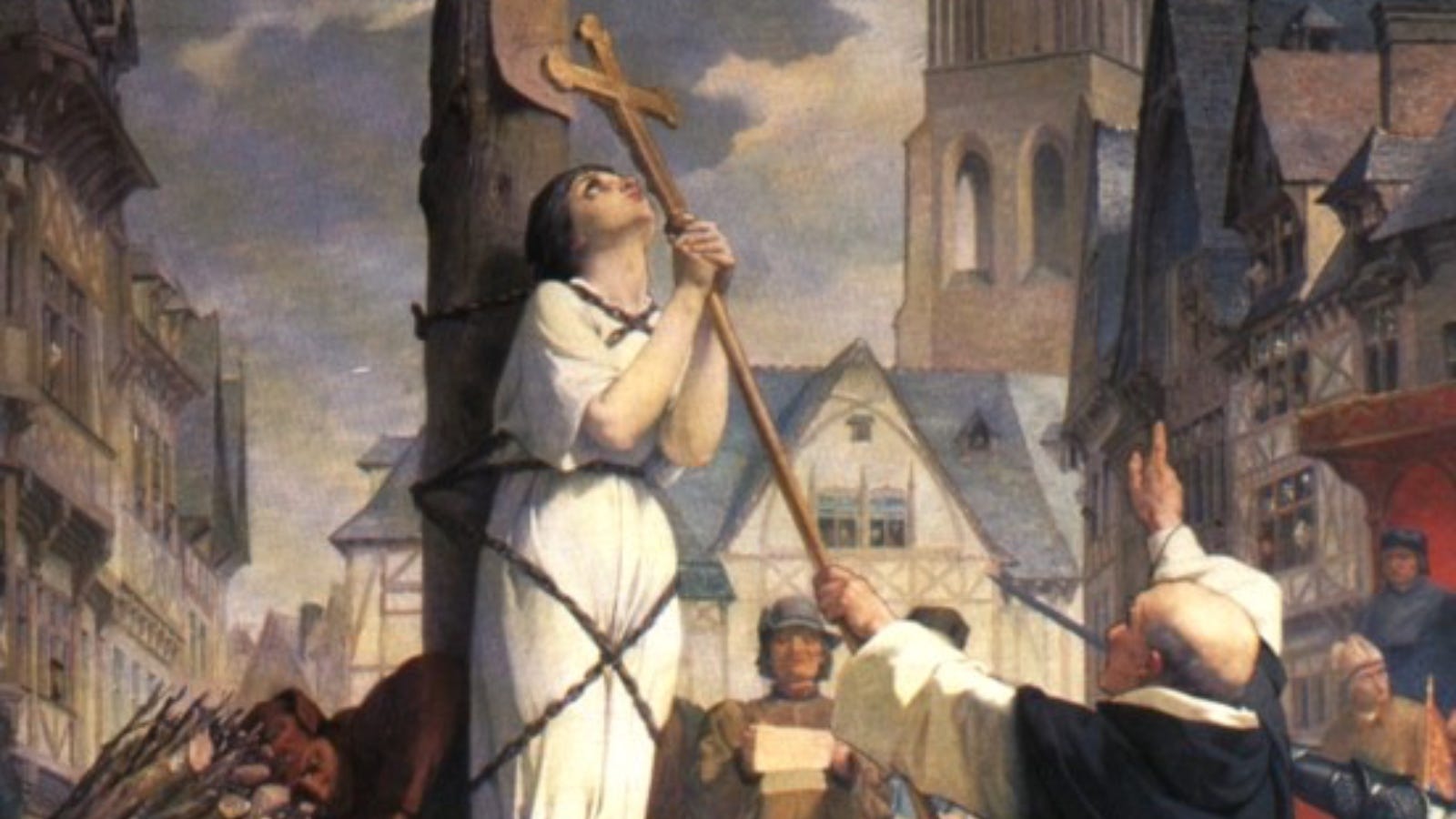

30th May 1431
7th July 1456
(read time: 8 mins.)
On 30 May 1431, Joan of Arc was burned at the stake in the Old Market Square in Rouen. She was nineteen years old. The charges against her ran from heresy and sorcery to what the judges treated as most damning of all: her stubborn insistence on wearing men’s clothing.
Domrémy-la-Pucelle sits in the Vosges region of northeastern France—a village so small that even today it barely troubles the mapmakers.
Fewer than a hundred inhabitants are scattered along the River Meuse, hemmed in by oak woods, cultivated fields and pocket-sized vineyards.
In 1412 it was simply Domrémy, a frontier settlement caught in the crossfire of a conflict that had dragged on for 75 years.
The Hundred Years’ War between England and France was raging. Domrémy found itself in a region hotly contested between the Anglo-Burgundian alliance and the Dauphin, the future French king Charles VII.
Out of Curiosity
The Hundred Years’ War is a misnomer. It actually lasted 116 years, not as a single continuous campaign but more a string of bruising flare-ups, broken by long truces while both sides caught their breath and replenished their arrow stocks.
It began in 1337, during an era when English-held fiefdoms sprawled across southwestern France. At the high‑water mark, English lands would swell to roughly a third of modern-day France.
Tension had heightened back in 1328 when the French King Charles IV died without a male heir. England’s King Edward III claimed the French throne as Charles IV’s nephew through his mother, Isabella.
The French magnates, displaying the sort of selective reasoning that would make a modern lawyer proud, insisted that the crown could not pass through a woman.
They later justified this under the mantle of Salic Law—an ‘ancient principle’ that was retrofitted to block claims like Edward’s.
Instead, the crown passed to Philip VI, Charles IV’s cousin. War was inevitable from that point, but was triggered in 1337 when the emboldened Philip tried to confiscate Edward III’s French territory, Aquitaine.
And so the Hundred Years’ War had begun.
Jeanne Darc
In that year, 1412, a peasant farmer from Domrémy, Jacques Darc, and his wife Romée had a daughter. Her name was Jeanne.
Jeanne’s parents raised five children in an era when surviving itself was an achievement.
Life in medieval Domrémy was grim enough. Homes ran to one or two rooms with dirt floors, made grimmer still by the livestock often sharing the space.
Most villagers were subsistence farmers who handed over roughly a third of their earnings to the local lord and the church. Peasants worked the fields from dawn to dusk. If they made it to forty-five, they counted themselves fortunate before dysentery or plague caught up with them.
Women could add childbirth to that list.
The typical diet was bread, watery stew (or pottage) and a little bit of cheese. Meat was a luxury reserved for feast days. Entertainment ran to Church festivals, the occasional wedding and swapping stories about whose cow had died most dramatically.
Joan of Arc hears voices
Joan grew up like any other village girl. She tended sheep and spun wool. Staying alive mattered more than reading or writing, which nobody bothered with anyway.
She was also exceptionally pious—though so were half the village, there was little else to distract them. But at thirteen, something changed. Jeanne (known today by the English ‘Joan’) started hearing voices.
At first, the voices offered Joan general spiritual guidance. Over time, though, the messages grew more specific.
It turned out that Saint Michael, Saint Catherine and Saint Margaret had strong opinions about French military strategy. The saints urged her to rise up and drive the English out of France.
Joan kept these celestial briefings to herself until she was seventeen. Then the voices insisted she could wait no longer.
Out of Curiosity
Despite great victories at Crécy (1346) and Poitiers (1356), English lands had been eroded by the French so that only Aquitaine and an area around the port of Calais remained.
However, Henry V’s glorious victory at the Battle of Agincourt (1415) and the subsequent Anglo-Burgundian alliance sealed in the Treaty of Troyes in 1420, reversed English misfortunes.
By the time Joan had turned 17, the Anglo-Burgundian camp once again held swathes of northern and western France—including Paris.
After two years of trying, Joan finally persuaded the local garrison commander to give her safe passage to Chinon in February 1429.
There she would present herself to the Dauphin—the heir-apparent son of Charles the Mad, who had disinherited him in favour of Henry V and his heirs.
Even in the territory the Dauphin controlled, he couldn’t be anointed king: Anglo-Burgundian forces held Reims, where French kings had been crowned for centuries.
For a teenage peasant girl in 1425, this would be quite the career pivot.
Through what must rank among history’s greatest sales pitches, Joan convinced the Dauphin to let her lead troops to Orléans where the English had held the city under siege for nearly six months.
Joan d’Arc heads for Orléans
French morale was low. The situation looked hopeless.
Then Joan arrived in white armour, carrying a banner emblazoned with the names of Jesus and Mary. She didn’t so much command the troops as inspire them into a religious frenzy.
She was Joan…. Joan d’Arc.
When the French launched their attack on Les Tourelles in May 1429, the fighting was brutal. Joan was in the thick of it, armed with nothing but her banner. On the third day, an arrow punched through her shoulder between neck and collarbone.
She was carried from the field. But when Joan overheard the commanders discussing retreat, she hauled herself up, returned to the fight and rallied the troops again.
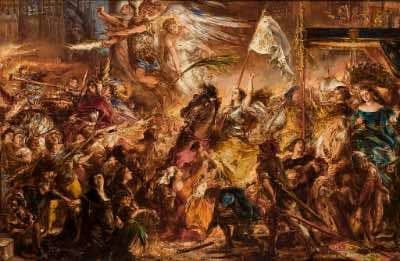
The next day, the English siege broke. The victory at Orléans on 8 May 1429 became the stuff of legend.
On 17 July 1429, the Dauphin became Charles VII, crowned in Reims Cathedral, with Joan of Arc—the Maid of Orléans—standing close by, banner in hand.
Joan is captured and put on trial
At this point, Joan should have gone home. But she didn’t.
Joan fought on, leading an ill‑fated assault on Paris in September 1429. The attack failed and she was wounded again. Her voices, she claimed, had warned her she wouldn’t live long. They were right.
In May 1430, during a skirmish at Compiègne, Joan was captured by Burgundian troops who promptly sold her to the English.
The English wanted her dead, but they faced a problem. They needed an excuse that wouldn’t inadvertently create a martyr.
They needed to discredit her first, and by extension, Charles VII’s crown.
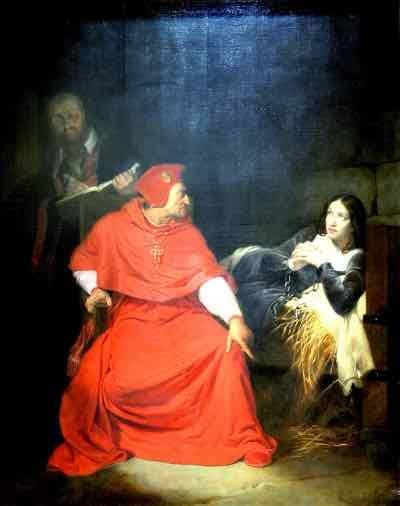
Joan of Arc’s trial started the following January in Rouen, the capital of English-occupied France. Her first public interrogation started 595 years ago this coming Saturday, 21 February 1431.
The proceedings were a masterclass in medieval legal gymnastics. Joan, still a teenager, faced a panel of dozens of theologians and legal scholars. She had no lawyer, no advocate, no one to advise her.
Who’s wearing the trousers?
The charges ran from heresy and sorcery to what the judges treated as most damning of all: her stubborn insistence on wearing men’s clothing.
The theological heavyweights at the trial devoted serious energy to the trouser question: Were they heretical?
Joan pointed out that she was less likely to be assaulted in breeches than in a dress. The scholars were unconvinced by her pragmatic approach to fashion.
Despite the hopelessness of her situation, the Maid of Orléans held her own. When asked if she knew she was in God’s grace, she gave one of history’s most elegant non-answers:
If I am not, may God put me there;
and if I am, may God so keep me.
It was a perfect response. Saying “yes” would be presumptuous heresy. Saying “no” would be an admission of sin.
Nonetheless, the verdict was never in doubt.
On 24 May 1431, faced with the threat of immediate execution by burning, Joan recanted. She signed a document—with a cross since she couldn’t write—renouncing her voices and exchanging her soldier’s clothes for a woman’s dress.
She was sentenced to perpetual confinement.
However, three days later, Joan appeared again in male attire, claiming that promises had been broken and she was ‘still chained among men’. The court had no choice but to declare her a relapsed heretic.
