



24th October 1972 / 24th October 2005
(read time: 3 mins.)
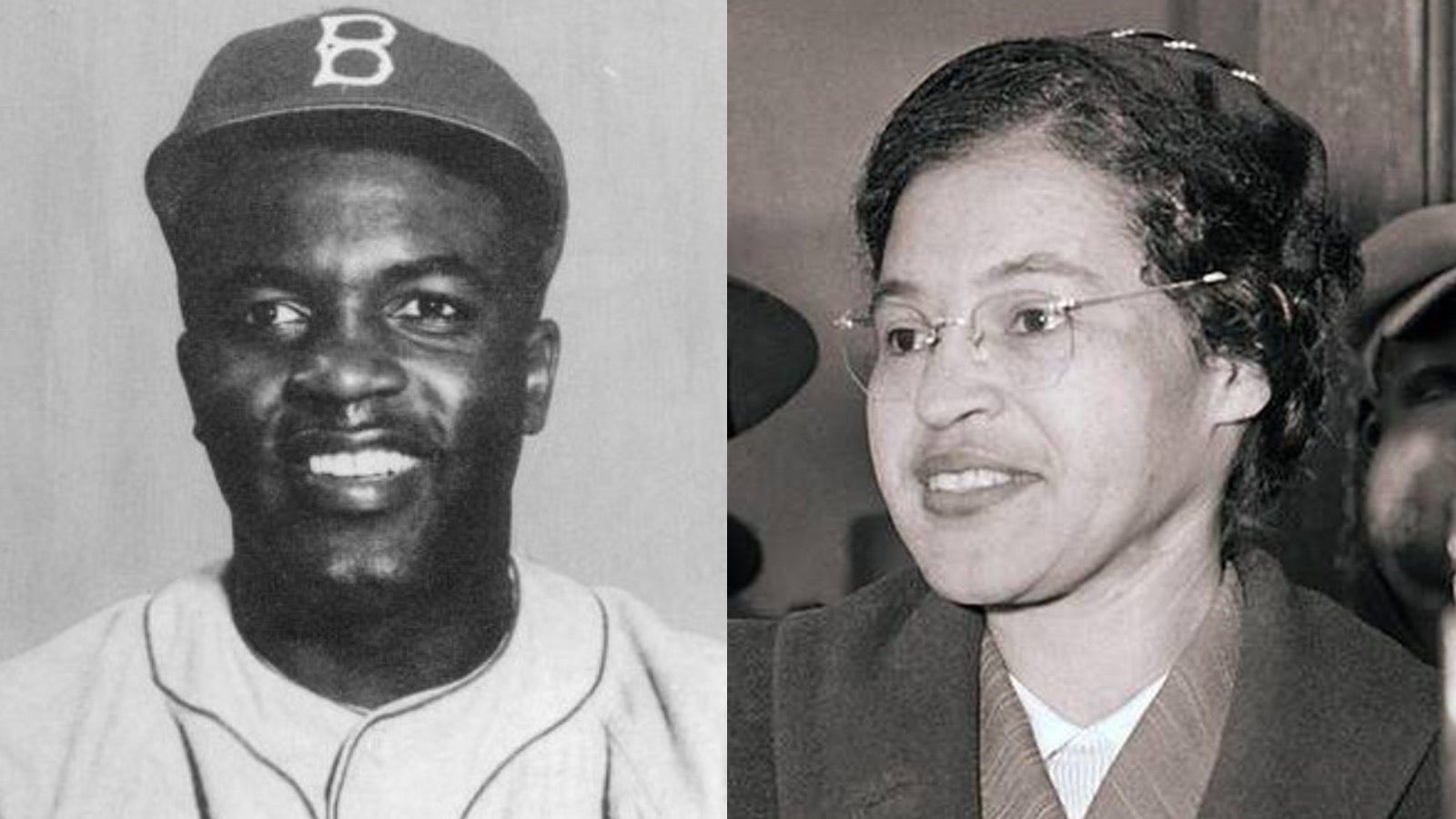
Both Jackie Robinson and Rosa Parks stood firm when their human rights were violated on a bus—eleven years apart. Both were awarded the Presidential Medal of Freedom and Congressional Gold Medal. Unlike Robinson, Parks received them during her lifetime. With glorious symmetry, Rosa Parks died on the 33rd anniversary of Jackie Robinson’s death.
Jackie Robinson…
…is widely remembered in America as having broken ‘the colour barrier’. Against all odds, he became the first African American to play Major League Baseball and fulfil a stellar career with the Brooklyn Dodgers.
Robinson’s story perhaps started in 1944 while stationed at Camp Hood, Texas. Like many other young men at the time, he had been drafted into the U.S. Army soon after the Japanese attack on Pearl Harbour in December 1941.
In Texas, Jim Crow Laws - legal racial segregation - were still in force. One day in July 1944, Robinson boarded a military bus and took his seat near the front. Despite exemption from Jim Crow on military buses, the driver ordered Jackie to move to the back.
Robinson refused. The bus driver unleashed some unwarranted racial abuse, but Jackie remained calm. His reward… arrest by the military police and court-martial.
Jackie was acquitted of all charges but the vindication was cold comfort. He had lost confidence in an army that could subject him to such racial injustice.
With his superiors keen to deflect any criticism of racial prejudice, a compromise was reached. Jackie received an honourable discharge from the army - ‘by reason of physical disqualification’.
The army’s loss proved to be baseball’s gain. Robinson broke the colour barrier in 1947, was awarded Rookie of the Year and MVP (Most Valuable Player) with the Brooklyn Dodgers. In addition, he won a World Series and was inducted into the National Baseball Hall of Fame in 1962.
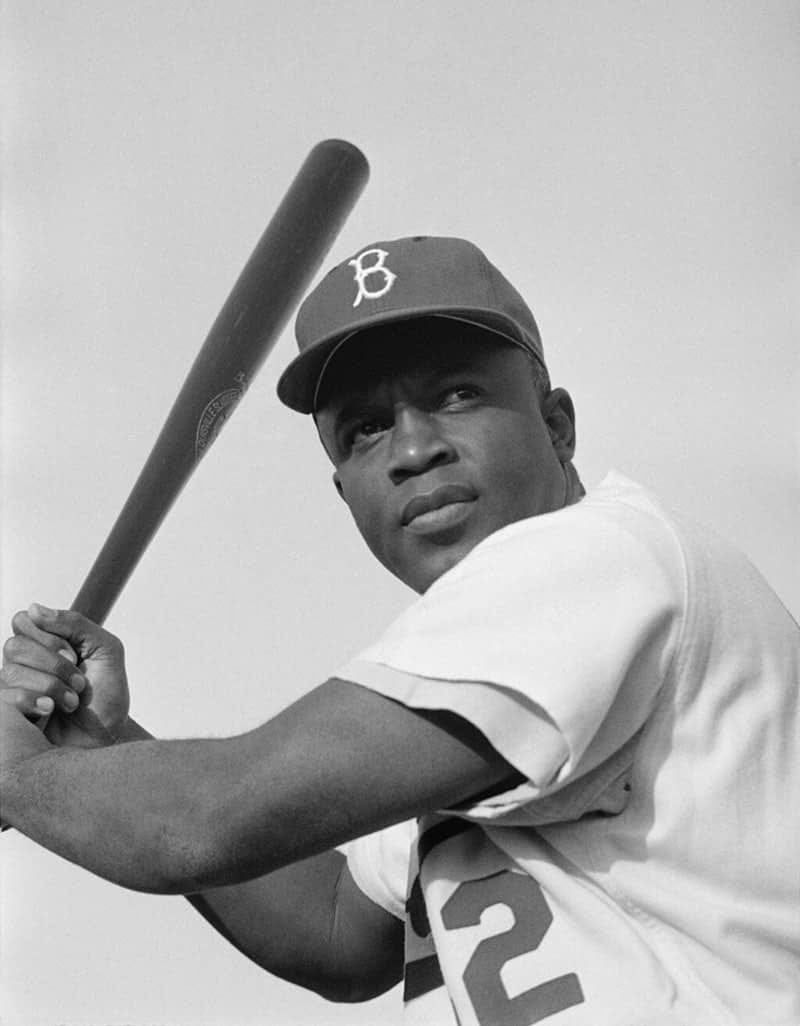
The man who was discharged from the army by reason of physical disqualification had proved himself one of baseball’s finest players, achieved while performing under extreme pressure.
Jackie Robinson went on to become a high-profile voice in civil rights advocacy. For his contribution, he was posthumously awarded the Presidential Medal of Freedom by Ronald Reagan in 1984 and the Congressional Gold Medal in 2003 by George W. Bush, the two highest civilian honours in the United States.
Rosa Parks (née Louise McCauley)…
…was born in Tuskegee, Alabama in 1913. As an African American, she was regularly subject to racial discrimination and segregation.
By the time Jackie Robinson was being arrested at Camp Hood in 1944, Rosa had been married to Raymond Parks for 12 years. During that period she had become involved with the National Association for the Advancement of Colored People (NAACP).
Roll forward to December 1955: Rosa Parks was now a seamstress at the Montgomery Fair department store in Montgomery, Alabama.
One evening, Rosa was heading home after a long day’s work. She boarded her usual bus in Cleveland Avenue and paid the fare. She sat down in the coloured section, one row back from seats reserved for white passengers.
As the bus took on more passengers, the reserved area reached capacity - white passengers were now standing in the aisle. The driver halted the bus, climbed into the passenger area and shifted the segregation zone sign back one row.
Without moving, Rosa was now seated in the white-designated area.
The bus driver asked Parks to give up her seat. As with Jackie Robinson eleven years earlier, she refused. The bus remained stationary until the police arrived a short while later to arrest Rosa.
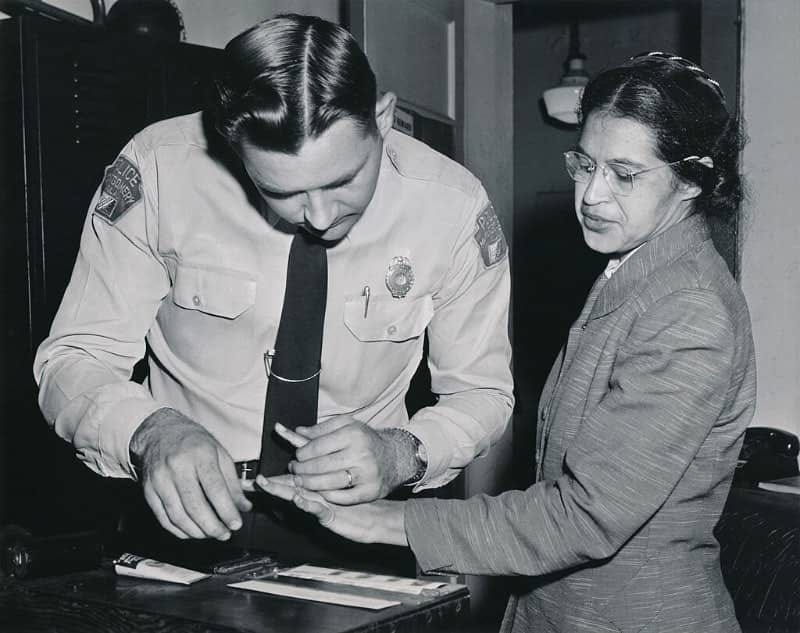
Parks was released on bail within a few hours. Nonetheless, her employers wasted no time in dismissing her.
The ensuing Montgomery bus boycott lasted for 381 days. African Americans accounted for 75% of the Montgomery Bus Company’s passenger base. The boycott was a financial disaster.
With a strong whiff of irony, the bus company itself lobbied the city to reform the very segregation laws its driver had enforced the previous year.
In November 1956, the US Supreme Court upheld a ruling that segregation on public transport was unconstitutional. The Montgomery bus boycott was over.
