



7th November 1940
(read time: 2 mins.)
Howard Clifford was working quietly at his desk on 7 November 1940. Then a call came in. The Tacoma News Tribune received word of excessive movement in the Tacoma Narrows Bridge. Howard was dispatched to take a look. Within two hours, the bridge lay at the bottom of Puget Sound.
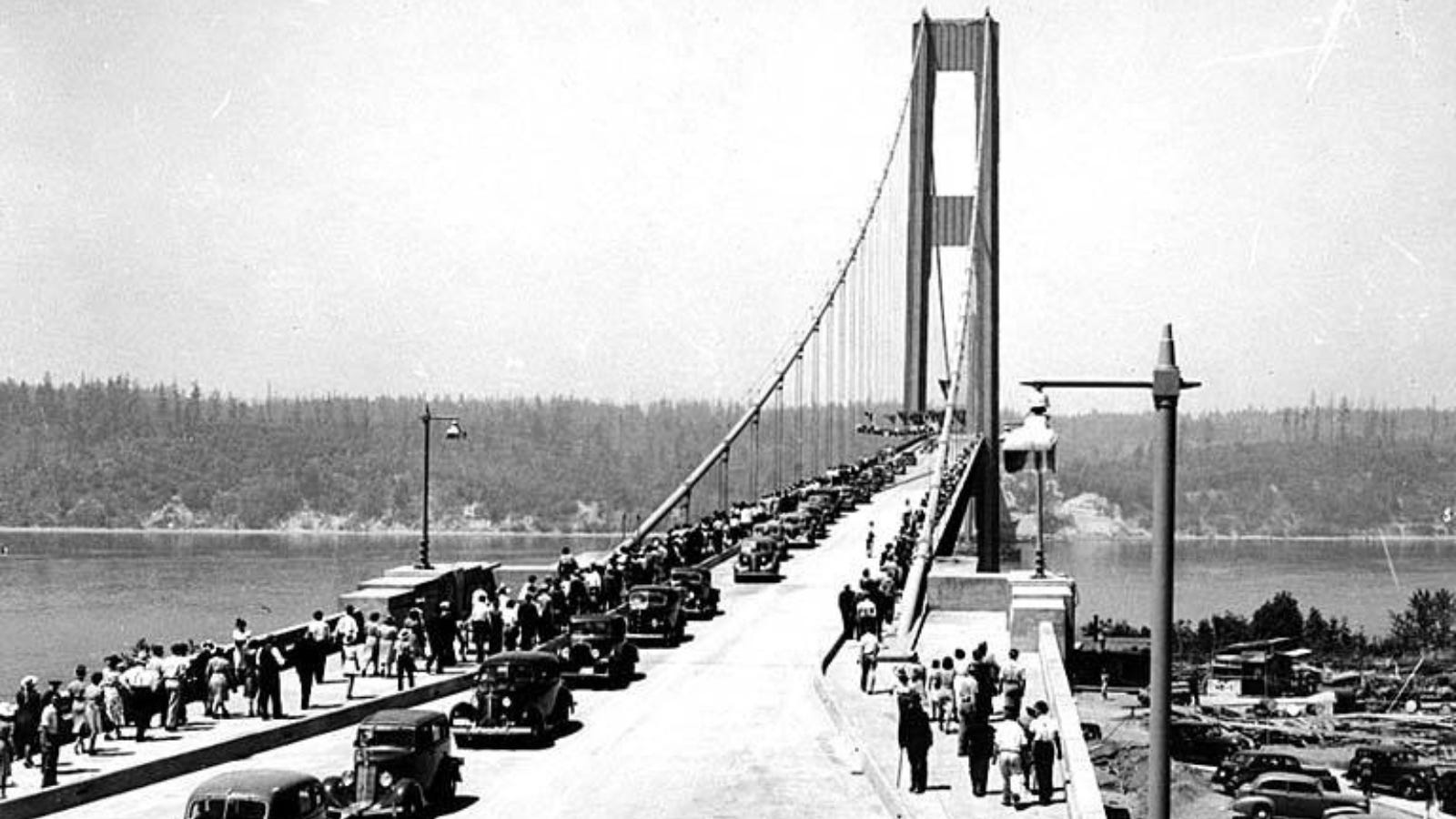
The first Tacoma Narrows Bridge opened to traffic on 1 July 1940 after less than two years of construction.
The bridge was a marvel of engineering. She spanned 6,000 feet across Puget Sound, 25 miles southwest of Seattle, Washington State, as the crow flies.
She was the world’s third-longest suspension bridge. Only New York’s George Washington Bridge and San Francisco’s Golden Gate Bridge were longer.
Most importantly for the locals, the new bridge saved a two-hour trip from Tacoma on the east side to the Kitsap Peninsula on the west.
However, what the Tacoma Narrows Bridge saved in time, she made up for in excitement.
In anything but very light winds, the bridge would ripple like a flag in a breeze. Perfectly acceptable behaviour for a flag, rather less so for a bridge. The locals nicknamed her ‘Galloping Gertie’—though given the bridge’s tendency to undulate rather than gallop, ‘Rippling Rita’ might have been more apt.
Anyone who’s pushed a child on a swing understands resonance instinctively. Time your push perfectly, and the swing goes higher and higher with no additional effort. That’s resonance at work.
Every object has a natural resonant frequency, and if you apply force in sync with it, the movement amplifies continuously until something breaks. (Best to stop pushing the swing before that point.)
When an opera singer hits the exact resonant note of a wine glass, it will eventually shatter. When wind blows across a bridge at right angles and matches its natural frequency, the structure will amplify its own movement until it tears itself apart.
And there’s nothing you can do to stop it.
Eighty-five years ago this Friday, on the morning of 7 November 1940, 38 mph winds were pulsing up Puget Sound and across the beam of the Tacoma Narrows Bridge.
At first, she rippled, then she undulated.
The Tacoma News Tribune received word of excessive movement in the bridge. Howard Clifford was dispatched to take a look. Exhibiting the professional death wish of a true photojournalist, Howard walked onto the bridge, snapping like crazy.
He wasn’t the only one snapping at that moment.
While on the bridge, Clifford tried to rescue Tubby, a beleaguered spaniel, from an abandoned car. Unfortunately, the terrified dog bit him with sufficient enthusiasm to end the rescue effort.
By 9.30 a.m., a lateral twist appeared in the central span of the bridge.
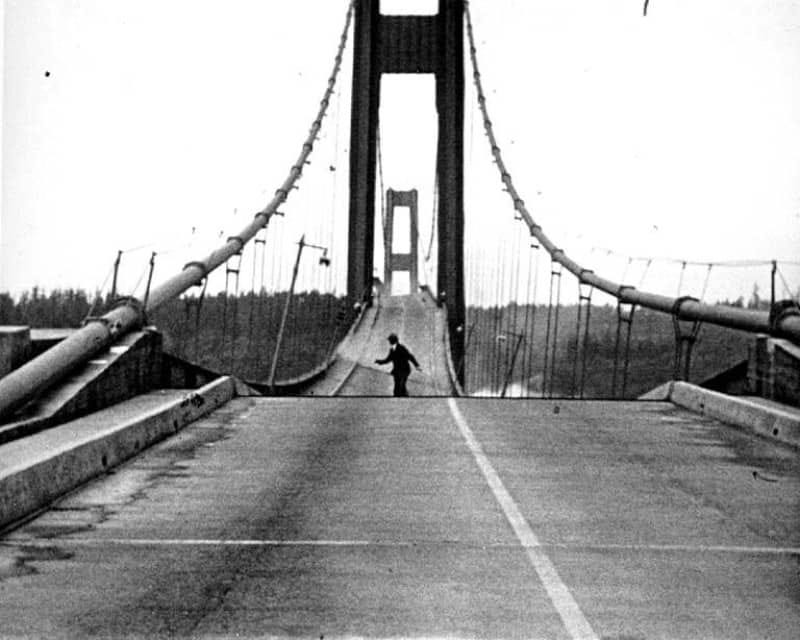
In this dramatic photo taken by freelance photographer Jim Bashford, you can see Howard staggering off the bridge just in time.
At 11 a.m., the bridge structure failed. Ten minutes later, the central span lay at the bottom of Puget Sound. If you’d like to see the bridge in its final death throes, check it out here.
Luckily, no one perished that day in November 1940 - except for poor old Tubby.
Feeling nervous about your next suspension bridge crossing? Don’t worry. The 1940 collapse provided excellent learning material for engineers. Modern suspension bridges—including today’s Tacoma Narrows Bridge—are designed to stay firmly horizontal in strong winds.

Thank you for joining me.
Steve
HOST & CHIEF STORY HUNTER
ATTRIBUTIONS
Tacoma Narrows Bridge: UW Digital Collections, No restrictions, via Wikimedia Commons.
Opening day of the Tacoma Narrows Bridge: University of Washington Libraries Digital Collections, Public domain, via Wikimedia Commons.
.jpg)
