



4th September 1839
(read time: 6 mins.)
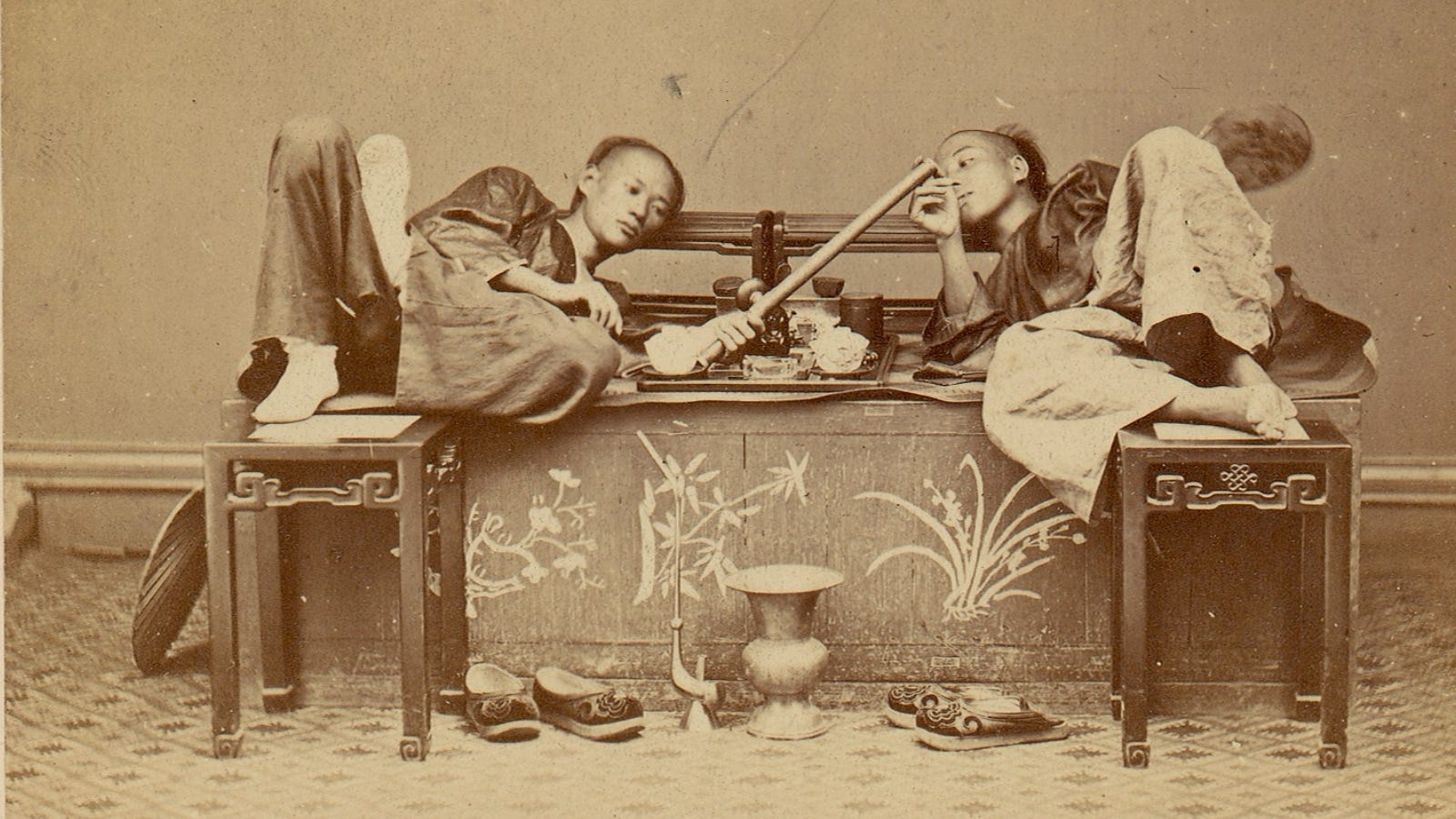
Empires were rarely built on fair play. The solution was elegantly simple, if morally bankrupt: create a market where none existed. To satisfy the British consumer’s addiction to tea, the Government would engineer a Chinese addiction to something far more potent—Opium. Conflict was inevitable. The First Opium War broke out on 4th September 1839.
Having watched rather too much David Attenborough over the festive break and convincing myself that microplastics were staging a hostile takeover of my internal organs—brain included—I did what any sensible person would do: I ditched the tea bags and bought a teapot together with some organic loose-leaf tea.
Terribly quaint. I hadn’t brewed a proper cup of tea since I was sixteen.
I kid you not, what a revelation. I’d forgotten how wonderful a decent cup of tea could taste. No bitterness, just the smooth, aromatic delivery of that daily fix we Brits have been imbibing since the mid-17th century.
The British tea drinking habit
By the 1830s, the British were consuming 30 million pounds (in weight) of tea each year. That’s 6,000 of today’s London double-decker buses filled to the brim with leaves. Imagine the entire bus fleet trundling around London packed with Earl Grey instead of passengers.
In the 168 years since Charles II’s wife, Catherine of Braganza, had made tea a fashionable court beverage in 1662, it had trickled down from the aristocracy’s teacups into every working-class household in Britain.
On average, 5% of a worker’s wages were spent buying tea—the equivalent of a modern London bus driver handing over £1,650 a year for tea leaves.
Which brings me to an uncomfortable truth about addictions—someone always pays for them. It might seem a stretch to blame two Opium Wars on our national obsession with tea. But, indirectly, there it is.
Out of Curiosity
United Kingdom annual tea consumption today stands at 250,000,000 pounds (113 million kilograms), approximately eight times that of 1830.
To put it another way, each year the UK consumes a wellie boot-full of tea per person, three to four times as much as 100 years earlier.
Britain began sourcing tea from India in 1839. Up until that point, most of the tea imported was from China. This caused a problem. There was little that Britain produced that China wanted. While the Brits craved for tea, porcelain and silk, the Chinese saw British goods as ‘barbarian and inferior’. Apparently, they weren’t clamouring for heavy woollens, Protestant hymn books and boiled mutton.
Opium becomes Britain’s currency of exchange
For the most coveted goods, the Chinese would only accept silver. Britain’s reserves were haemorrhaging.
Empires, however, were rarely built on fair play. The solution was elegantly simple, if morally bankrupt: create a market where none existed. To satisfy the British consumer’s addiction to tea, the Government would engineer a Chinese addiction to something far more potent—Opium.
Using the British East India Company’s foothold in India, British authorities turned Bengal’s fields over to opium poppies. They sold the harvests to private traders who smuggled them into China. By 1838, 40,000 chests of opium a year were crossing the border.
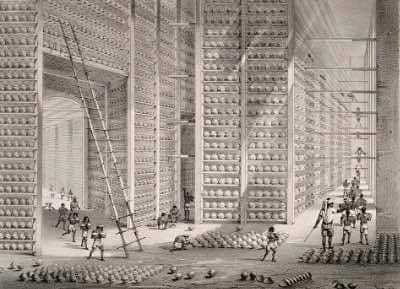
By 1840, opium addiction had spread to government officials, the imperial court and even the ranks of the military.
Chinese buyers paid for the smuggled opium in silver. British merchants then used that same silver to buy the tea, silk and porcelain for shipment home. By the 1830s, opium revenues alone covered Britain’s entire tea habit.
The trade imbalance had been spectacularly reversed. As opium sales flourished, silver that once flowed out of Britain into China was now moving in the opposite direction.
This ‘silver drain’ accelerated as addiction spread. Families spent themselves into bankruptcy, children were left to fend for themselves and China drifted towards a social and economic abyss.
The Chinese dare to close down Britain’s illicit opium trade
Towards the end of 1838, Emperor Daoguang dispatched one of his most trusted officials, Lin Zexu, to shut down the trade. Lin set about the task with ruthless efficiency: 1,700 Chinese dealers arrested, thousands of opium pipes destroyed, foreign trading posts blockaded until merchants surrendered their entire stocks.
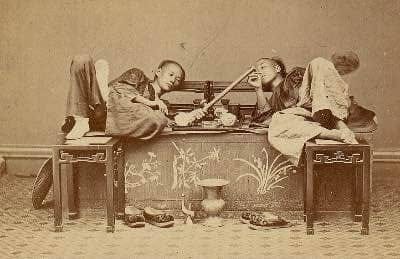
Charles Elliot, the British Chief Superintendent of Trade, was in a pickle. His blockaded staff had endured six weeks on warehouse scraps. Water was scarce, food supplies dwindling. On the bright side, they had plenty of tea. And twenty thousand chests of opium.
Elliot’s solution was as bold as it was unauthorised. He promised the British merchants that the government would compensate them for their opium if they surrendered it to Lin. They did.
Lin’s men spent three weeks destroying the opium. Crisis averted, everyone happy. Everyone except the British government, that is, which was incandescent. Paying out for lost opium was offensive enough. But having British citizens imprisoned for six weeks by a foreign power? Intolerable.
War was inevitable.
The First Opium War
Parliament was split on whether to go to war. Numerous MPs opposed war on the basis that peddling opium was morally indefensible. A young William Gladstone, the future Prime Minister, was particularly vocal in his disgust.
Nonetheless, Lord Melbourne’s government carried the vote on the grounds that…. well… the opium trade was just too profitable to give up.
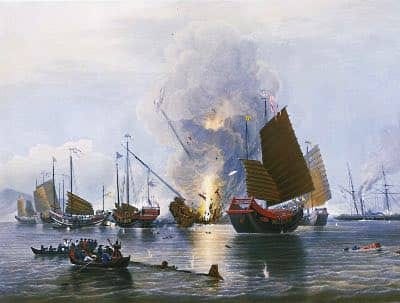
So the First Opium War erupted on 4 September 1839, and by June 1840, the main British naval expeditionary force had arrived. The war was a mismatch. The might of the British navy tore through fleets of Chinese junks with their antiquated cannons.
In an effort to prevent further escalation, Charles Elliot and Qishan—successor to Lin Zexu, disgraced after his crackdown precipitated the war—drafted the Convention of Chuenpi, on 20 January 1841.
Qishan and Elliot hammered out terms: China would pay £6 million in compensation for the destroyed opium, trade would resume at Canton, and—almost as an afterthought—one small, barren island would be ceded to Britain.
The island was called Hong Kong.
The convention achieved what diplomacy rarely does: complete agreement between the two rival powers. Both rejected it as worthless.
Emperor Daoguang couldn’t understand why Britain would wage war for the right to sell poison, while the Foreign Secretary and future Prime Minister, Lord Palmerston, dismissed Hong Kong as “a barren island with hardly a house upon it“.
Elliot proceeded regardless. On 25 January 1841, Captain Edward Belcher of HMS Sulphur landed a party on Hong Kong Island’s northern shore. The following morning, Commodore Sir James John Gordon Bremer raised the Union Jack and claimed Hong Kong Island for Queen Victoria.
Out of Curiosity
In the Batting the Breeze Original Stories podcast, I interviewed Bill Renwick, a former member of the Royal Hong Kong Police Force. Bill shared the story of his part in one of Asia’s highest profile drugs busts of the 1980s, Operation Clinker.
Think of The French Connection meets Popeye with a sprinkling of Keystone Kops, and you have all the ingredients for this fabulous story. Check it out here.
The entire ceremony probably lasted less than an hour. Six thousand Chinese inhabitants weren’t consulted.
The war continued.
