



17th March 1861
(Read time: 10 mins.)
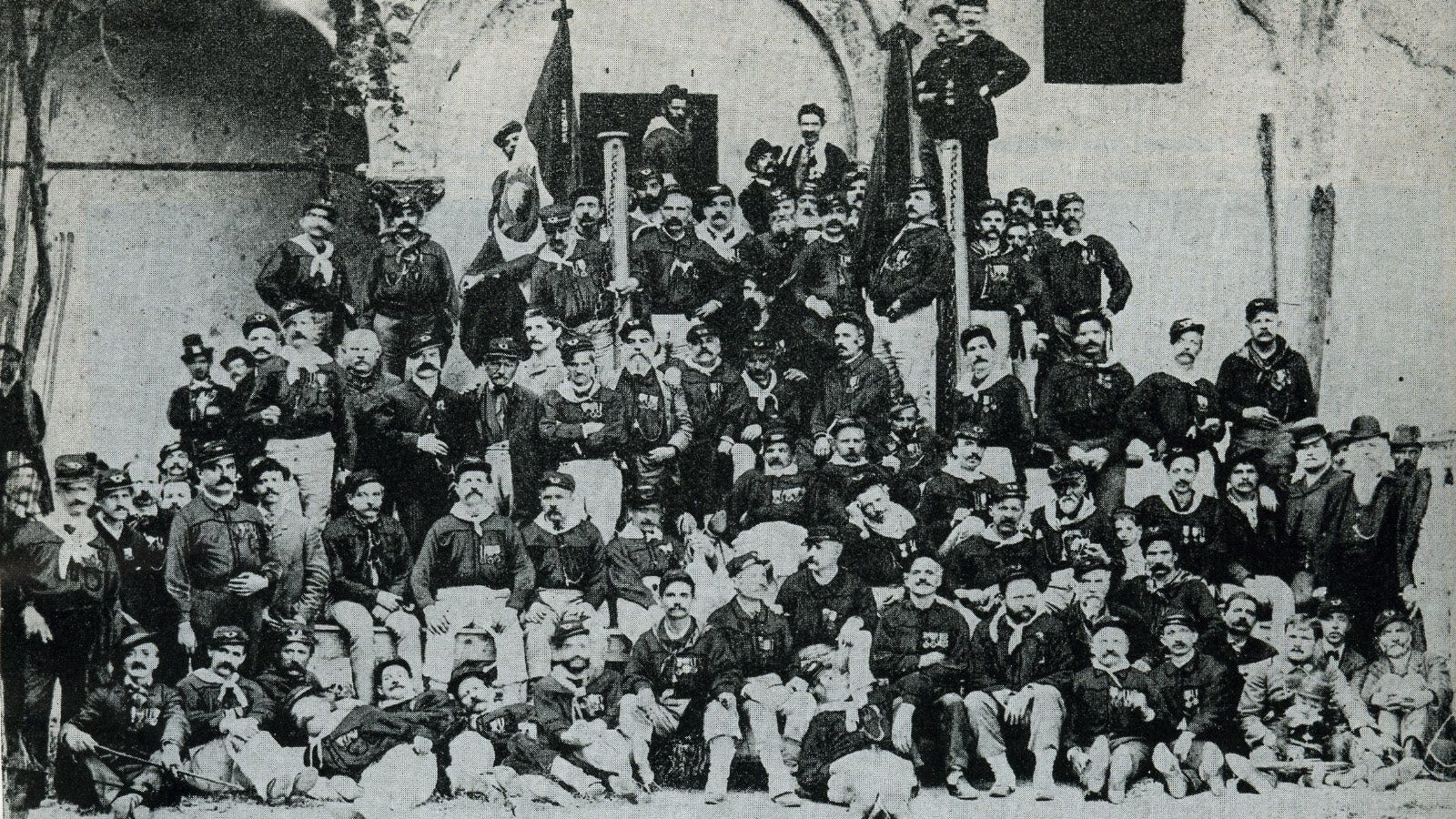
Giuseppe Garibaldi gathered a thousand men from Quarto—’I Mille’, ‘The Thousand’—and slipped out to sea. They wore red shirts, carried whatever weapons they could lay their hands on and headed out to challenge a Bourbon army tens of thousands strong. Within a year, they witnessed the unification of Italy.
There was a period in my early childhood—mid-70s, give or take—when Saturday-morning perfection was entirely achievable.
I was lucky enough to be regularly deposited at Gran and Grandpa’s at weekends. Presumably, my mother had identified that I was exhausting and she needed the break.
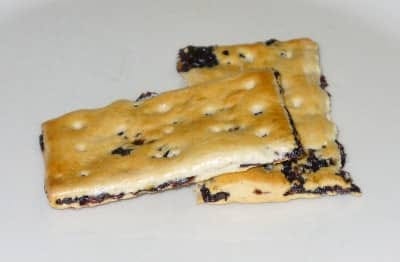
Whatever, it enabled me to watch Casey Jones steamin’-and-a-rollin’ across the black and white television screen, followed at some point by Gran producing the biscuit tin. Custard-Creams, Bourbons and Garibaldis. Of course, I always went for the Garibaldis.
Garibaldi biscuits are those flat, slightly austere rectangles with embedded squashed currants—or, as we called them, dead fly biscuits. I appeared to be the only person who chose them.
For everyone else, they were the biscuit you reached for when there was no other choice—the biscuit tin equivalent of the little blue-wrapped Bounty bars left at the bottom of the box of Celebrations after Christmas.
I didn’t know it then, but Gran, Casey Jones and Garibaldis had set a standard for Saturday mornings that the rest of my life has quietly failed to match.
But here’s the thing about Garibaldi biscuits: they were named after a man so extraordinary, so recklessly brave and so magnificently larger-than-life that a British pick-and-mix biscuit seems a totally inadequate tribute.
A warship, perhaps. A mountain range. A continent, at a stretch. But not a dead fly biscuit.
In 1860, the nation of Italy didn’t exist…
…but the idea of Italia can be traced back to the Ancient Greeks in the 5th century BCE, referring to the southern tip, rather prosaically, as ‘the land of the calves and bulls’.
By the late 1st century BCE, the Romans had stretched the term all the way to the Alps. After that, Italia retreated into the imagination—surviving in sermons, poems and letters… a name in search of a nation.
Fast forward to the nineteenth century.
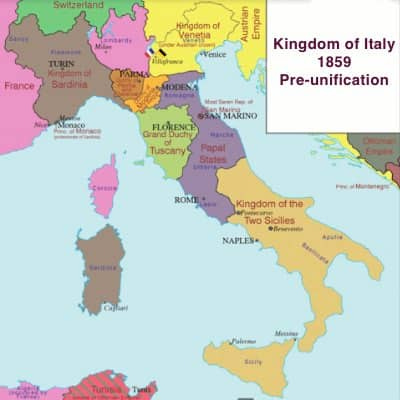
The boot of Europe was still a patchwork of factions, each squabbling with the next and most operating under varying degrees of foreign influence.
There was San Marino, Piedmont-Sardinia in the northwest, the Papal States, the Bourbon Kingdom of the Two Sicilies in the south, Austrian-ruled Lombardy-Venetia in the north and a few others.
The fragmented nature of the boot echoed across Europe. The continent was a collection of city-states, duchies, principalities and sprawling empires. They were stitched together by churches that told you God was in charge and monarchs who claimed to speak in His name.
For most people, this hierarchy was simply the way the world was arranged.
Then along came the Enlightenment…
…an eighteenth-century outbreak of reason and rational thought, closely followed by the French Revolution and the meteoric rise of Napoleon. The old order began to look a little shaky.
The Church’s unquestioned authority was under attack. Dynastic monarchy had been cut down to size—in the case of Louis XVI of France, quite literally. He lost his head.
These two great pillars of European society had developed deep cracks, and new ideas rushed to fill the vacuum.
The outcome was a powerful new narrative: that God—or history, or nature, take your pick—had divided humanity into distinct peoples. Each was bound by language, geography, history and—most importantly—a shared spirit. A nation wasn’t just a right, it was destiny.
This was Romantic Nationalism, and it was intoxicating stuff.
Rising levels of literacy, the expansion of the printing press and a growing tide of newspapers and novels did the rest. People who had never met could now imagine themselves as part of the same community.
In Italia, this groundswell of feeling had a name: the Risorgimento, or ‘the Resurgence’.
Once you could imagine it, you could want it. And once enough people wanted it, someone would have to go and fight for it.
Giuseppe Maria Garibaldi…
…was born on 4 July 1807. Not in Rome, not in Florence, not even in Milan, but Nice, part of the First French Empire.
In the early nineteenth century, Nice was still a modest Mediterranean port, a working harbour rather than a playground for princes. The young Giuseppe grew up in a seafaring family, watching the fishing boats come and go.
It was the kind of upbringing that leaves a boy with two options: stay at home and mend nets, or go to sea.
Garibaldi went to sea.
By his late twenties, Giuseppe had sailed the Black Sea, the eastern Mediterranean and beyond. He had also encountered the ideas of the Risorgimento through a man named Giuseppe Mazzini, whose vision of a unified, republican Italy had a profound effect on Garibaldi.
They say fail your way to success, and Garibaldi did just that.
In his first attempted revolution in 1834, Giuseppe convince himself that a mutiny within the Piedmontese (Sardinian) Navy might trigger a republican uprising.
It didn’t.
It did, however, trigger a trial for treason in absentia and a subsequent death sentence.
Garibaldi had other plans. He fled his homeland and spent twelve years in South America between 1836 and 1848, fighting first for rebels in Brazil and then for Uruguay. In the process, he perfected the hit-and-run tactics that would make his name.
Giuseppe’s South American exploits didn’t go unnoticed. Reports from Brazil and Uruguay filtered back through European papers. He was unwittingly acquiring the aura of a celebrity.
One of his more enthusiastic supporters was the author of The Three Musketeers, Alexandre Dumas, who met Giuseppe in Montevideo around 1847.
When Dumas returned to Europe, he enthusiastically promoted Garibaldi to anyone who cared to listen—particularly within his Parisian literary and intellectual circles.
Out of Curiosity
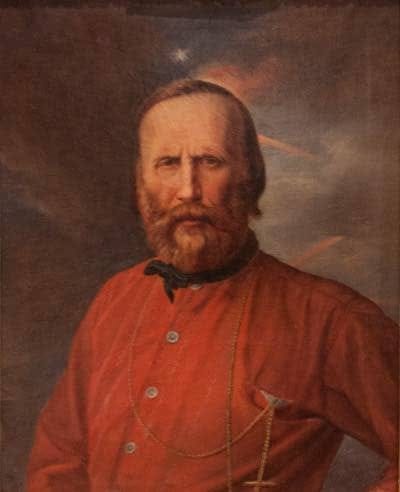
Whether by design or by accident, Garibaldi returned from exile in 1848 with a new look. His long hair, South American poncho, wide-brimmed hat and bright red shirt—a cast-off from a local slaughterhouse—were a caricaturist’s dream.
He had become a real-life romantic hero; part Che Guevara and part Nelson Mandela with a dash of Charlton Heston thrown in for good measure.
Revolution in the air
Garibaldi’s 1848 return coincided with a revolutionary wave breaking across Europe. In typical fashion, he threw himself into confrontation at the first opportunity.
By November, Pope Pius IX had fled Rome in disguise as the nationalist mood turned against him. Mazzini prepared to defend the newly proclaimed Roman Republic against a French expedition sent by Napoleon III to restore the Papacy.
The Risorgimento movement wasn’t anti-Catholic, it just didn’t agree with the Catholic Church running central Italia as its personal kingdom.
As expected, Garibaldi joined Mazzini and fought brilliantly against the odds, but lost anyway.
His Brazilian revolutionary wife, Anita, died during the desperate retreat through the marshes of Romagna. Giuseppe buried her himself, alone, and carried on.
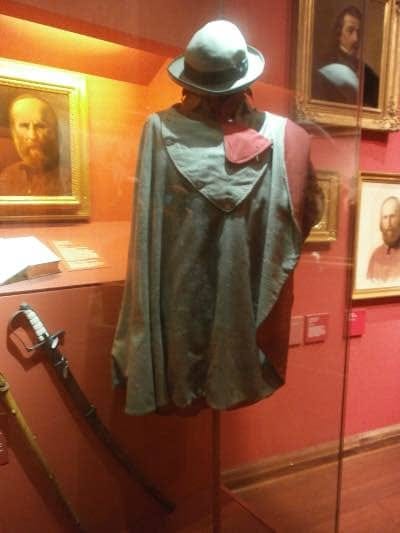
With the French, Austrian, Spanish and Neapolitan armies in pursuit, Garibaldi prudently sought another sabbatical in America, this time in New York City, where he spent the best part of two years making candles on Staten Island.
The flame of Italian nationalism was still burning, but, at that particular moment, probably not in a way that Garibaldi could have imagined.
This second catastrophic failure still didn’t diminish Garibaldi’s standing. If anything, his star shone even brighter. His causes were seen as just and he fought with extraordinary physical courage. Writers such as Dumas and Victor Hugo—author of The Hunchback of Notre-Dame and later Les Misérables—needed little encouragement to champion the romantic hero.
Even Abraham Lincoln had sounded Garibaldi out regarding a possible command in the Union Army. He declined. He had Italia to think about.
I Mille —1860
In the spring of 1860, Giuseppe’s patience paid off.
A revolt had flared up in Sicily against the highly unpopular Bourbon King of the Two Sicilies, Francis II. The revolt was faltering.
Garibaldi, now fifty-two years old, struggling with arthritis and with a white beard tucked behind his poncho and red shirt, decided that this was his moment.
On the evening of 5 May 1860, he gathered roughly a thousand men from Quarto, near Genoa—‘I Mille’, ‘The Thousand’—and slipped out to sea. They wore red shirts, carried whatever weapons they could lay their hands on and headed out to challenge a Bourbon army tens of thousands strong.
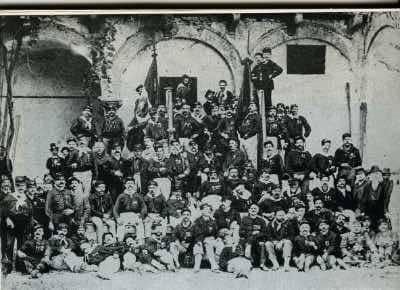
What followed was one of the most extraordinary military campaigns of the nineteenth century.
Garibaldi landed at Marsala on Sicily’s western tip in May 1860, and within weeks had routed the Bourbon forces at Calatafimi. His ragbag army of volunteers attacked uphill against professional soldiers and fortified defences with such ferocity that the Bourbon troops simply broke.
When one of his officers remarked that it looked impossible, Garibaldi allegedly replied:
Qui si fa l’Italia o si muore
“Here we make Italy—or we die.”
By early June, Garibaldi had taken Palermo. By August, he crossed to the Italian mainland.
The Bourbon kingdom was collapsing faster than anyone had dared hope. Naples fell with hardly a whimper in September. Garibaldi rode into the city in an open carriage through jubilant crowds. The king had already left.
Then Garibaldi astonished everyone.
The move that led to the unification of Italy
Mazzini pressed him to proclaim a republic—it was, after all, everything they had both fought for. Instead, Garibaldi handed everything he had conquered—the whole magnificent, hard-won southern peninsula—to Victor Emmanuel II, the King of Sardinia.
The revolutionary gave his revolution to a king.
Garibaldi was a fearless fighter, but he was also a realist. He knew that a republican Italy born out of his army would have been too fragile to face the inevitable fury of France and Austria.
Conversely, King Victor Emmanuel II already had an army, a functioning government and diplomatic relationships with the great European powers.
Better a united Italy under a monarch than a failed republic.
On 17 March 1861, the newly assembled Italian Parliament in Turin proclaimed the Kingdom of Italy, with Victor Emmanuel II as its first king.
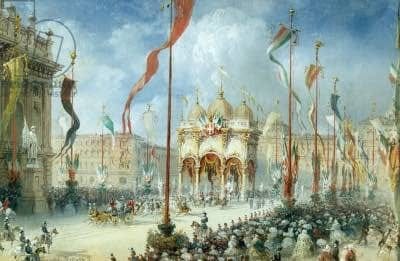
Out of Curiosity
The proclamation of the Kingdom of Italy took place thirteen days after Abraham Lincoln became the 16th President of the United States and twenty-six days before the outbreak of the American Civil War.
Garibaldi attended no ceremony. He accepted no title, no reward, no pension. The man who had done more than anyone alive to make Italy a reality simply went home to his farm on the island of Caprera, where he grew potatoes, tended his animals, and stared out at the sea.
He had unified a nation and asked for nothing in return.
FOOTNOTE
Garibaldi was not entirely done. The Kingdom of Italy had been declared in 1861 but Rome and the Venetian lands remained stubbornly outside it.
So he made further attempts to take Rome. His two failed excursions in 1862 and 1867 proved a little awkward as he ended up fighting against his own Italian government, which was terrified of upsetting the French.
Rome fell when the French were called home to face the Franco-Prussian war in 1870. The Italian army simply moved in.
As for Pope Pius IX, he withdrew into the Vatican and denounced the new Italian state until his death eight years later. The Vatican became an independent state in 1929 through an agreement with the future fascist dictator Benito Mussolini.
Vatican City was born.
Venice ‘came good’ in 1866, less through Garibaldian aggression than through Prussia’s defeat of Austria, after which Venetia was handed to Italy as part of the peace.
Trentino and South Tyrol—the Alpine regions bordering Austria and Switzerland—weren’t incorporated until after World War One in 1919, fulfilling promises made to Italy in return for joining the Allies in 1915.
Trieste and Istria followed the same logic: promised to Italy in 1915 and awarded after the war, though the ink didn’t dry on the paperwork until 1954.
The unification of Italy was complete.
Out of Curiosity
After unification, Garibaldi embarked on a number of triumphant tours across Europe.
In Britain, moving Garibaldi from place to place became a logistical nightmare. Processions were regularly halted and rerouted while Victorians abandoned all dignity and behaved like screaming fans at a pop concert.
Europe’s high society found the persona a little too much, but the public couldn’t get enough of him.
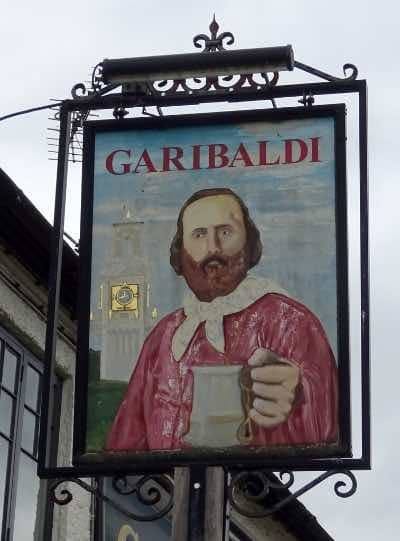
Which brings me back to the humble Garibaldi biscuit.
Giuseppe Garibaldi died on 2 June 1882, at the age of seventy-four, on his island of Caprera. He had spent his life fighting for the underdog, the forgotten and the overlooked. Perhaps a biscuit that nobody notices at the bottom of the tin is an entirely appropriate tribute after all.

Thank you for joining me.
Steve
HOST & CHIEF STORY HUNTER
ATTRIBUTIONS
Giuseppe Garibaldi: Davide Mauro, CC BY-SA 4.0, via Wikimedia Commons.
I Mille: sconosciuto, Public domain, via Wikimedia Commons.
Sign for the Garibaldi: Bourne End by JThomas, CC BY-SA 2.0, via Wikimedia Commons.
Garibaldi biscuit: James F. Carter, CC BY-SA 2.5, via Wikimedia Commons.
Kingdom of Italy: Artemka, CC BY-SA 3.0, via Wikimedia Commons.
Garibaldi’s poncho: Stefano Stabile, CC BY-SA 3.0, via Wikimedia Commons.
Royal Procession: Carlo Bossoli, Public domain, via Wikimedia Commons.


CC0: https://creativecommons.org/public-domain/cc0/
CC BY 4.0: https://creativecommons.org/licenses/by/4.0
CC BY-SA 3.0: https://creativecommons.org/licenses/by-sa/3.0
CC BY-SA 2.0: https://creativecommons.org/licenses/by-sa/2.0
CC BY-ND 4.0: https://creativecommons.org/licenses/by-nd/4.0/
CC BY-SA 4.0 https://creativecommons.org/licenses/by-sa/4.0/