

Dates with History Midweeker
The historical joyride for a curious mind


Dates with History Midweeker — Spend a few minutes with me exploring a handful of historical moments, figures and the occasional oddity connected to this week. Some you’ll know. Some you won’t—hopefully! 1st July 2026.

Happy Wednesday!
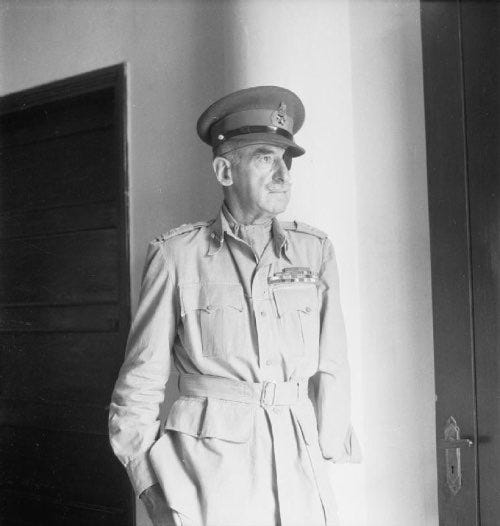
The first Chancellor of the German Empire, Otto von Bismarck, is often quoted as having said that, ‘God reserves a special providence for fools, drunkards, children—and the United States of America’. Had he lived a little longer, he might have included a fourth category for a single character—Adrian Carton de Wiart.
Brussels, 1880. Adrian Carton de Wiart entered the world half Belgian, half Irish, and in a hurry. At nineteen, he decided Oxford and the law weren’t for him, slipped away, gave a false name, claimed to be twenty-five and signed up for the Boer War. The army took him at his word.
The 1914–15 campaign in Somaliland relieved de Wiart of his left eye and part of his ear. The following year at Ypres, a German artillery shell shattered his left hand. When the surgeon declined to amputate the dangling fingers, de Wiart removed them himself. By 1916 he was back on the Western Front, one-eyed, one-handed, and in good spirits.
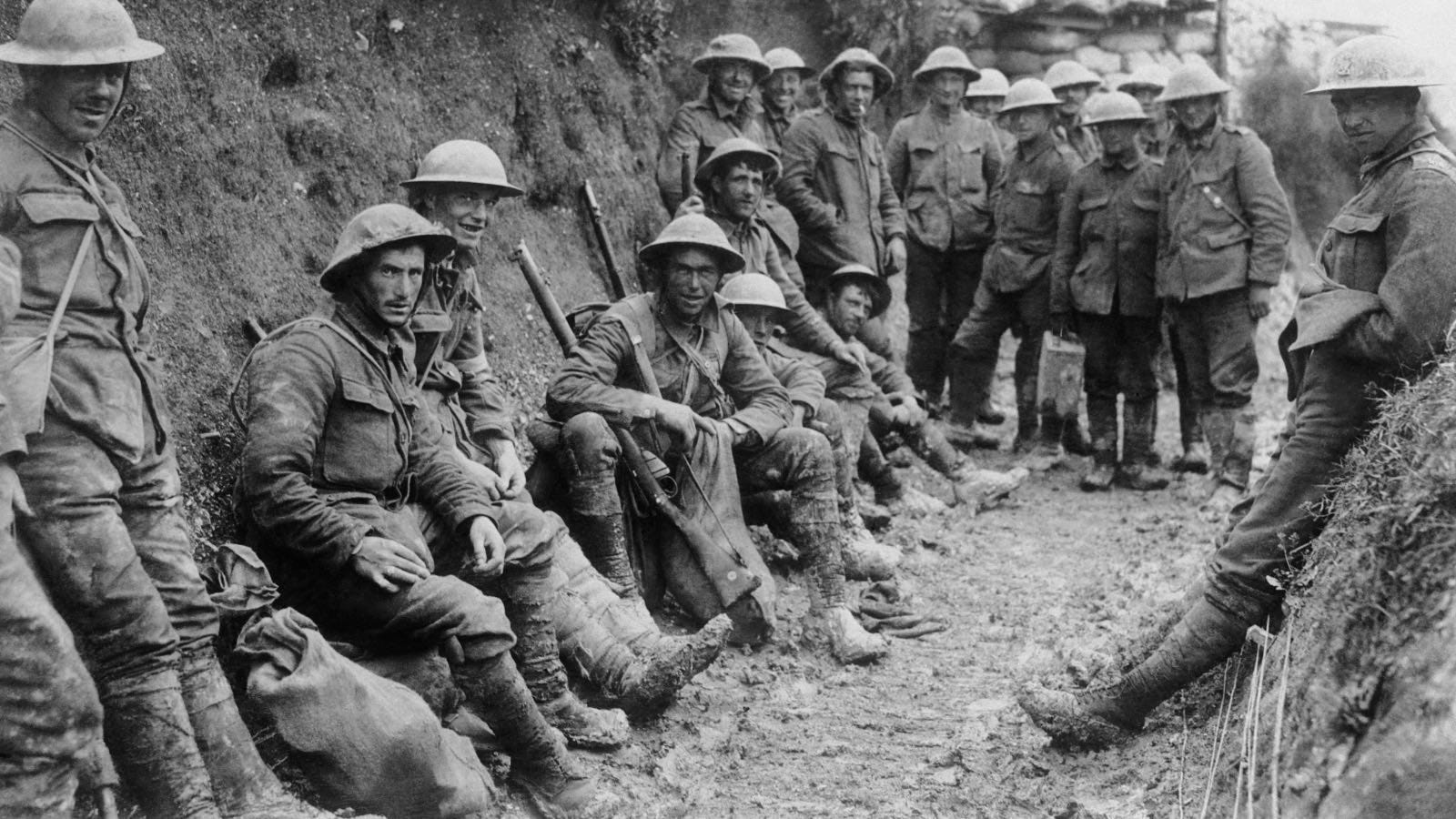
Two years in, the Western Front had delivered mud, industrial-scale death and a front line that had barely moved. Something had to give. The British and French settled on a massive offensive along the River Somme: a week-long artillery bombardment designed to pulverise the German defences so completely that the infantry could simply walk through whatever was left.
Much of the 1914–18 Great War has faded into dates and footnotes. The Battle of the Somme hasn’t. Five months and a million casualties later, the Allies advanced scarcely seven miles—so much sacrificed for so little.
One hundred and ten years ago today, 1 July 1916, at 07:30, 100,000 British troops went over the top. They were ordered to walk, not run. The guns had done their work, they were assured, and the German defences were finished. They weren’t. By nightfall, 57,000 men were dead, wounded or missing. The first day of the Battle of the Somme remains the bloodiest day in the history of the British Army.
The following morning at the shattered village of La Boisselle, three of the four battalion commanders had become casualties. Carton de Wiart took charge of all four, moving back and forth through intense fire to organise positions, secure supplies and ensure every yard stayed held. He was shot in the ankle. Later, in the head. He remained in command throughout.
Adrian Carton de Wiart’s Victoria Cross citation in November 1916 gave him credit for averting a serious reverse on 2–3 July 1916, through “dauntless courage and inspiring example”. His memoir, Happy Odyssey, gives the medal rather less attention. There was, after all, more to cover—two air crashes, an Italian PoW camp from which he tunnelled out, and the small matter of his verdict on the whole experience... “Frankly, I had enjoyed the war...“
We are all told that the pen is mightier than the sword, but I know which of these weapons I would choose.
ADRIAN CARTON DE VIART
The Stone of Scone is coming home, it’s coming…
Thirty years ago this Friday, 3 July 1996, UK Prime Minister John Major announced in Parliament that the Stone of Scone—Scotland’s ancient coronation stone—would be going home.
It was exactly 700 years since Edward I had removed the Stone from Scone Abbey, Perth in 1296 on the first of many invasions of Scotland. Destination... Westminster Abbey.
For centuries before Edward’s men prised it from the abbey floor, the Stone of Scone was the centre-piece of each Scottish enthronement.
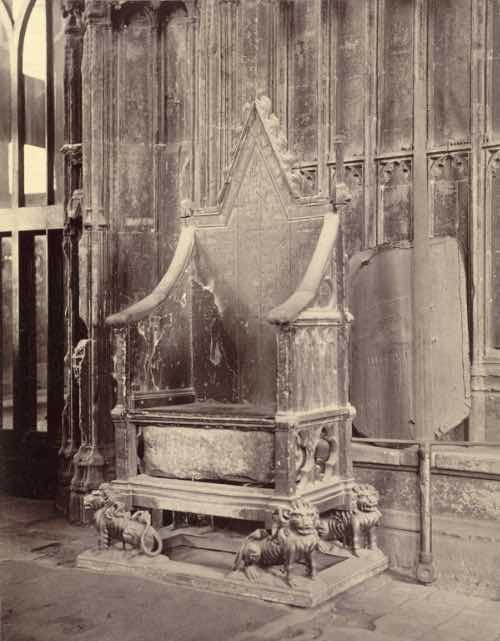
Edward commissioned a Coronation Chair to house the Stone, and both featured at almost every English/British coronation from Edward II (1308) through to Elizabeth II (1953), a total of 26 monarchs.
Out of Curiosity
I mentioned that the Coronation Chair and Stone featured at ‘almost’ every coronation... well here’s why.
It was a tale of two Marys.
First came Mary Tudor in 1553, England’s first queen in her own right. The Catholic Mary decided that the ancient chair had been tainted by the Protestant sympathies of her late half-brother Edward VI, and was crowned on a substitute throne. ‘Polluted‘, she called it.
Mary II had a more practical problem in 1689. She wasn’t snubbing the chair on principle. Her husband, William III, was sitting in it. Crowned jointly, with only one Coronation Chair between them, somebody had to compromise—and it wasn’t going to be the king.
A copy was hastily knocked up for Mary.
Following John Major’s announcement, later that year on St Andrew’s Day, 30 November 1996, the Stone crossed the border into Scotland under police escort and on to Edinburgh Castle, where 10,000 onlookers turned out to cheer.
There was a small caveat in the agreement—that the Stone be made available for all future coronations. Sure enough, in 2023, the Stone made the journey south again, briefly resuming its old position beneath Charles III at his coronation, before being sent straight back to Scotland.
The Coronation Chair is on permanent display in Westminster Abbey. I popped into the Abbey a couple of weeks ago—for a 700-year-old piece of carpentry, the chair is looking remarkably healthy.
Question of the Week
Of course, Saturday marks 250 years since the American Declaration of Independence, 4 July 1776, when the 13 British-controlled colonies declared their independence from Great Britain.
Extraordinarily, on the 50th anniversary of the Declaration of Independence, 4 July 1826, two former US Presidents—and Founding Fathers—died.
Which US Presidents were they?
And finally… 75,000 days ago
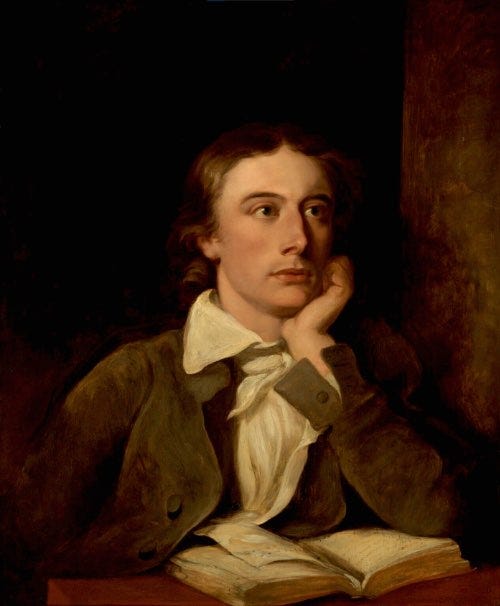
John Keats entered the world in London on 31 October 1795, the son of a prosperous livery-stable manager—by contrast with the starving poet he would later become.
At eight, he lost his father to a fall from a horse, while his mother followed five years later, worn out by tuberculosis. So, by his mid-teens, Keats was effectively an orphan—his affairs in the hands of a guardian more keen to lock up his inheritance than unlock his prospects.
Keats trained as a surgeon, but by the age of 21 had glimpsed the literary life and walked away from medicine to write poetry full-time.
It transpired that Keats would only enjoy four years pursuing his new passion. A year after abandoning the scalpel, he contracted tuberculosis on a walking tour of Scotland.
And yet, in that brief window, Keats wrote Ode to a Nightingale, The Eve of St Agnes and To Autumn—poems now ranked among the finest in the English language. They are also ones I can recite, having had them drilled into me for my English Literature O-Level longer ago than I’d care to admit.
Despite a move to the warmer climate of Rome, John Keats died 75,000 days ago last Sunday, 23 February 1821, penniless and unaware of any inheritance that might have come his way. He was 25 years old.
As he lay on his deathbed, Keats’ friend Joseph Severn asked how he felt. He replied...
“Better, my friend. I feel the daisies growing over me”.
Out of Curiosity
For those of you born after the early 1980s, or who didn’t grow up in England, O-Levels were exams invented primarily to make teenagers miserable, at a time when that wasn’t considered a safeguarding issue.
Here’s how it worked. You turned up at school aged eleven, spent five years being taught things, and then just as summer arrived, you were locked in a sports hall for three weeks and told to write down everything you knew. Just you, a pen and the slowly dawning realisation that you should have revised more.
Your grandparents will tell you—don’t make eye contact, it only encourages them—that O Levels were much harder than anything you face today, and that GCSEs—their soft, mollycoddled replacement—are the devil’s spawn.
“Season of mists and mellow fruitfulness,
Close bosom-friend of the maturing sun;
Conspiring with him how to load and bless
With fruit the vines that round the thatch-eves run;”
JOHN KEATS—To Autumn, 1819.
Question of the week… answer
John Adams, the second president of the United States, and Thomas Jefferson, the third, both died 200 years ago this Saturday, 4 July 1826—exactly fifty years after Congress adopted the Declaration of Independence.
That afternoon, as Adams lay dying in Quincy, Massachusetts, he is said to have murmured, “Thomas Jefferson still survives,” unaware that Jefferson had slipped away at Monticello, Virginia, a few hours earlier.
Unsurprisingly, these twin deaths have fuelled their share of conspiracy theories ever since—not helped by a third presidential death exactly five years later on the same date: James Monroe, the fifth president, died on 4 July 1831.
To all my American friends and readers, here’s wishing you a very happy 250th Independence Day from across the Atlantic!

Thank you for joining me. Enjoy the rest of the week!
Steve
CHIEF STORY HUNTER & WRITER
ATTRIBUTIONS
Carton de Wiart: Cecil Beaton, Public domain, via Wikimedia Commons.
John Keats: William Hilton, Public domain, via Wikimedia Commons.
Royal Irish Rifles: Royal Engineers No 1 Printing Company., Public domain, via Wikimedia Commons.
Coronation Chair with Stone of Scone: Cornell University Library (No restrictions or No restrictions), via Wikimedia Commons.


.jpg)
I also have an archive of one-to-one interviews with some extraordinary folk with a story to tell. You can listen to the Batting the Breeze Original Stories podcast FREE on Apple Podcasts, Spotify, Overcast,Pocket Casts, Amazon Music or almost any podcast player of your choice. Check out the Batting the Breeze website.
Registered address: 115 Burley Road, Christchurch, Dorset, UK BH23 8AY
Copyright © 2026 Logical Business Ltd. All rights reserved.
Dates with History and Batting the Breeze are properties of Logical Business Ltd.