



10th February 1906
(read time: 10 mins.)
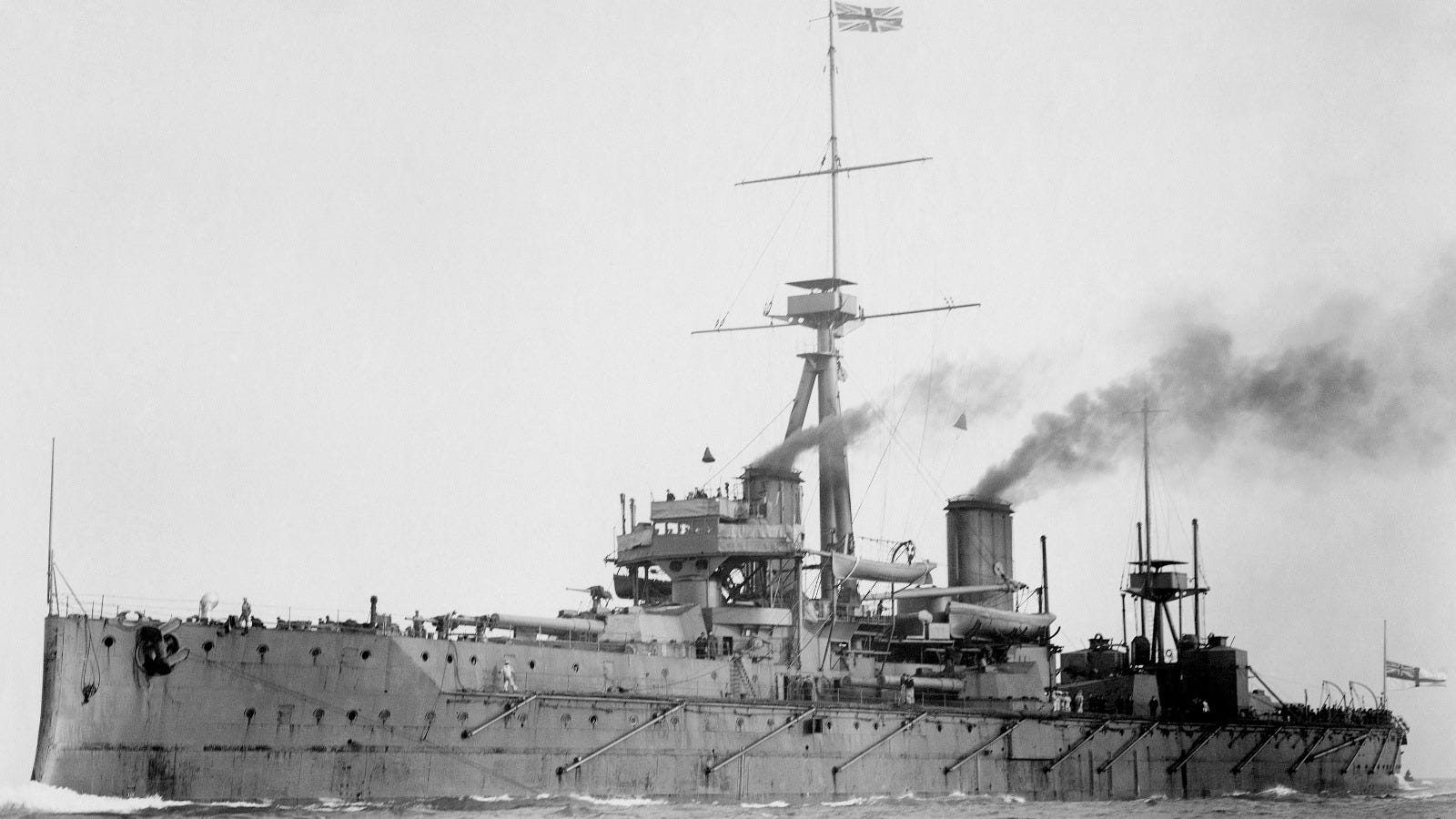
On 10 February 1906, Admiral Fisher stood beside King Edward VII at Portsmouth Dockyard, watching as the last blocks were knocked away. The King reached for that bottle and swung it against her bow. The 18,000-ton vessel slid into the Solent, stirring up waves that would be felt around the world.
We know that every object tells a story. That doesn’t necessarily mean we’re motivated to investigate every object we see.
Growing up, my parents’ house was full of things that had simply always been there. I walked past them every day for years without wondering where they came from or why they mattered: a black and white photograph in a frame, an ornament gathering dust, a print of an old master.
And then there was that small, dark leather box on the mantlepiece.
Years later, I discovered a handwritten note by my grandmother mentioning ‘an empty valve box which was to hold a crystal used for detecting and receiving wireless signals‘.
She was referring to that dark leather box. It turned out to be the property of the Imperial German Navy during World War I.
The question is, how did it end up on our mantlepiece?

The story begins on a cold February morning in 1906 at Portsmouth Dockyard on the south coast of England. Sixty thousand people had gathered to witness something extraordinary.
King Edward VII stood ready with a bottle of Australian sparkling wine, preparing to christen the most revolutionary warship the world had ever seen.
He swung the bottle against the bow. It bounced back. He swung again. This time it shattered.
I christen you Dreadnought!
John Arbuthnot Fisher
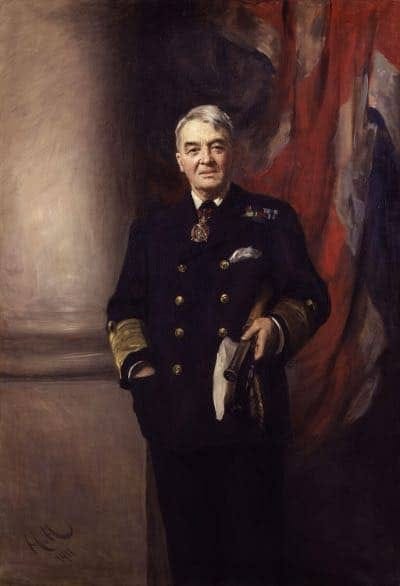
The man standing beside the King that day, watching his monumental, steel vision become reality, was Admiral John Arbuthnot Fisher.
‘Jackie’ Fisher was born in 1841 in Ceylon (present-day Sri Lanka), just as Queen Victoria’s reign was gathering momentum and the British Empire was spreading unchecked across the globe.
He was about five feet seven inches tall, ‘stocky, with a round face and a fixed, compelling gaze’. Jackie’s parents were British, though some later suggested Asian ancestry due to his distinctive features and yellow-tinged skin.
The truth was simpler: dysentery and malaria in middle life had nearly killed him.
At thirteen, Fisher joined the Royal Navy. It was 1854.
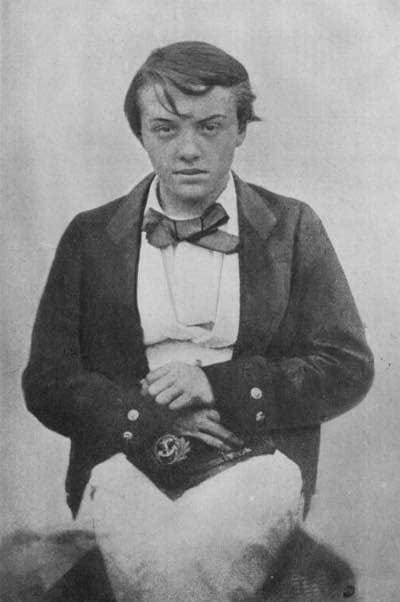
By the 1860s, Jackie had made his name as a champion of torpedo technology. While stationed in China, he installed the first electrical firing system on any Royal Navy warship.
The more conservative admirals weren’t impressed. Torpedoes, they sniffed, were ‘underhand and un-British‘.
Fisher didn’t care.
The two-power standard
In 1899, Jackie Fisher was appointed commander-in-chief of the Mediterranean Fleet, and by 1904 he had been promoted to First Sea Lord, head of the Royal Navy.
It was perfect timing. The world was shifting. Germany, under Kaiser Wilhelm II, had been expanding its navy since 1898 to stake a claim as a global power.
The British clung to their long-standing ‘two-power standard’, meaning the Royal Navy should outnumber the combined fleets of any two other powers. That policy was under pressure.
Fisher wasn’t intoxicated by a desire for quantity. He wanted quality. He knew that overwhelming firepower, range and speed were the keys to winning on the high seas.
The first Dreadnought
Fisher demanded the impossible.
He wanted a ship with ten 12-inch guns in five twin turrets—raw destructive power. She would have steam turbine propulsion—unprecedented in a large warship—and a speed of 21 knots.
And most ambitiously of all, Fisher wanted her built in twelve months. The typical battleship took around 2½ years to complete.
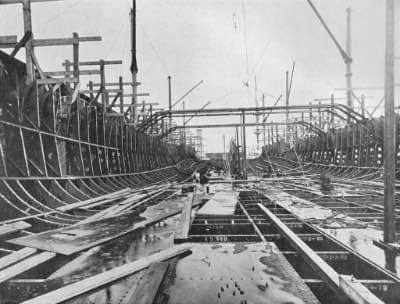
The keel was laid at Portsmouth Dockyard on 2 October 1905. Three thousand men would work a punishing 69-hour week—six days straight, 6 a.m. to 6 p.m., with compulsory overtime and a 30-minute lunch break.
By day 125—just four months after the keel was laid—the hull was finished.
…and so we return to that cold February morning in 1906—the launch.
On 10 February 1906, Admiral Fisher stood beside King Edward VII at Portsmouth Dockyard, watching as the last blocks were knocked away. The great hull hung on a single symbolic cable.
The King reached for that bottle—Irvine’s Victorian sparkling wine by later accounts—and swung it against her bow.
The 18,000-ton vessel slid into the Solent, stirring up waves that would be felt around the world.
She was 526 feet of revolutionary naval power and would carry a crew of 800. Her four propeller shafts, driven by steam turbines, would give her an unprecedented top speed of 21 knots. Those 12-inch guns could hurl 850-pound shells nearly ten miles.
She was HMS Dreadnought.
Poignantly, overlooking proceedings was HMS Victory—Lord Nelson’s flagship from the Battle of Trafalgar in 1805—serving out her days reduced to harbour duties.
In that moment, the old wooden warship and the revolutionary steel dreadnought, separated by a century of naval evolution, shared the same waters.
One represented Britain’s past naval supremacy; the other, its uncertain future.
Out of Curiosity
The name Dreadnought came from the old English ‘dread nought’—fear nothing. It was perfect for Fisher, whose personal motto was “Fear God and Dread Nought.”
HMS Dreadnought was the sixth Royal Navy ship to bear the name. The first had fought off the Spanish Armada in 1588. Number five had sailed with Nelson at Trafalgar.
But this Dreadnought would eclipse them all.
HMS Dreadnought catalyses Britain’s naval decline
Paradoxically, Fisher’s masterstroke, HMS Dreadnought, may have accelerated Britain’s decline as a global power.
The fearsome ship had made Britain’s massive naval fleet almost obsolete overnight. The older vessels in the fleet became ‘pre-dreadnoughts’, relics of a bygone era.
Japanese, German and American navies—followed by other European powers—scrambled to build their own dreadnoughts.
Fisher had wiped the slate clean. The Empire’s naval dominance was suddenly under threat.
Despite the British government’s commitment to an ambitious shipbuilding program, Germany had narrowed Britain’s advantage by 1914.
The naval arms race unleashed by the HMS Dreadnought drained the treasury, fuelled tensions that helped tip Europe into war, and left Britain economically exhausted by 1918—victorious, but in no position to celebrate.
Fisher’s revolutionary warship had made Britain supreme at sea—but at a cost the Empire would struggle to afford.
Admiral John Fisher’s death
Jackie Fisher died on 10 July 1920. His coffin, mounted on a gun carriage, was drawn through London’s streets to Westminster Abbey by bluejackets—ordinary sailors honouring their admiral.
Eight admirals acted as pallbearers, led by Admiral Jellicoe, commander of the Grand Fleet at the Battle of Jutland four years earlier in 1916.
Fisher’s ashes were later placed in the grave of his wife at Kilverstone, Norfolk, under a chestnut tree, overlooking the figurehead of his first seagoing ship, HMS Calcutta.
At the time of Fisher’s death, about 120 dreadnoughts had been launched worldwide. They would dominate the world’s navies for a further 25 years, evolving into massive ships capable of 32 knots—twice the speed of typical 1914 pre-dreadnoughts.
Fisher had started his career in a navy of wooden sailing ships armed with muzzle-loading cannons—the sort of vessels Nelson would have recognised.
He ended it commanding a navy of steel battlecruisers, submarines and the first aircraft carriers. Quite a transformation for one career.
Out of Curiosity
Not many people can claim they invented text-speak. Fisher is credited by the Oxford English Dictionary with the earliest known use of ‘OMG’. In a letter to Winston Churchill, then Minister of Munitions, written on 9 September 1917, the 76-year-old former admiral vented his spleen:
“I hear that a new order of Knighthood is on the tapis*—O.M.G. (Oh! My God!)—Shower it on the Admiralty!!”
Fisher was bitter and resentful toward the Admiralty leadership. He had resigned as First Sea Lord in May 1915 in a dramatic clash with Churchill over the disastrous Dardanelles campaign.
So when Fisher heard rumours of a new knighthood being created, he responded with scornful sarcasm—a mock-horrified reaction suggesting they should hand out honours liberally to the very officials he held in contempt for bungling the war effort.
* ’tapis’ = table
…back to that dark leather valve box
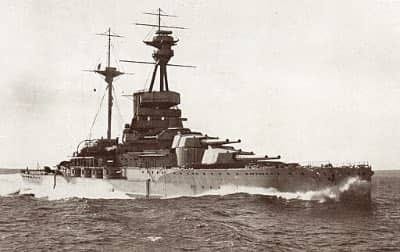
The super-dreadnoughts inevitably followed—bigger and faster than the original HMS Dreadnought. One of those super-dreadnoughts was HMS Revenge, commissioned in 1916 with the 1st Battle Squadron and later serving as flagship.
She carried eight 15-inch guns, each of which could send a shell the size of a small car over 15 miles.
She was a leviathan of the sea.
My grandfather, Cecil Bottle, had run away from home at fourteen and enlisted in the Royal Navy. By 1916, he was serving as a telegraphist and fought in the infamous Battle of Jutland—the largest naval battle of World War I, where fifty-eight dreadnoughts and battlecruisers clashed in the North Sea.
By the end of the war, Cecil Bottle was serving aboard the mighty HMS Revenge.
Scapa Flow
On 21 November 1918, as part of the terms of the Armistice, the German fleet surrendered at the Firth of Forth in Scotland.
Over the next few days, they were escorted to Scapa Flow in the Orkney Islands to be detained during the peace negotiations at the Treaty of Versailles.
One of those escorts was HMS Revenge with Chief Telegraphist Cecil Bottle on board.
The Germans remained in control of their vessels but were closely guarded by the British 1st Battle Squadron.
For seven months, the German fleet sat at anchor while diplomats argued over the problem of what to do with them.
Then on 21 June 1919, with most of the British fleet conveniently away on exercises, Rear Admiral Ludwig von Reuter decided to solve the problem himself. He ordered his entire fleet scuttled; seacocks opened, compartments flooded.

It was the greatest act of naval self-destruction in history: fifty-two of the seventy-four interned ships slipping beneath the surface of Scapa Flow within hours.
Better to sink them in a Scottish anchorage than hand them over to the victors as trophies.
Cecil Bottle was sent on trips to many of these semi-submerged vessels to see if any radio equipment could be salvaged.
From an array of recovered radio equipment, he kept an empty valve box as a souvenir—a dark leather container that protected the crystals used in wireless sets to detect and receive signals.
