The Gregorian Calendar and Britain's Lost Eleven Days
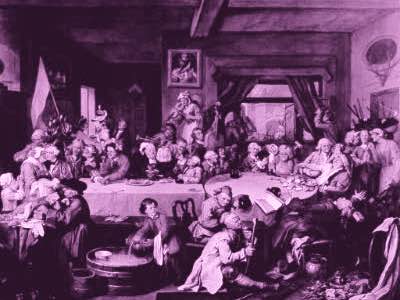

2 September 1752
(read time: 5 mins.)
When Britain finally adopted the Gregorian calendar in 1752, eleven days simply vanished. The public was baffled. The taxman was not. Some things never change.
If you had lived in Great Britain or anywhere in the British Empire in September 1752, you would have gone to bed on the 2nd and woken up on the 14th.
Eleven entire days—gone. And not because you'd had a particularly good evening. You didn't sleep through them. You weren't drunk (probably). They simply ceased to exist.
Eleven days quietly abolished—erased from the calendar and never coming back. No refunds, no appeals. Miss a birthday? Tough. Owe rent on the 7th? Fascinating problem.
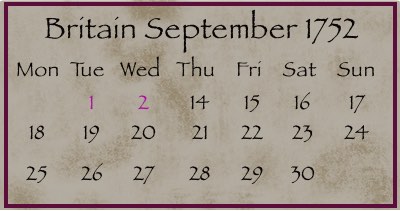
Julian to Gregorian Calendar.
How come?
Well, to understand this, let’s step back a few years and look at how everyday folk in Britain arranged their yearly cycle back in the Middle Ages, say around 500 CE*.
The year was divided into Quarter Days, named after Christian festivals, to make them easy to remember. As well as their ecclesiastical origins, these were also the days on which rents were payable to the feudal landlords. God and mammon sharing a calendar.
Lady Day: (Feast of the Annunciation), 25 March; This was New Year’s Day. Night and day were balanced, marking the beginning of the agricultural year. It was time for farmers to get planting.
Midsummer Day: (Feast of St. John the Baptist), 24 June; falling near the summer solstice, the longest day. A time for festivals, celebrating nature, fertility and community.
Michaelmas: (Feast of St. Michael and All Angels), 29 September; a celebration of the end of the harvest season and the beginning of autumn.
Christmas: (Feast of the Nativity), 25 December; the Christian celebration of the birth of Jesus. It’s all about the family, gifts and feasting for the winter.
This natural view of the annual cycle sat well with the calendar mechanism of the day, the Julian Calendar.
Introduced by the future Roman dictator Julius Caesar in 46 BCE, the Julian calendar followed the solar cycle, aligning with the Earth’s orbit around the sun.
To handle that awkward quarter-day, Caesar's astronomers did what any sensible bureaucrat would do—they rounded down for three years and then added an extra day every fourth year. The leap year was born. It was elegant, it was logical and for over fifteen centuries, it was the calendar the entire Western world lived and died by.
The Julian calendar was an improvement on the previous Roman calendar, which was a lunar affair—built around the Moon’s cycles rather than the Sun’s. The Roman calendar encouraged higgledy-piggledy theories regarding the length of a year and needed regular tweaking.
How long was a year, exactly? Excellent question. Ask ten Romans and you would get eleven answers. The calendar required constant patching to stop it drifting embarrassingly out of sync with the seasons.
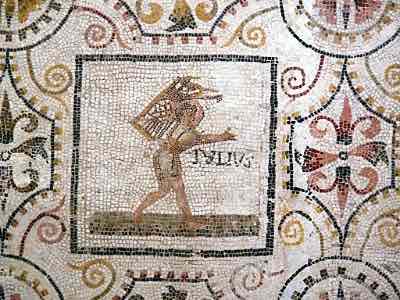
Roman calendar mosaic, depicting July/Julius, 3rd century CE.
By contrast, the Julian calendar kept the twelve dividers, the months, to track the lunar cycle, more or less. You may remember from school learning that the months were named after Roman Gods and significant figures, so; January/Janus, March/Mars, May/Maia, not forgetting July, which Caesar named in honour of……. himself.
The leap year accounted for the extra 1/4 day per year. February received the extra day not as the shortest month but because, at the time, it was the last month of the year.
Fast-forward to 2 September 1752.
The Gregorian calendar was adopted (named after Pope Gregory XIII). This allowed Britain to fall in step with most of Western Europe, which had converted back in 1582.
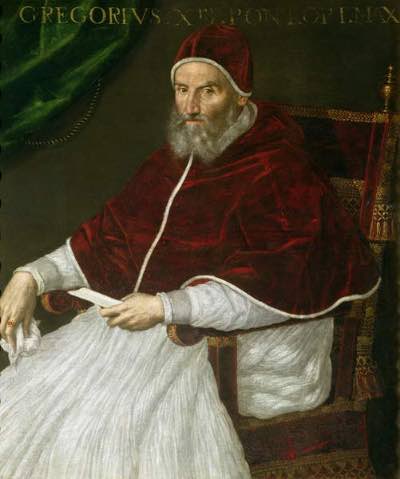 Pope Gregory XIII
The Gregorian calendar calculated the solar year to be 365.2425 days. This greater precision meant even less tampering was necessary.
However, the change highlighted a problem. Adjusting to the Julian calendar 170 years after most of Western Europe had converted meant that Great Britain was now 11 days behind. The solution… simply remove 11 days from the calendar.
The 3rd of September 1752 became the 14th of September 1752. Job done.
Not everyone took the change without fuss. Some people were genuinely convinced that eleven days had been lopped off their lives—that they were ageing faster than nature intended, victims of a calendrical mugging.
However, apart from a few adjustments around the Quarter Days, Britain adapted with admirable calm. The Gregorian calendar has since become the world's calendar of choice.
Out of Curiosity
Just in case you’ve never quite got your head around the leap year rule, as defined by the Gregorian calendar...
Leap Year
A year is a leap year if it is divisible by 4. So, 2024 is a leap year.
Exception
A year marking the turn of a century, e.g. 2000, 2100, 2200, can only be a leap year if it is divisible by 400.
This means that 1600 and 2000 were leap years, with the next century leap year set for 2400.
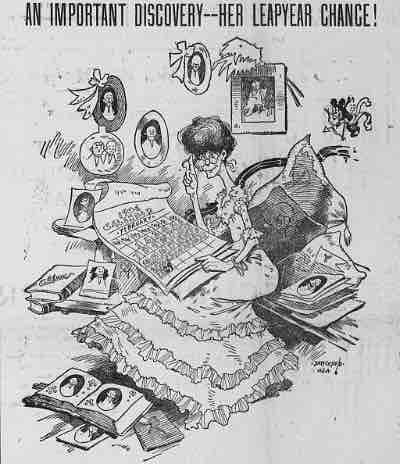
In parts of Ireland and Scotland, a legend grew up that in a leap year (especially on 29 February) a woman could propose marriage to a man rather than waiting for him to ask. This was sometimes called “Bachelor’s Day” or “Ladies’ Privilege”.
FOOTNOTE
In the United Kingdom today, 5 April marks the end of the tax year.
On this day, individuals and corporations calculate the amount of tax due to His Majesty’s Revenue and Customs. The date may seem a little random… until you remember that the old New Year’s Day was 25 March.
When Britain switched to the Gregorian calendar in 1752, the Inland Revenue—as HMRC was then known—was perfectly happy to lose eleven days from the calendar, but considerably less happy to lose eleven days of tax receipts.
The solution was straightforward: move the end of the tax year eleven days forward to 4th April. In 1800, another one-day leap year adjustment was applied and, hey presto, 5th April is now the last day of the UK tax year.
*I have used BCE (Before Common Era) and CE (Common Era) instead of the more traditional BC and AD.
The cover image shows William Hogarth’s painting “An Election Entertainment” (1755) featuring the anti-Gregorian calendar banner "Give us our Eleven Days".
Random History Challenge
On 14th May 1998, one of the world’s most loved singers died in Los Angeles, California. In 1935 he started singing with a group called The Three Flashes who then became the Hoboken Four. What was his name?
Reveal Answer
Answer:
Frank Sinatra.

Frank Sinatra 1957
📚 Time for more history?
ATTRIBUTIONS:
Frank Sinatra: English: Photograph by Capitol Records, per a credit found in the 1959 edition of the International Celebrity Register at page 696. No known source credits an individual photographer, Public domain, via Wikimedia Commons.
Julian to Gregorian Calendar: Atul Bishnoi, CC BY-SA 4.0, via Wikimedia Commons.
An Election Entertainment: William Hogarth, Public domain, via Wikimedia Commons.
Roman calendar: Sousse Mosaic Ad Meskens, CC BY-SA 3.0, via Wikimedia Commons.
A spinster spots her chance with a Leap Year; Bob Satterfield, Public domain, via Wikimedia Commons.
Pope Gregory XIII; Lavinia Fontana, Public domain, via Wikimedia Commons.
Check out the date button below to see if I have written any other articles for this date with history.

Chief Story Hunter
I am passionate about the world and the people in it—both living or otherwise. I talk to people with personal stories to share on the 'Batting the Breeze Original Stories' podcast. I write a weekly newsletter—The Breezer—which shares a wide range of historical snippets relevant to the week following each Sunday morning’s edition.
And, of course, I write this historical blog which I hope you enjoy reading. Oh, yes—I will also be releasing a 'Dates with History' podcast soon too! If you are curious about the world and its history, I think I can scratch that itch for you.

Captain James Cook and the Art of Careening