The Bombe's Blind Spot—Tacit Knowledge

14 March 1940
(read time: 8 mins.)
Alan Turing’s masterpiece, The Bombe, was installed at Bletchley Park, Buckinghamshire on 18 March 1940 and changed the course of World War II. It broke the Enigma code, but it couldn’t do it alone.
A visit to Bletchley Park got me thinking about the concept of ‘tacit knowledge’. Bletchley Park is the home of the Bombe, the machine which helped to decipher encrypted messages from the German Enigma machines throughout World War II, made famous by the film The Imitation Game featuring Benedict Cumberbatch and Keira Knightley.
The Bombe was primarily Alan Turing's brainchild, but let’s not forget that the actual Enigma code was originally cracked by three Polish mathematicians—Marian Rejewski, Jerzy Różycki, and Henryk Zygalski. I was pleased to see the fitting memorial at Bletchley Park to their work, which significantly shortened the length of WWII and saved countless lives.
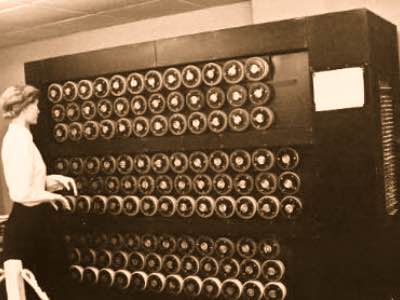
The Bombe is the main attraction at Bletchley Park. It’s a large, rudimentary, part-electrical, part-mechanical device designed to reveal the settings for the Enigma machine on any given day, to enable the decoding of all Enigma-encrypted messages.
The following day, the Germans would change the settings and the Bombe had to start all over again. (In fact, by the end of the war, there were over 200 Bombes in the UK and more than 100 Bombes in the USA.)
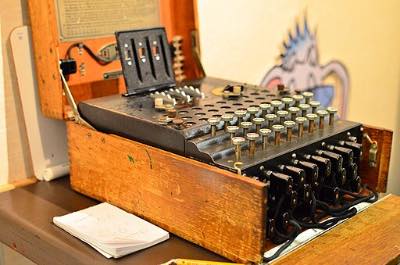
The German Enigma machine.
The point is that time was of the essence. The longer the Bombe took to work out the Enigma settings on any given day, the more likely important decrypted information would be lost.
Turing realised that processing time could be shortened if humans made a few guesses at the start of the day about some of those settings. This time saved could be significant. A 'crib'—a potential word or phrase—was input to the Bombe to give it a head start.
But here's where tacit knowledge earned its keep: selecting the right crib wasn't a matter of pure logic or systematic process. It required hunches born from experience, pattern recognition that couldn't be written down and that peculiar human knack for sensing what felt right.
The codebreakers weren't just following a formula—they were drawing on something the Bombe could never possess, no matter how many rotors it spun. Once the Bombe had completed its task, the information gathered was then passed over to more humans, the crypto-analysts, who used intuition and experience to complete the deciphering.
So, back to tacit knowledge;
tacit adjective
[tas-it]
‘implied or indicated but not actually expressed’
The word 'tacit' comes from the Latin ’tacitus’, which means ‘to be silent’.
It was fascinating to learn how humans worked alongside the grunting processing power of a rudimentary computer to produce a result greater than the sum of their individual efforts. Those humans, admittedly very bright, relied on their own personal store of experiences, learnings, interactions and observations to win each day.
In other words, they relied on their tacit knowledge.
Tacit knowledge is effectively our personal intellectual blueprint. It is unique to each of us and difficult to pass on. That’s why smart organisations (like MI6 at Bletchley Park) employ people with wide-ranging backgrounds to maximise the benefits of that tacit knowledge.
It’s also the reason we parents nag our children to read ‘behind a subject’, not because it will help them pass a particular exam, but because it will top up their reservoir of tacit knowledge for the future.
Polymath Michael Polanyi, in the 1950s and 1960s, realised that humans “believe more than we can know” and “know more than we can say”. He contemplated the idea of tacit knowledge as a basis for problem-solving, invention, leadership and decision-making.
I think this is why we still have a long way to go before AI machines topple humans. As it is hard to pass on tacit knowledge from humans to humans, so it is also hard (so far!) to pass on tacit knowledge from humans to machines.
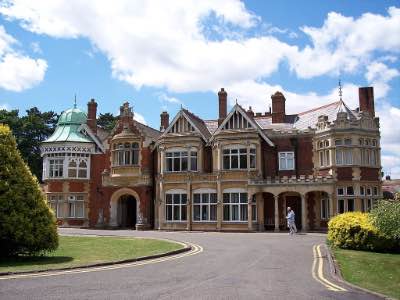
Bletchley Park, Buckinghamshire, England.
So many thoughts came home with me from that day at Bletchley Park, but let me spotlight two in particular:
Firstly, it highlighted how important storytelling has been throughout the generations as an effective attempt to short-cut the process of acquiring tacit knowledge, by sharing rich, colourful and timeless stories.
Secondly, the thought of unique, individual blueprints reminded me why meeting new people is always a delight—nobody's running quite the same program, though some, it must be said, might benefit from a software update.
A little tacit knowledge might have helped here...
A company accountant returned home from work and was sitting with his 6-year-old daughter, trying to explain the concept of infinity.
“What is the biggest number in the world?” he asked her.
After some consideration, she replied: “5,324”.
Her father said, “What about 5,325”?
She sighed, “Oh, I was so close”!"
📚 Time for more history?
ATTRIBUTIONS:
Bletchley Park: Draco2008 from UK, CC BY 2.0, via Wikimedia Commons.
The Enigma machine: crudmucosaz, CC BY 2.0, via Wikimedia Commons.
The Bombe: User Messybeast on en.wikipedia, CC BY-SA 3.0.
Check out the date button below to see if I have written any other articles for this date with history.
Chief Story Hunter
I am passionate about the world and the people in it—both living or otherwise. I talk to people with personal stories to share on the 'Batting the Breeze Original Stories' podcast. I write a weekly newsletter—The Breezer—which shares a wide range of historical snippets relevant to the week following each Sunday morning’s edition.
And, of course, I write this historical blog which I hope you enjoy reading. Oh, yes—I will also be releasing a 'Dates with History' podcast soon too! If you are curious about the world and its history, I think I can scratch that itch for you.
The Gregorian Calendar and Britain's Lost Eleven Days