Here’s to Weary Dunlop, a true Australian hero

12 July 1907
(read time: 2 mins.)
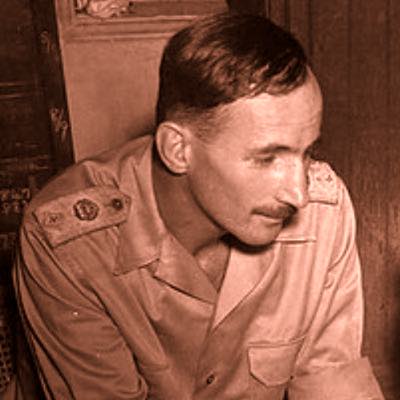
Colonel Sir Ernest Edward "Weary" Dunlop, senior medical officer in the Australian Army Medical Corps, born on this day, was captured by the Japanese and sent to the infamous Burma-Thailand Railway in 1942.
There’s little more exciting than uncovering the life of a true hero, and one that has remained seemingly unknown and uncelebrated—at least in my neck of the woods in the UK. I am sure down under my Australian friends would recoil that I had never heard of this particular true Australian hero—Weary Dunlop.
Colonel Sir Ernest Edward "Weary" Dunlop was born 12 July 1907 in Wangaratta, Victoria, Australia. Although Victoria was—and still is—primarily an Aussie Rules Football state, Weary became the first Victorian to play for the Wallabies (the Australian rugby union team) in 1932 at the Sydney Cricket Ground, having only started playing the code a year earlier.
But it was in the arena of war that Dunlop left an indelible impression on the Australian psyche. As a senior medical officer in the Australian Army Medical Corps in 1942, he was captured by the Japanese and sent to the infamous Burma-Thailand Railway.
Conditions for prisoners on the ‘Death Railway’ were notoriously brutal. Prisoners of War (POWs) endured beatings, torture, malnutrition and disease. Over 2,500 Australians perished on the railway between 1942-1945, a number that may have been much higher without the presence of Weary Dunlop.
As well as meticulously tending to his sick and dying men throughout, he would fearlessly stand up to his Japanese captors, endangering his own life to negotiate better rations and conditions for his men. It was reported that on one occasion, he refused an opportunity to escape in favour of remaining with his patients. His presence provided a much-needed morale boost to the men in captivity with him.
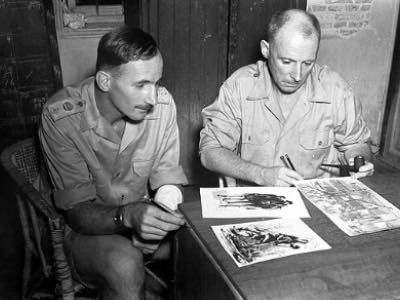
Lieutenant-Colonel E.E. ‘Weary’ Dunlop and Lieutenant-Colonel Albert Coates at Nakhon Pathom hospital camp, Thailand, 1945.
In later life, in addition to continuing a career as a surgeon, Weary fought endlessly for the welfare and rights of former POWs. He also revisited the Burma-Thailand Railway on several occasions to help promote reconciliation with Japan after the war.
Out of Curiosity
By the way, if you were wondering about the nickname 'Weary', well it was because he was “tired”... like a Dunlop tyre!
Weary was awarded the Order of the British Empire (OBE) in 1947 and knighted in 1969, but his credentials as an Australian hero were formalised in 1976 when he was named Australian of the Year.
Sir Ernest Edward Dunlop died in 1993 and received a full State funeral at St. Paul’s Cathedral in Melbourne on what would have been his 86th birthday, 12 July 1993.
He is remembered down under today through statues in Canberra and Victoria and through the Sir Edward ‘Weary’ Dunlop Medical Research Foundation, amongst others. From now on, each year I shall toast this true Australian hero.
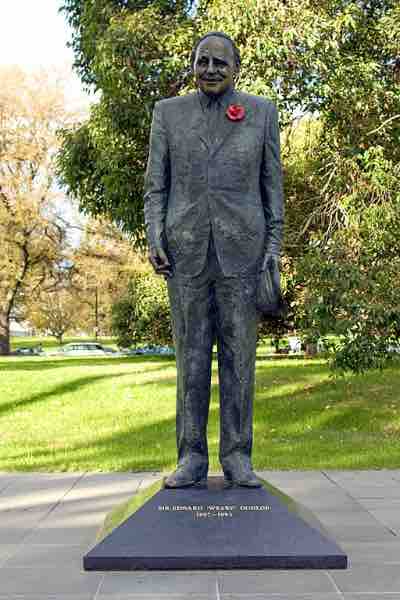
Statue of Edward ‘Weary’ Dunlop, King’s Domain, Melbourne, Australia
📚 Time for more history?
ATTRIBUTIONS:
Weary Dunlop 1945: http://hellfire-pass.commemoration.gov.au/surviving-the-camps/weary-dunlop.php, CC BY-SA 4.0, via Wikimedia Commons.
Weary Dunlop statue: Rexness, CC BY-SA 2.0, via Wikimedia Commons.
Check out the date button below to see if I have written any other articles for this date with history.

Chief Story Hunter
I am passionate about the world and the people in it—both living or otherwise. I talk to people with personal stories to share on the 'Batting the Breeze Original Stories' podcast. I write a weekly newsletter—The Breezer—which shares a wide range of historical snippets relevant to the week following each Sunday morning’s edition.
And, of course, I write this historical blog which I hope you enjoy reading. Oh, yes—I will also be releasing a 'Dates with History' podcast soon too! If you are curious about the world and its history, I think I can scratch that itch for you.
The Gregorian Calendar and Britain's Lost Eleven Days