Harold Habgood and St Clement Danes

31 July 1944
(read time: 4 mins.)
Harold Habgood served in the RAF during World War II. In July 1944, Habgood’s Lancaster was shot down over eastern France. Within two days, 31 July 1944, Habgood was executed by the Gestapo.
If you ever find yourself near Trafalgar Square in London with a spare hour or so, take a stroll along The Strand. Within a few minutes, you will stumble into St Clement Danes Church.
The church is best known to many English children from the nursery rhyme Oranges and Lemons, which refers to the bells of a number of churches within proximity to the City of London.
Oranges and lemons,
Say the bells of St. Clement's.
You owe me five farthings,
Say the bells of St. Martin's.
…and so on
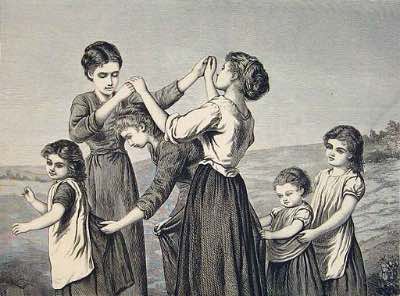
"Oranges And Lemons", Nicholl Bouvier Games 1874, "The Pictorial World", Agnes Rose Bouvier (1842 - 1892).
The Church has been designated as the Central Church of the RAF since its most recent restoration in 1958. It was actually reconsecrated in the October, within one month of former RAF Air Chief Marshal Sir Patrick Hine and his 111 Squadron colleagues completing the world record 22-plane loop at Farnborough (Check out our Batting the Breeze Original Stories podcast episode Twenty-two Black Arrows).
Out of Curiosity
The Church of St Clement Danes plays the tune of Oranges and Lemons every three hours between 9 am and 5 pm—if you happen to be passing.
St Clement Danes Church has a rich history that goes back much further than 1958. The “Danes” element in the name refers to the Danish settlers who built the original church on the site in the 9th century. One of the most notable figures buried there is the Danish King of England and son of Cnut, Harold I (Harefoot).
But it was another Harold that caught my attention when I last visited.
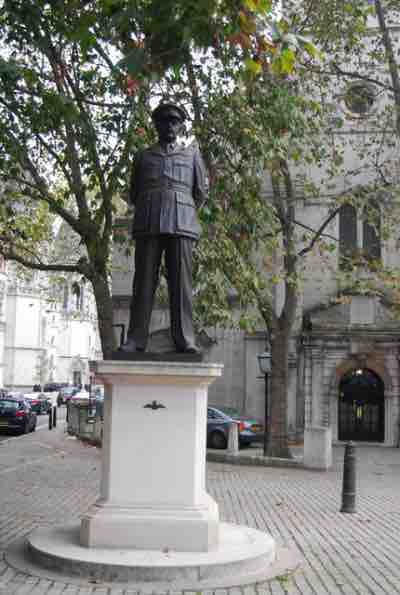
Sir Arthur 'Bomber’ Harris outside St Clement Danes Church, The Strand, London.
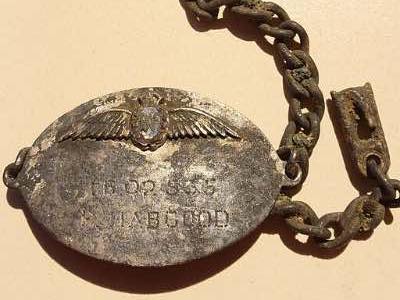
I walked into the church past the imposing figures of Sir Arthur “Bomber” Harris and Air Chief Marshal Lord Hugh Dowding. I turned towards a glass cabinet on the left. In the cabinet, I noticed a small, tarnished silver bracelet lying on the central shelf among a host of other RAF-related memorabilia.
The bracelet belonged to Harold Habgood, who served in the RAF during World War II. He was a member of an Avro Lancaster Bomber crew. His role was bomb-aimer, or bombardier, responsible for identifying targets and releasing bombs at critical moments.
In July 1944, Habgood’s Lancaster was shot down over eastern France. Habgood and three crew members parachuted to safety. He hid in a barn in the village of Ottrot, some 15 miles from Strasbourg.
Unfortunately for Habgood, he was spotted by a local woman who reported his location to the Gestapo. The Gestapo transported him six miles up the road to Natzweiler-Struthof, the only concentration camp built by the Nazis on French soil.
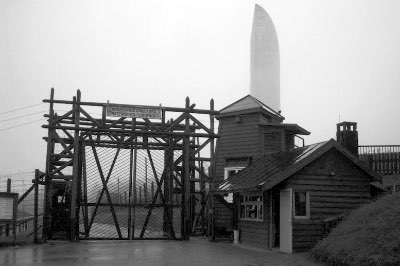 Natzweiler-Struthof Concentration Camp.
Within two days, 31 July 1944, Habgood was executed. It was a gross violation of the Geneva Convention and one for which the perpetrators paid with their own lives in 1946.
Harold was 21 years old.
It was a sorry story among so many sorry stories from World War II. But Harold’s story has an uplifting and unlikely postscript.
In 2018, a young woman named Anna Bernard was doing routine maintenance in the ash pit at the preserved Natzweiler-Struthof camp when something small caught her eye in the soil. A silver bracelet—a gourmette—engraved with RAF wings, a name and a service number. Silver being stubbornly resistant to the passage of time, it had survived decades underground in remarkable condition.
The bracelet belonged to Harold Habgood. Memorial staff tracked down his nephew Paul and niece Marilyn. Identification was clinched with a 1943 letter in which Harold had described receiving exactly such a bracelet, engraved just so, sent by relatives in Canada who presumably had no idea it would one day be doing archaeological duty in Alsatian soil.
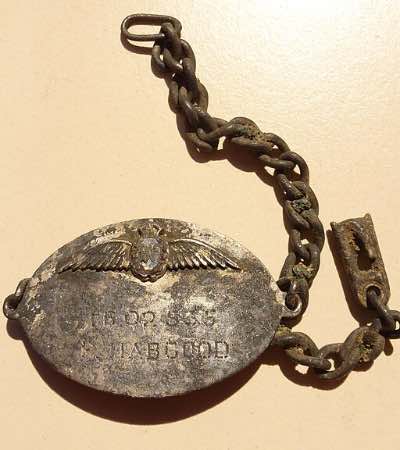
Harold Habgood's silver bracelet, on display at St Clement Danes Church.
In September 2021, at a ceremony at Struthof, French minister Geneviève Darrieussecq formally returned the bracelet to the family—the finder, Anna Bernard, present to see the moment through.
The family later chose to pass it to the RAF, where it now sits in that commemorative cabinet at St Clement Danes Church in London.
📚 Time for more history?
ATTRIBUTIONS:
Harold Habgood’s bracelet: Déportation-Résistance, CC BY-SA 4.0, via Wikimedia Commons.
Oranges and Lemons: Agnes Rose Bouvier (1842 - 1892), Public domain, via Wikimedia Commons.
Statue of "Bomber" Harris: N Chadwick, CC BY-SA 2.0, via Wikimedia Commons.
Natzweiler-Struthof concentration camp, courtesy of Wikimedia Commons.
Check out the date button below to see if I have written any other articles for this date with history.

Chief Story Hunter
I am passionate about the world and the people in it—both living or otherwise. I talk to people with personal stories to share on the 'Batting the Breeze Original Stories' podcast. I write a weekly newsletter—The Breezer—which shares a wide range of historical snippets relevant to the week following each Sunday morning’s edition.
And, of course, I write this historical blog which I hope you enjoy reading. Oh, yes—I will also be releasing a 'Dates with History' podcast soon too! If you are curious about the world and its history, I think I can scratch that itch for you.
The Gregorian Calendar and Britain's Lost Eleven Days